Types of Digital Marketing: 10 Channels Explained With Examples (2026)
A detailed, practical guide to the main types of digital marketing in India: SEO, Google Ads, social media ads, organic social, content, email, WhatsApp, influencer, affiliate and video marketing, with how each works, when to use it, and the skills and roles behind it.
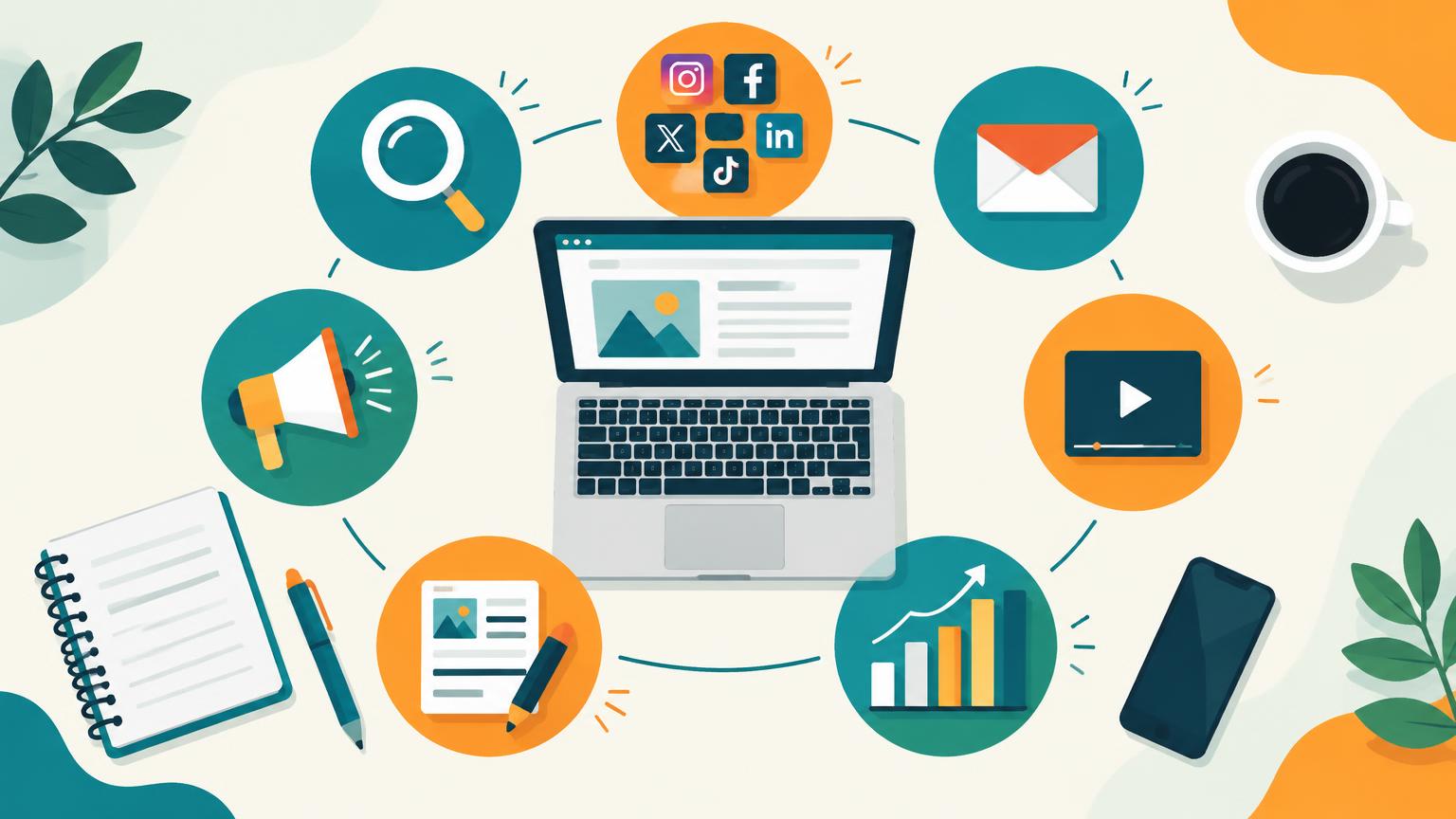
- 01How to think about digital marketing channels
- 021. Search engine optimization (SEO)
- 032. Paid search advertising (Google Ads)
- 043. Social media advertising (Meta, LinkedIn, YouTube)
- 054. Organic social media marketing
- 065. Content marketing
- 076. Email marketing
- 087. WhatsApp marketing
- 098. Influencer marketing
- 109. Affiliate marketing
- 1110. Video marketing
- 12Where AI fits across all of these channels
- 13Performance marketing: an approach, not a channel
- 14Comparison table: types of digital marketing at a glance
- 15How to choose the right mix
- 16Learning these channels with structured guidance
We'll email you our Performance Marketing Setup Checklist instantly.
No spam. Unsubscribe anytime.
"Digital marketing" is not one skill — it's a collection of different channels, each with its own way of reaching people, its own costs, and its own timeline for results. A small business owner trying to decide where to spend money, and a student trying to decide what to learn, both run into the same confusion: should you focus on SEO, run Google Ads, post on Instagram, start an email list, or all of the above?
This guide walks through the ten types of digital marketing businesses in India actually use in 2026, explains how each one works step by step, when it makes sense, what skills it needs, and what job roles exist around it. It ends with a comparison table and a simple way to choose where to start, whether you're building a business or a career.
How to think about digital marketing channels
Before the list, it helps to group channels along two lines:
- Paid vs organic. Paid channels (Google Ads, social ads, influencer collaborations) get you visibility immediately but stop working the moment you stop paying. Organic channels (SEO, content, organic social) take longer to build but keep working without ongoing spend once established.
- Acquisition vs retention. Some channels are built to find new people who haven't heard of you (SEO, paid ads, influencer marketing). Others are built to keep and convert people who already know you (email, WhatsApp, retargeting ads).
Most real marketing plans use a mix from both groups. Relying on only one channel, especially only a paid one, is risky because costs can rise or the platform can change its rules.
1. Search engine optimization (SEO)
What it is: The practice of improving a website so it appears higher in Google's unpaid (organic) search results for terms your potential customers search.
How it works, step by step:
- Keyword research — find what your customers actually type into Google (for example, "best CA for GST filing in Pune").
- On-page optimization — make sure each page's title, headings and content clearly match that search intent.
- Technical SEO — ensure the site loads fast, works on mobile, and Google can crawl and index it (checked via Google Search Console).
- Content creation — publish pages and articles that genuinely answer the searcher's question, not just stuff keywords.
- Link building and authority — earn mentions and links from other credible sites, which signals trust to Google.
- Measurement — track rankings, organic traffic and conversions over months, not days.
When to use it: When you want steady, long-term traffic and can wait 3–12 months to see meaningful results. Best for businesses with evergreen demand (clinics, local services, education, SaaS).
Hypothetical Indian example: A hypothetical Jaipur-based interior design studio publishes detailed blog posts like "modular kitchen cost in Jaipur" and "2BHK interior design ideas," and within eight months starts appearing on page one for these searches, which is an example of how local SEO can compound, not a guaranteed outcome.
Skills needed: Keyword research, basic HTML/CMS knowledge, content writing, understanding of Google Search Console and Analytics, patience for long feedback loops.
Typical roles: SEO executive, SEO analyst, SEO specialist, content + SEO lead.
2. Paid search advertising (Google Ads)
What it is: Paying to show ads at the top of Google's search results when someone searches a relevant term, charged per click.
How it works, step by step:
- Decide your goal (leads, sales, calls, app installs) and target cost per result.
- Research keywords your buyers search, grouped into tightly themed ad groups.
- Write ads matching each keyword group's intent, with clear offers and calls to action.
- Set up conversion tracking (via Google Tag Manager and GA4) before spending a rupee, so you know what's working.
- Launch with a modest daily budget, then review the search terms report regularly to add negative keywords (terms you don't want to pay for).
- Adjust bids, budgets and ad copy based on what the data shows, and scale what performs.
When to use it: When you need measurable leads or sales quickly, or want to test demand for a new product before investing in SEO.
Hypothetical Indian example: A hypothetical Ahmedabad-based test-prep institute runs Search ads for "best NEET coaching Ahmedabad" and gets daily enquiry calls, with cost per lead tracked weekly as an illustrative figure, not a promised outcome.
Skills needed: Keyword research, ad copywriting, conversion tracking, bid strategy, budget management, data analysis.
Typical roles: PPC executive, Google Ads specialist, paid search analyst, performance marketing executive.
3. Social media advertising (Meta, LinkedIn, YouTube)
What it is: Paid ads shown within Facebook, Instagram, LinkedIn or YouTube feeds, targeted by demographics, interests, behaviour or custom audiences (like past website visitors).
How it works, step by step:
- Define the audience — by age, location, interest, or by uploading a list of existing customers for a "lookalike" audience.
- Choose the objective in the ad platform (awareness, traffic, leads, conversions).
- Create the creative — image, video or carousel, written specifically for a scrolling feed, not a search bar.
- Set budget and schedule, and install the platform's tracking pixel on your website.
- Launch and let the algorithm's learning phase run for a few days before judging results.
- Test multiple creatives and audiences side by side, then shift budget toward whichever combination performs.
When to use it: When your product benefits from visual demonstration, when you're targeting people who aren't actively searching yet (demand generation), or for B2B lead generation on LinkedIn.
Hypothetical Indian example: A hypothetical D2C skincare brand in Bengaluru runs Instagram Reels ads showing before-and-after routines to a lookalike audience built from past buyers — illustrating the creative-plus-targeting approach, with actual results varying by product and budget.
Skills needed: Audience targeting, creative direction, copywriting for short attention spans, pixel/conversion setup, budget testing, basic video editing.
Typical roles: Social media ads executive, Meta Ads specialist, performance marketing executive, media buyer.
4. Organic social media marketing
What it is: Building an audience and engagement on platforms like Instagram, LinkedIn, Facebook or X through unpaid posts, reels and community interaction.
How it works, step by step:
- Define the brand's voice and the audience you're trying to reach on each platform.
- Plan a content calendar mixing education, entertainment and promotion (a common rule of thumb is roughly 80% value, 20% direct promotion).
- Create and post consistently, following each platform's native formats (reels, carousels, polls).
- Engage with comments and messages — organic social is as much about conversation as publishing.
- Track engagement rate, follower growth and, where tracked, traffic or leads generated.
- Repurpose top-performing content into other formats and channels.
When to use it: For brand building, customer trust, and community, especially for consumer brands and personal/founder brands. It's a slower path to direct sales than paid ads.
Hypothetical Indian example: A hypothetical home-bakery business in Lucknow grows an Instagram following by regularly posting process reels and customer reactions, which is an illustration of consistency building an audience, not a specific case study.
Skills needed: Content planning, copywriting, basic design/video editing (Canva, CapCut), community management, understanding platform algorithms.
Typical roles: Social media executive, community manager, content creator, social media manager.
5. Content marketing
What it is: Creating valuable content — blog posts, guides, videos, infographics, newsletters — to attract and educate an audience, usually feeding into SEO, email and social channels rather than standing alone.
How it works, step by step:
- Research what your audience actually struggles with or searches for.
- Map content to each stage: awareness (broad educational content), consideration (comparisons, guides) and decision (case-style examples, demos).
- Create the content in whatever format fits — long-form articles, downloadable guides, short videos.
- Distribute it through SEO, social media and email rather than assuming people will find it on their own.
- Add clear next steps (newsletter signup, free consultation, demo request) so content leads somewhere.
- Review which pieces drive traffic, leads or shares, and create more like them.
When to use it: As the foundation feeding SEO and social; valuable for any business selling something that needs explanation before a purchase decision.
Hypothetical Indian example: A hypothetical B2B software company publishes a "GST invoicing checklist for small businesses" guide that is shared in WhatsApp business groups, as an illustration of content distribution, not a documented result.
Skills needed: Research, writing, basic SEO, understanding of the buyer's questions at each stage, repurposing content across formats.
Typical roles: Content writer, content marketer, content strategist.
6. Email marketing
What it is: Sending targeted emails to a list of subscribers or customers to nurture relationships, announce offers, or recover abandoned purchases.
How it works, step by step:
- Build a list through signup forms, lead magnets or customer purchases — never buy email lists.
- Segment the list by behaviour or interest (new subscriber, past customer, cart abandoner).
- Set up automated sequences (welcome series, abandoned-cart reminder) using a platform like Mailchimp or similar tools.
- Write subject lines and content that are genuinely useful, not just promotional, to keep open rates healthy.
- Send campaigns and automations, then test subject lines, send times and content.
- Track open rate, click rate and resulting sales, and clean the list of inactive addresses periodically.
When to use it: For retention, repeat purchases and nurturing leads who aren't ready to buy yet. Among the most cost-effective channels because list ownership isn't dependent on a platform's algorithm.
Hypothetical Indian example: A hypothetical online stationery store in Chennai sends a weekly newsletter with new arrivals and a small discount for subscribers who haven't purchased in 60 days, illustrating a re-engagement sequence rather than a reported result.
Skills needed: Copywriting, segmentation, basic automation setup, A/B testing, understanding of spam and deliverability rules.
Typical roles: Email marketing executive, CRM/lifecycle marketer, marketing automation specialist.
7. WhatsApp marketing
What it is: Using WhatsApp — through the WhatsApp Business app, the WhatsApp Business API, or click-to-WhatsApp ads — to send catalogues, order updates, broadcast offers and handle customer queries, usually to people who have already interacted with the brand.
How it works, step by step:
- Set up a WhatsApp Business profile or API account with catalogue, business hours and quick replies.
- Collect opt-in consent from customers (through a website form, in-store, or a click-to-WhatsApp ad) — unsolicited messaging breaks platform rules.
- Segment contacts into lists (new leads, repeat customers, cart abandoners).
- Send broadcast messages or automated flows for order confirmations, reminders and offers.
- Use quick replies and, where volume is high, a chatbot for common questions, with a human handoff for complex ones.
- Track delivery, read and response rates, and link conversations to actual orders where possible.
When to use it: For retention, order updates, and converting warm leads in markets where WhatsApp usage is extremely high, such as India. Not meant for cold outreach to strangers.
Hypothetical Indian example: A hypothetical grocery delivery service in Indore uses WhatsApp to send order confirmations and a weekly catalogue of discounted items to existing customers, as an illustration of a retention flow. For a full breakdown of tools, API costs and compliance rules, see our dedicated WhatsApp marketing guide; it's also covered as a standalone module in PMAcademy's AI Digital Marketing Course, which includes a WhatsApp Marketing module among its 18 modules.
Skills needed: Consent and compliance awareness, message sequencing, basic chatbot/flow setup, customer service tone.
Typical roles: CRM executive, WhatsApp/retention marketer, customer engagement specialist (often part of a broader digital marketing role).
8. Influencer marketing
What it is: Partnering with content creators who have an engaged audience to promote a product or service through their own content.
How it works, step by step:
- Define your goal — awareness, trust-building, or direct sales via a discount code or affiliate link.
- Identify creators whose audience genuinely matches your customer, not just follower count.
- Agree on deliverables, usage rights, disclosure requirements (ads must be labelled) and payment or product exchange.
- Brief the creator on key messages while allowing their authentic style — audiences notice scripted content.
- Track using unique discount codes, trackable links or platform-provided insights.
- Evaluate engagement and resulting traffic or sales, and build longer-term relationships with creators who perform well.
When to use it: For trust-building with audiences who are sceptical of direct ads, particularly in categories like beauty, fashion, food and fitness.
Hypothetical Indian example: A hypothetical regional food brand in Kochi partners with a few local food bloggers who share honest reviews with a discount code, as an illustration of how tracked codes work, not a documented campaign.
Skills needed: Creator outreach and negotiation, campaign briefing, basic contract and disclosure knowledge, tracking via codes/links.
Typical roles: Influencer marketing executive, partnerships manager (often combined with a social media role).
9. Affiliate marketing
What it is: Paying partners (affiliates) a commission for sales or leads they generate through a unique tracked link, so you only pay for results.
How it works, step by step:
- Set up an affiliate program (through a platform or your own tracking system) with clear commission rates.
- Recruit affiliates — bloggers, coupon sites, comparison sites, or individual creators — relevant to your product.
- Provide affiliates with tracked links, banners or codes.
- Affiliates promote your product through their own content or audience.
- Track sales or leads attributed to each affiliate link and pay commissions on a schedule.
- Review which affiliates drive genuine, converting traffic versus low-quality clicks, and adjust the program.
When to use it: For e-commerce and subscription businesses wanting performance-based promotion with limited upfront risk, since payment is tied to actual results.
Hypothetical Indian example: A hypothetical online course platform works with education bloggers who earn a commission for every paid signup through their link, illustrating how affiliate tracking works rather than a specific reported outcome.
Skills needed: Program management, tracking/attribution tools, partner relationship management, fraud awareness (fake or low-quality clicks).
Typical roles: Affiliate marketing manager, partnerships executive.
10. Video marketing
What it is: Using video — on YouTube, Instagram Reels, or a website — to explain, demonstrate or entertain, often cutting across several other channels (it can be organic, paid, or part of content marketing).
How it works, step by step:
- Decide the video's purpose: brand awareness, product explanation, testimonial, or entertainment-led reach.
- Script around a clear hook in the first few seconds — attention drops off fast on social platforms.
- Film and edit for the platform it will live on (vertical for Reels/Shorts, longer-form for YouTube).
- Add captions, since many viewers watch with sound off.
- Publish organically and/or boost with ad spend depending on the goal.
- Track watch time, completion rate and the action it drives (clicks, signups, sales).
When to use it: When your product benefits from being seen in use, for building trust through faces and voices, and because most platforms currently favour video in their algorithms.
Hypothetical Indian example: A hypothetical fitness studio in Pune posts short workout-demo Reels that are later boosted as ads to a local audience, illustrating how organic and paid video can combine.
Skills needed: Scripting, basic filming and editing, platform-specific formatting, understanding of hooks and pacing.
Typical roles: Video marketer, content creator, social media executive with video focus.
Where AI fits across all of these channels
AI tools aren't a separate "type" of digital marketing — they now sit inside almost every channel above. In SEO, AI helps draft outlines and analyse competitor content. In paid ads, platforms use AI for automated bidding and generating ad variations. In social and content, AI speeds up first drafts, captions and basic image or video generation. In WhatsApp and email, AI powers chatbot replies and subject-line suggestions.
What AI doesn't do on its own is set strategy, understand your specific customer, or verify that generated content is accurate — that still needs a person who understands the channel. PMAcademy's AI Digital Marketing Course is built around this idea: it teaches AI tools inside the context of SEO, ads, content, social and WhatsApp marketing across 18 modules, rather than treating "AI marketing" as its own disconnected skill. Details on fees are on the course fees page, and the placement support page explains the guidance offered after the course (support, not a guaranteed job).
Performance marketing: an approach, not a channel
It's worth being clear that performance marketing is not an eleventh channel sitting next to the list above — it's a way of running several of these channels (typically paid search, paid social and affiliate marketing) where every rupee is tied to a measurable outcome like a lead or sale, rather than paying simply for impressions or brand exposure. If you want the full distinction with examples, read our guide on what performance marketing is. PMAcademy's flagship 6-week Performance Marketing Course teaches Google Ads, Meta Ads, analytics and funnel-building together, which is exactly how these channels are used in real jobs.
Comparison table: types of digital marketing at a glance
| Channel | Cost to start | Time to see results | Best for | Core skill |
|---|---|---|---|---|
| SEO | Low (time-intensive) | 3–12 months | Long-term, evergreen demand | Keyword research, content, technical basics |
| Google Ads (paid search) | Pay-per-click budget | Days to weeks | Fast, measurable leads/sales | Campaign building, tracking, bid strategy |
| Social media ads | Pay-per-result budget | Days to weeks | Visual products, demand generation | Targeting, creative, testing |
| Organic social media | Low (time-intensive) | Weeks to months | Brand trust, community | Content planning, consistency |
| Content marketing | Low to moderate | Months | Educating buyers, feeding SEO | Research, writing, repurposing |
| Email marketing | Low (platform fee) | Weeks | Retention, repeat sales | Copywriting, segmentation |
| WhatsApp marketing | Low to moderate (API costs) | Days to weeks | Retention, order updates, warm leads | Consent, sequencing, service tone |
| Influencer marketing | Varies widely | Weeks | Trust-building via creators | Outreach, briefing, tracking |
| Affiliate marketing | Commission-based | Months | Performance-based sales | Program and partner management |
| Video marketing | Low to moderate | Weeks to months | Demonstration, engagement, reach | Scripting, editing, hooks |
How to choose the right mix
There's no single "best" channel — the right combination depends on three questions:
- What's your goal? If you need leads or sales this month, lean on paid search and paid social. If you're building for the next few years, invest in SEO and content alongside paid channels.
- Who are you selling to? Consumer products often do well with social ads, influencer marketing and video. B2B and considered purchases (education, finance, real estate) usually need content, SEO, email and LinkedIn.
- What's your budget and time? Organic channels cost time rather than money; paid channels need an ongoing budget but deliver faster. Most small businesses in India start with Google Ads or Meta Ads for quick traction, build an email/WhatsApp list from those customers, and invest in SEO and content once cash flow allows.
For someone learning digital marketing to build a career rather than run a business, the practical advice is different: pick one or two channels to go deep in first (commonly SEO or paid ads), understand the rest at a working level, and build real, small projects you can show in interviews. Our guide on how to become a digital marketer lays out that learning path step by step, and our digital marketing tools guide lists the specific platforms used across each channel discussed here, with free and paid options.
Learning these channels with structured guidance
Reading about ten different channels is useful, but most people learn faster with structured practice and feedback. PMAcademy runs a free live masterclass on Friday, 2 October 2026, 8:00–9:00 PM IST (details and registration at /#batches) where you can see how these channels fit together before committing to a course. From there:
- The 6-week Performance Marketing Course (₹20,000 single payment or ₹25,000 in two installments) focuses on Google Ads, Meta Ads and analytics for people who want to specialise in paid, measurable marketing.
- The 8-week AI Digital Marketing Course (₹15,000 single payment or ₹20,000 in two installments of ₹10,000 each) covers 18 modules spanning SEO, social, content, WhatsApp marketing and AI tools, for a broader foundation across channels. Fee details are on the fees page.
Whichever path you choose, the goal is the same: understand how each channel actually works, where it fits in a customer's journey, and how to measure whether it's working — because in digital marketing, almost everything can be measured, and that's exactly what makes it a skill worth learning properly.
Glossary
- SEO
- Search engine optimization: improving a website so it ranks higher in unpaid Google search results.
- SEM / PPC
- Search engine marketing or pay-per-click: paid ads that appear on search engine results pages, most commonly through Google Ads.
- CPC
- Cost per click: the amount an advertiser pays each time someone clicks a paid ad.
- CTR
- Click-through rate: the percentage of people who see an ad or post and click on it.
- Organic reach
- The number of people who see your content without you paying to promote it.
- Lead magnet
- A free resource (guide, template, discount) offered in exchange for someone's email address or phone number.
- Affiliate link
- A trackable link given to a partner so sales or signups from their referral can be credited and paid out.
- Attribution
- The process of deciding which marketing channel or touchpoint gets credit for a sale or lead.
Sources & Further Reading
Frequently Asked Questions
What are the main types of digital marketing?+
The most commonly used types are search engine optimization (SEO), paid search advertising (Google Ads), social media advertising (Meta, LinkedIn, YouTube ads), organic social media marketing, content marketing, email marketing, WhatsApp marketing, influencer marketing, affiliate marketing and video marketing. Most businesses use a combination rather than relying on just one.
Which type of digital marketing is best for beginners to learn?+
SEO and content marketing are good starting points because they teach you how search and audiences work without needing an ad budget. Google Ads and Meta Ads are good second skills because they are measurable and in high demand for jobs. Most structured courses, including PMAcademy's [6-week Performance Marketing Course](/), teach search, social and analytics together so you understand how channels connect rather than learning them in isolation.
What is the difference between digital marketing and performance marketing?+
Digital marketing is the umbrella term for all online marketing channels, including branding-focused activity like organic social posts or sponsorships. Performance marketing is an approach within digital marketing where every rupee spent is tied to a measurable result such as a lead, sale or app install, usually through paid search, paid social and affiliate channels. Read our detailed explainer on [what performance marketing is](/blog/what-is-performance-marketing) for the full comparison.
Which digital marketing channel gives the fastest results?+
Paid channels — Google Ads and social media ads — typically show results within days because you are paying for visibility immediately. SEO, content marketing and organic social usually take a few months to a year to build momentum because they rely on earning trust and rankings without paying for placement. Many businesses run paid ads for quick results while SEO and content build up in the background.
Is WhatsApp marketing a real digital marketing channel?+
Yes. WhatsApp has very high open rates in India compared to email, and businesses use it for order updates, catalogues, broadcast offers and customer support through the WhatsApp Business API and tools like click-to-WhatsApp ads. It works best for retention and conversion of people who already know your brand, not for reaching strangers. Our dedicated guide to [WhatsApp marketing](/blog/whatsapp-marketing) covers tools, costs and compliance in detail.
Do I need to learn every type of digital marketing to get a job?+
No. Most entry-level roles focus on one or two channels, such as SEO executive, Google Ads executive or social media executive. It helps to understand the basics of all channels so you can see how they fit together, but you should aim to go deep in one or two first. Our guide on [how to become a digital marketer](/blog/how-to-become-a-digital-marketer) lays out a channel-by-channel learning order.
What tools are used across these digital marketing channels?+
Common tools include Google Ads and Google Analytics for paid search and measurement, Meta Ads Manager for Facebook and Instagram, Google Search Console and keyword research tools for SEO, Mailchimp or similar platforms for email, WhatsApp Business API tools for messaging, and AI tools like ChatGPT for research and writing. Our [digital marketing tools guide](/blog/digital-marketing-tools) lists the full stack with free and paid options.
How is AI changing these types of digital marketing?+
AI tools now help with keyword and audience research, first drafts of ad copy and content, image and video generation, chatbot-style customer replies, and faster reporting across every channel listed in this guide. They speed up the work but still need a person to set strategy, check accuracy, and decide what the business actually needs. Courses like PMAcademy's [AI Digital Marketing Course](/ai-digital-marketing-course) cover how AI fits into each channel rather than teaching it separately.
Join our live training program and become a performance marketing professional.