ChatGPT Ads Manager: How OpenAI Ads Work (2026 Guide)
ChatGPT Ads Manager explained: how ChatGPT Ads work, what the OpenAI Ads Manager does, where ads are rolling out, how ChatGPT Ads compare to Google Ads and Meta Ads, and how marketers in India should prepare in 2026.
- 01What is ChatGPT Ads Manager?
- 02How ChatGPT Ads work
- 03Where ChatGPT Ads are available
- 04ChatGPT Ads vs Google Ads vs Meta Ads
- 05Who can advertise on ChatGPT?
- 06How to run ChatGPT Ads: a practical setup
- 07What this means for marketers in India
- 08Will ChatGPT replace Google Ads?
- 09Your 30-day preparation checklist
- 10Final thoughts
We'll email you our Performance Marketing Setup Checklist instantly.
No spam. Unsubscribe anytime.
For two decades, paid acquisition has essentially been a two-horse race. Google Ads captured people who already knew what they wanted and typed it into a search box. Meta Ads created demand for people who did not know they wanted it yet. Every media plan, every agency retainer and every performance marketing job description has been built on that split.
Want hands-on practice? Our live ChatGPT Ads course walks you through ChatGPT Ads Manager setup step by step.
A third surface is now opening: ChatGPT Ads. Instead of bidding on keywords or interest clusters, advertisers can reach people based on what they are asking an AI assistant right now.
This guide covers what ChatGPT Ads actually are, how the OpenAI Ads Manager works, where it is available, how it compares to Google and Meta, and what an Indian marketer should do about it in the next 30 days. If you are new to paid channels in general, start with what is performance marketing and come back.
What is ChatGPT Ads Manager?
ChatGPT Ads Manager is OpenAI's self-serve advertising platform for placing sponsored content inside ChatGPT conversations. It lets a business create ads, set budgets, define what kind of conversations it wants to appear in, and measure the resulting clicks and conversions — the same job Google Ads and Meta Ads Manager do for their own surfaces.
The important structural difference is the unit of targeting. Google's unit is a query. Meta's unit is a person and their interests. ChatGPT's unit is a conversation — a running exchange with context, follow-up questions and stated constraints.
That single change has consequences all the way down to your ad copy, which we will get to.
Reality check: This platform is new and still rolling out. Treat published details as a starting point and verify current availability, formats and pricing inside the Ads Manager itself before you commit budget. Be sceptical of blog posts quoting exact CPCs — including estimates in this article's keyword tables.
How ChatGPT Ads work
Three mechanics define the channel today.
1. Intent-first matching
Ads are matched to the user's current conversation rather than their long-term browsing profile. Someone asking "which is the best performance marketing course in Hyderabad, I'm a fresher with no budget" has expressed category, city, experience level and price sensitivity in one sentence. No keyword ever carried that much qualification.
2. Clearly labelled sponsored placements
Ads appear as sponsored cards, visually distinct from the assistant's answer. They are not injected into the AI's response text, which protects answer trust and means the ad has to earn the click on its own merit.
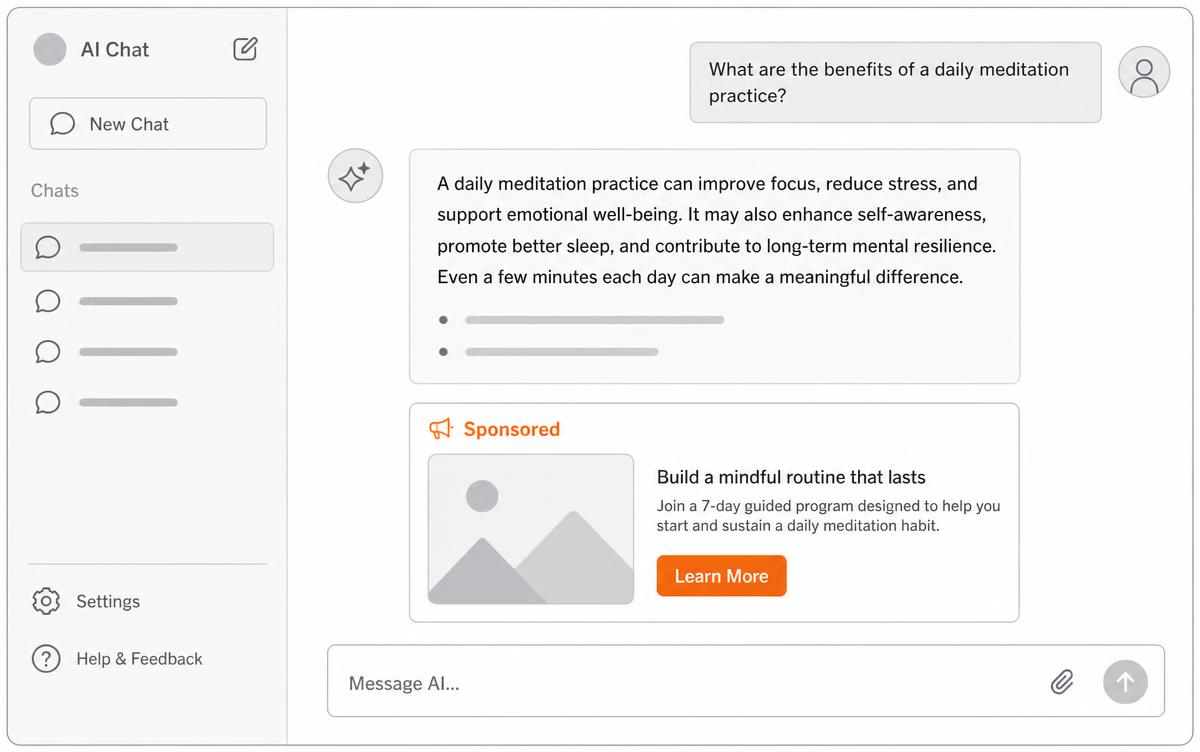
3. Paid subscribers stay ad-free
Ads are served to Free and Go users. Plus, Pro, Business, Enterprise and Edu plans remain ad-free. Plan your audience expectations accordingly — the ad-visible population skews consumer and early-stage rather than enterprise power users.
Where ChatGPT Ads are available
Based on OpenAI's rollout information, the Ads Manager is expanding across markets including:
- United States
- Canada
- United Kingdom
- Australia
- Japan
- South Korea
- Brazil and parts of Latin America
More markets are expected over time. India has not been confirmed in the initial phase. That is not a reason to ignore the channel — it is a reason to build the groundwork while competition for the format is still near zero. Every asset you need for ChatGPT Ads (question map, answer-shaped landing pages, first-party capture, clean tracking) also improves your existing Google and Meta performance immediately.
ChatGPT Ads vs Google Ads vs Meta Ads
The three platforms map to three different user behaviours.
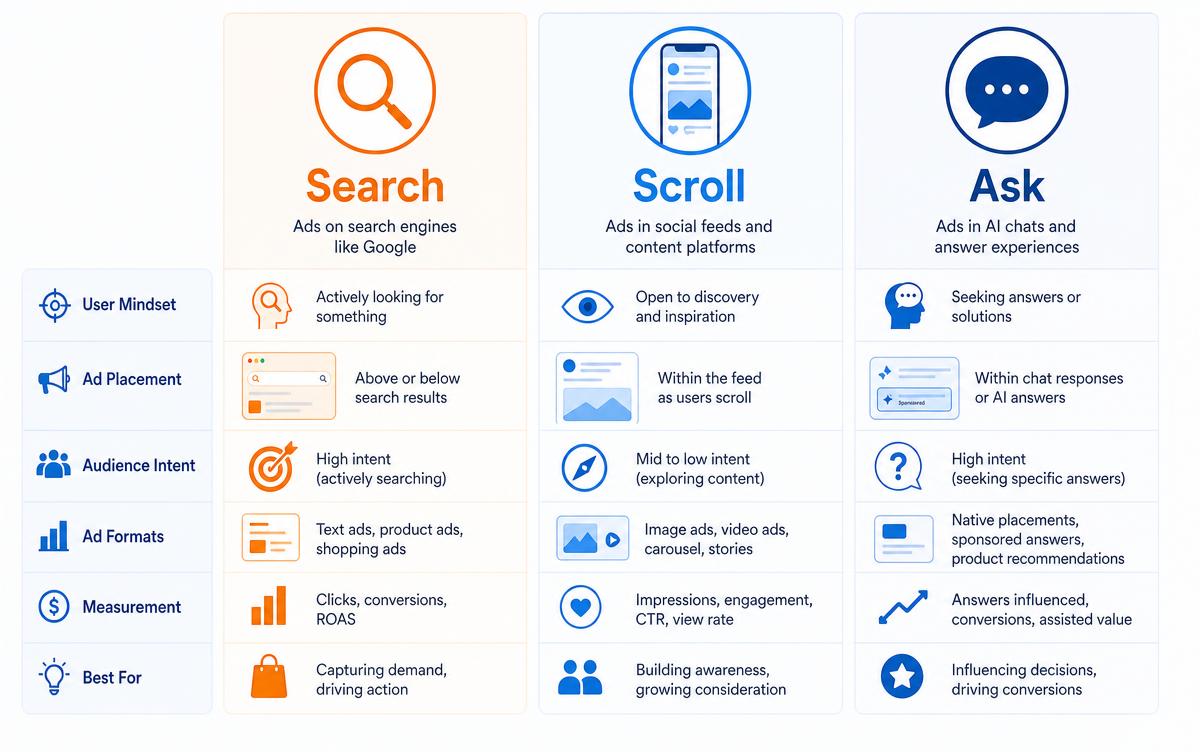
| Google Ads | Meta Ads | ChatGPT Ads | |
|---|---|---|---|
| User behaviour | Searching | Scrolling | Asking |
| Targeting unit | Keywords | Interests & demographics | Conversation context & intent |
| Funnel stage | Capture existing demand | Create demand | Influence research & comparison |
| Copy style | Keyword-matched headlines | Scroll-stopping creative | Helpful, conversational next step |
| Signal quality | High but short | Broad but inferred | Very specific, stated by the user |
| Attribution | Mature, well-instrumented | Mature, privacy-constrained | Early, needs first-party support |
| Best for | Bottom-funnel conversions | Awareness and volume | Shortlist and decision influence |
The honest reading: ChatGPT is not competing with Google for the final click. It is competing for the moment before the final click — the moment when a buyer decides which three brands are worth searching for by name.
Who can advertise on ChatGPT?
The Ads Manager is built as a self-serve tool, which means the practical requirements are the same as any other paid channel:
- A live business with a payment method in a supported billing country.
- A landing page that loads fast and states one clear offer.
- Compliance with OpenAI's advertising policies — expect the usual restricted categories (financial claims, health claims, adult content, misleading guarantees) to be tightly policed, and expect enforcement to be stricter than average because ads sit next to an answer users are meant to trust.
- Working conversion tracking, because you will need your own numbers to judge a new channel.
If you are an agency evaluating this for clients, the performance marketing agency guide covers how to structure the tracking and reporting side before you add a new channel to a retainer.
How to run ChatGPT Ads: a practical setup
Step 1 — Build a question map, not a keyword list
Open a sheet and write 30–50 questions your buyers would actually ask an assistant. Include the messy, qualified ones: "is a ₹25,000 marketing course worth it if I already have a job". Group them into comparison, pricing, how-to and shortlist intents. That grouping becomes your campaign structure.
Step 2 — One objective per campaign
Pick a single measurable action: lead form, demo booking, purchase or call. Early-phase inventory is limited, so a diluted objective produces unreadable data.
Step 3 — Write like a helpful next step
The ad sits beside a genuinely useful answer. If your copy shouts, it loses by contrast.
Weak: "India's #1 Performance Marketing Course! Enrol Now!!" Strong: "Fresher with no ad budget? A live 6-week Google + Meta Ads programme with a real ₹5,000 campaign you run yourself."
Name the constraint the user stated. Make the outcome concrete. Never promise a guaranteed result you cannot evidence.
Step 4 — Match the landing page to the question
A comparison question goes to a comparison page. A pricing question goes to pricing. A "how do I start" question goes to a curriculum or roadmap page. Sending everything to the homepage wastes the highest-quality intent signal available in paid media.
Step 5 — Instrument before you spend
Install GA4 and GTM, define the conversion event, verify it fires in debug mode, and capture email or phone at conversion. Add server-side events where you can. Conversational traffic often converts later via a branded search, so first-party data is what saves the channel from looking falsely unprofitable.
Step 6 — Judge on blended results
Hold other channels flat, run a small budget for three to four weeks, and ask one question: did total qualified leads go up? Platform-reported conversions in a young ad system are directional at best. Our ROAS formula guide covers how to set the break-even threshold before you start.
What this means for marketers in India
The channel may not be live here yet, but the skill shift already is — because the same behaviour change is happening on Google's AI answers and every other assistant.
Skills that gain value:
- AI-first content strategy — writing pages that assistants can quote, with direct answers, specific numbers and citable sources.
- Conversational copywriting — persuasion that reads as help, not as a shout.
- Landing-page optimisation — one question, one answer, one action, fast.
- First-party audience building — email, phone and CRM data you own.
- Conversion tracking and attribution — GA4, GTM, server-side events, incrementality thinking.
Skills that lose relative value: keyword-list volume, manual bid micro-management, and any workflow that assumes last-click tells the truth.
The marketers who win the next two years are the ones who understand intent, not the ones who memorise platform interfaces. Interfaces change every quarter. Intent does not.
If you are planning your career around this shift, the career in performance marketing guide breaks down which roles are growing and what they pay, and our jobs board lists current openings.
Will ChatGPT replace Google Ads?
No — and framing it as a replacement leads to bad budget decisions.
- Google captures explicit, ready-to-act search demand.
- Meta generates awareness and interest at scale.
- ChatGPT influences research, comparison and decision-making.
A buyer might ask ChatGPT which options to consider, see three brands, then search one of them by name on Google and convert there. Last-click will credit Google with 100% of that sale. That is exactly why you measure blended results rather than channel-reported ones.
The smartest brands will run all three and treat the assistant layer as the new top of the consideration funnel.
Your 30-day preparation checklist
Do this whether or not the Ads Manager is live in your market yet:
- Write your 30–50 question map and group it by intent.
- Audit your top five landing pages: does each answer one specific question in the first screen?
- Add a direct-answer paragraph to the top of your five highest-traffic blog pages.
- Verify GA4 conversion events fire correctly for every lead form and purchase.
- Start collecting first-party email and phone data on every conversion.
- Set your break-even CPA and ROAS thresholds so a new channel can be judged fairly.
- Rewrite one existing ad in conversational, constraint-naming style and test it on Meta this month.
- Bookmark the OpenAI Ads Manager and check monthly for India availability.
Final thoughts
We are moving from an internet where people search to one where people ask. Search rewarded brands that matched keywords. Asking rewards brands that are genuinely the best answer to a specific, qualified question — and are structured so a machine can tell.
ChatGPT Ads are the paid expression of that shift. The platform will change; the behaviour will not. Build for the behaviour.
The creative side of that shift is already usable today — see our ChatGPT photo editing prompts for 65 copy-paste prompts that turn one product shoot into a full set of ad creatives.
Want to learn this hands-on? Our AI-powered performance marketing course covers Google Ads, Meta Ads, conversion tracking and AI workflows with live campaigns you run yourself.
Glossary
- Conversation intent
- What a user is trying to accomplish in their live chat with an AI assistant, inferred from the current conversation rather than from search keywords or browsing history.
- Sponsored card
- A clearly labelled advertising unit shown alongside an AI answer, visually separated from the assistant's organic response.
- OpenAI Ads Manager
- OpenAI's advertiser interface for creating, targeting, budgeting and measuring ads shown inside ChatGPT.
- Ad-free tier
- A paid subscription plan on which no advertising is served. For ChatGPT this currently includes Plus, Pro, Business, Enterprise and Edu.
- AI-first content
- Content structured so an AI assistant can quote, summarise and cite it — direct answers first, clear headings, factual specifics and verifiable sources.
- First-party data
- Customer information you collect directly, such as email, phone or purchase history, which you can use for measurement and audiences without relying on third-party cookies.
- Incrementality
- The additional conversions a channel genuinely caused, measured against a baseline, as opposed to conversions it merely reported credit for.
- Attribution
- The rules deciding which touchpoint gets credit for a conversion. Conversational channels typically sit mid-journey and are under-credited by last-click models.
Sources & Further Reading
Frequently Asked Questions
What are ChatGPT Ads?+
ChatGPT Ads are sponsored placements shown inside ChatGPT conversations. Instead of matching to a keyword typed into a search box or to interest-based audience segments, they are matched to the context of what the user is currently asking the assistant. The ads appear as clearly labelled sponsored cards, kept visually separate from the AI's own answer.
Is the OpenAI Ads Manager available in India?+
The rollout began in a set of markets including the United States, Canada, the United Kingdom, Australia, Japan, South Korea, Brazil and parts of Latin America, and OpenAI has said it will expand over time. India has not been confirmed as part of the initial phase, so Indian advertisers should treat this as a prepare-now channel: build the question map, landing pages and tracking today, and be ready when access opens. Always check the OpenAI Ads Manager for current availability before planning budget.
Who sees ads in ChatGPT?+
Ads are currently served to Free and Go users. Plus, Pro, Business, Enterprise and Edu subscriptions remain ad-free. This matters for targeting expectations: the ad-visible audience skews towards consumer and early-stage users rather than paying power users inside enterprises.
How much do ChatGPT Ads cost?+
OpenAI has not published a universal rate card, and any specific CPC figure circulating online should be treated as an estimate rather than fact. The practical approach is to plan a small test budget, measure cost per qualified lead rather than cost per click, and compare it against your existing Google Ads and Meta Ads benchmarks before scaling.
Will ChatGPT Ads replace Google Ads?+
No. Google captures explicit search demand at the moment of purchase intent, Meta creates demand through discovery, and ChatGPT influences the research and comparison stage in between. The realistic 2026 outcome is that brands run all three and use ChatGPT to shape the shortlist that later shows up as a branded search on Google.
How are ChatGPT Ads different from Google Ads?+
Three differences matter. Targeting is based on live conversation context rather than a keyword match type. The user is in a dialogue, so the ad has to read like a helpful next step rather than a competing headline. And attribution is messier, because the conversation may influence a decision that converts days later through a branded search — which makes first-party data and incrementality testing more important.
What skills do marketers need for ChatGPT Ads?+
Conversational copywriting, question-mapping instead of keyword-listing, landing pages that answer one specific question fast, first-party data collection, and solid conversion tracking with GA4, GTM and server-side events. Analytical judgement matters more than platform button-clicking, because the platform's own reporting will be thinner in the early phase.
Can small businesses advertise on ChatGPT?+
The Ads Manager is designed as a self-serve platform, which historically means small advertisers can participate once the market is live. The bigger constraint for a small business is not access but readiness: a fast landing page, a single clear offer and working conversion tracking will determine whether the traffic converts.
How do I track conversions from ChatGPT Ads?+
Use GA4 with Google Tag Manager, define an explicit conversion event for your key action, tag the destination URLs so the source is identifiable, and capture email or phone at the point of conversion so you have first-party data. Then check blended results: did total leads rise while other channels stayed flat? That is more reliable than platform-reported numbers in a new channel.
Should I change my SEO strategy because of AI ads?+
Yes, but not because of the ads — because of the answers. Content that gets quoted by AI assistants is structured with a direct answer first, clear headings, specific numbers and citable sources. That same structure also helps in traditional search, so it is a low-risk change. Our guide on SEO and performance marketing covers how the two channels compound.
Join our live training program and become a performance marketing professional.
Instant-download resources from the PMAcademy shop that pair with this guide.