Performance Marketing Course Syllabus (2026): Week-by-Week Modules, Tools & Projects
The complete performance marketing course syllabus for 2026: week-by-week modules for Google Ads, Meta Ads, YouTube, LinkedIn and ChatGPT Ads, GA4/GTM tracking, AI tools, projects, certifications and interview prep.
- 01What is a performance marketing course?
- 02Performance marketing course syllabus at a glance
- 03Week 1: Foundations — performance marketing basics, landing pages and SEO
- 04Week 2: Google Ads using Claude AI
- 05Week 3: Meta Ads using Claude AI
- 06Week 4: YouTube Ads, LinkedIn Ads and ChatGPT Ads Manager
- 07Week 5: Tracking (GA4 + GTM + Pixel + CAPI) and remarketing
- 08Week 6: AI for performance marketing, certifications and career mastery
- 09Beginner syllabus vs advanced syllabus
- 107 things to check in any performance marketing syllabus
- 11Course details: duration, timings and fees
- 12Who should follow this syllabus?
- 13Conclusion
We'll email you our Performance Marketing Setup Checklist instantly.
No spam. Unsubscribe anytime.
If you are comparing courses, the performance marketing course syllabus tells you more than any advert. It shows whether you will actually run ads and track results, or just watch slides. This guide explains, step by step, what a complete syllabus should include in 2026, how it is split week by week, and what you should be able to do after each module.
We use the syllabus of our own live performance marketing course online as the worked example, and add a checklist you can use to judge any other course.
What is a performance marketing course?
A performance marketing course teaches you to run paid online ads — Google, Meta (Facebook and Instagram), YouTube, LinkedIn and now ChatGPT — and to measure them by results such as leads, sales, cost per lead and ROAS. New to the term? Read what is performance marketing first.
That focus on results is why the syllabus is different from a general digital marketing course. It spends far more time on ad accounts, budgets, tracking and optimisation, and less on topics like organic social media posting.
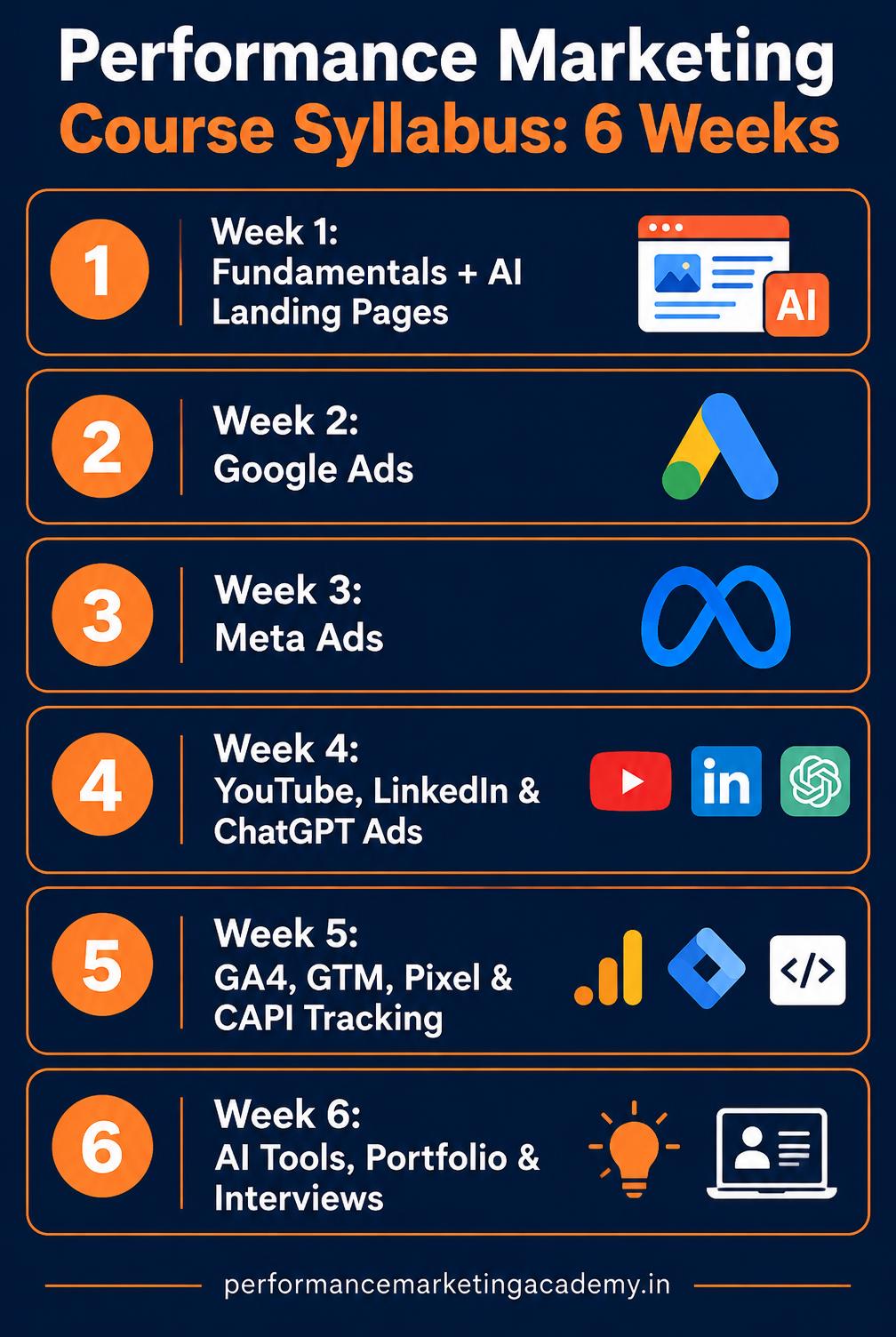
Performance marketing course syllabus at a glance
| Week | Module | You will be able to |
|---|---|---|
| 1 | Fundamentals, landing pages with AI, SEO basics | Explain CPC, CPA, ROAS; build a simple landing page with AI |
| 2 | Google Ads using Claude AI | Plan keywords, launch Search and Performance Max campaigns |
| 3 | Meta Ads using Claude AI | Run Facebook/Instagram lead and sales campaigns with audiences |
| 4 | YouTube Ads, LinkedIn Ads, ChatGPT Ads Manager | Pick the right extra channel and set up a campaign on it |
| 5 | Tracking (GA4 + GTM + Pixel + CAPI), remarketing | Track leads and purchases correctly; build remarketing audiences |
| 6 | AI for performance marketing, certifications, portfolio, interviews | Report results, pass certifications, apply for jobs or clients |
Classes are live, Monday to Friday, one hour a day. You pick one of four daily batch timings: 8:30–9:30 AM, 10:00–11:00 AM, 5:30–6:30 PM or 8:00–9:00 PM IST. One-to-one sessions are also available.
Week 1: Foundations — performance marketing basics, landing pages and SEO
Everything later depends on this week, so it starts slowly.
Topics covered:
- What performance marketing is and how it differs from brand marketing
- The marketing funnel: awareness, consideration, conversion, retention
- Core metrics: impressions, CTR, CPC, CPM, conversion rate, CPA, ROAS — see our CPC, CPM and CTR explainer
- How to set a goal and a budget for a campaign
- Landing page creation using AI: structure, headline, offer, form and speed
- SEO and content optimisation using AI: why organic search still supports paid ads
Step by step, what you do this week:
- Pick a practice business (a local service, an online store or a course).
- Write its offer and target customer in one sentence.
- Build a one-page landing page with AI tools.
- Calculate a target cost per lead from the price and profit of the offer.
Landing pages get a full module because ads only bring clicks — the page turns clicks into leads. Our guide on Google Ads landing pages shows why one page for every search wastes money.
Week 2: Google Ads using Claude AI
Google Ads reaches people at the moment they search, which is why most performance marketing jobs list it first.
Topics covered:
- Account structure: campaigns, ad groups, keywords, ads
- Keyword research and match types (broad, phrase, exact), negative keywords
- Writing responsive search ads, with Claude AI as a copy assistant
- Bidding strategies: maximise clicks, maximise conversions, target CPA, target ROAS
- Performance Max and Shopping campaigns for e-commerce
- Reading the search terms report and cutting wasted spend
Step by step:
- Research 30–50 keywords for your practice business and group them by intent.
- Add negative keywords to block searches that will never buy.
- Write three ads per ad group with Claude, then edit them yourself.
- Set a daily budget and a bidding strategy that fits your goal.
- Review search terms after the first days and adjust.
For the jobs this skill leads to, read Google Ads jobs in India.
Week 3: Meta Ads using Claude AI
Meta Ads (Facebook and Instagram) reaches people before they search. It is the main channel for D2C brands, local services and lead generation.
Topics covered:
- Business Manager, ad account, Page and Pixel setup
- Campaign objectives: Awareness, Traffic, Engagement, Leads, Sales
- Audiences: interests, lookalikes, custom audiences and Advantage+ audience
- Creative: images, Reels, carousels and hooks, with Claude for copy ideas
- Lead forms vs website leads
- Creative testing, ad fatigue and frequency
Step by step:
- Choose the objective that matches your goal (Leads or Sales, not Traffic, for most businesses).
- Create three creatives with different hooks.
- Start with a broad audience and let the algorithm learn.
- After a few days, keep the winning creative and replace the weakest.
Our Facebook Ads guide covers each of these steps in more detail.
Week 4: YouTube Ads, LinkedIn Ads and ChatGPT Ads Manager
Once Google and Meta make sense, the syllabus adds the channels that suit specific businesses.
- YouTube Ads — video campaigns for reach and consideration, plus Demand Gen campaigns.
- LinkedIn Ads — best for B2B, hiring and high-value services, where job title targeting matters.
- ChatGPT Ads Manager — the newest paid channel. You learn campaign setup, audiences, AI-written creatives, budgets and conversion tracking.
The goal of this week is judgement: knowing which channel fits which business, instead of running every channel at once.
Week 5: Tracking (GA4 + GTM + Pixel + CAPI) and remarketing
This is the module most short courses skip, and the one interviewers test the most. If tracking is wrong, every number in the ad account is wrong.
Topics covered:
- Google Analytics 4: events, key events (conversions), reports
- Google Tag Manager: tags, triggers and variables
- Google Ads conversion tracking and Enhanced Conversions
- Meta Pixel and Conversions API (CAPI), and avoiding double counting
- UTM links to see which campaign brought each visit
- Consent basics: why some visitors are not tracked
- Remarketing and audience targeting: website visitors, video viewers, lead lists
Step by step:
- Install GA4 and Google Tag Manager on your landing page.
- Create a "lead" event that fires only after a form is submitted.
- Send that conversion to Google Ads and Meta.
- Test it with a real form submission and check it appears in each tool.
- Build a remarketing audience of visitors who did not convert.
Week 6: AI for performance marketing, certifications and career mastery
The last week turns skills into a job, freelance clients or growth for your own business.
Topics covered:
- AI tools for ad copy, keyword research, audits, reporting and creative ideas
- Weekly reporting: spend, leads, CPA and ROAS, and explaining what changed
- Certifications: Google Ads Search, Google Ads Measurement, GA4, Meta Blueprint, LinkedIn Marketing Labs and HubSpot
- Resume and LinkedIn optimisation: ATS resume, portfolio website, job search plan — see our performance marketing resume guide
- Interview preparation: Google Ads, Meta Ads and GA4 questions, case study round, mock interviews — practise with our performance marketing interview questions
- Freelancing and agency setup: proposals, pricing and finding the first client
- Real client projects: local business, e-commerce, lead generation, real estate, healthcare and education campaigns
Beginner syllabus vs advanced syllabus
| Area | Beginner syllabus | Advanced syllabus |
|---|---|---|
| Google Ads | Search campaigns, keywords, match types | Performance Max, Shopping feeds, value-based bidding |
| Meta Ads | Objectives, audiences, creatives | Advantage+ campaigns, creative testing frameworks, CAPI |
| Tracking | GA4 and GTM basics, lead event | Server-side tagging, offline conversions, CRM reconciliation |
| Reporting | Spend, leads, CPA | ROAS by product, profit, lifetime value, incrementality |
| Budget | ₹500–₹2,000 a day practice campaigns | Scaling accounts of several lakh rupees a month |
| Best for | Students, career changers, business owners | Working marketers with 1–3 years' experience |
Our 6-week course covers the full beginner column and the most useful parts of the advanced column, so freshers can start and working marketers can fill gaps.
7 things to check in any performance marketing syllabus
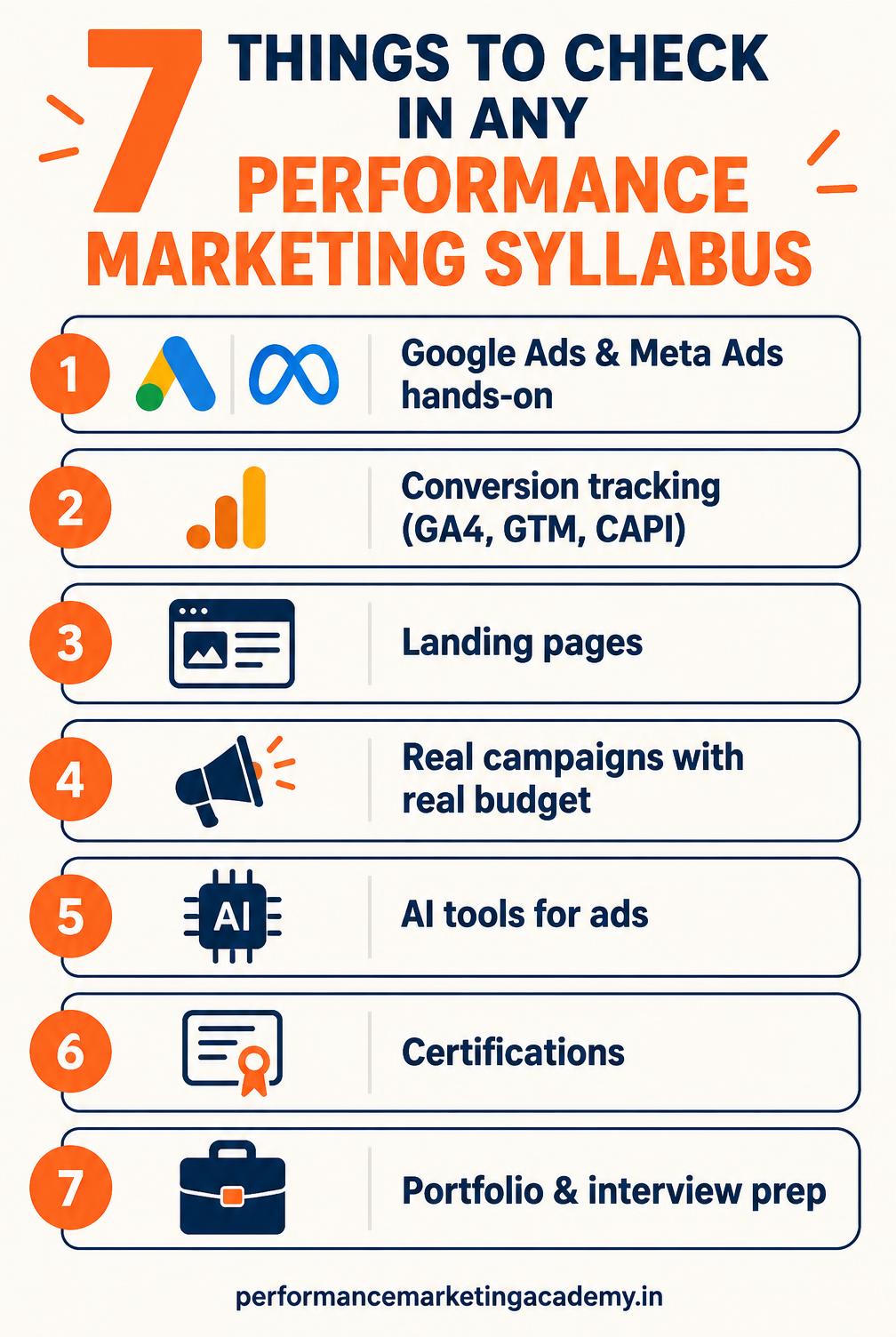
- Hands-on Google Ads and Meta Ads — you should build campaigns, not just watch them.
- Conversion tracking — GA4, GTM, Pixel and CAPI should have their own module.
- Landing pages — ads without a good page waste money.
- Real campaigns — ask whether you will run live campaigns or only use demo accounts.
- AI tools — 2026 courses should teach AI for copy, research and reporting.
- Certifications — Google and Meta certifications help a fresher's resume.
- Portfolio and interview prep — results you can show matter more than a certificate.
To compare courses on fees, duration and these points side by side, see our list of the best performance marketing courses in India, and our guide on how long a digital marketing course takes.
Course details: duration, timings and fees
| Detail | PMAcademy performance marketing course |
|---|---|
| Duration | 6 weeks, live online |
| Schedule | Monday to Friday, 1 hour a day |
| Batch timings (IST) | 8:30–9:30 AM, 10:00–11:00 AM, 5:30–6:30 PM, 8:00–9:00 PM |
| One-to-one | Available on request |
| Fees | ₹20,000 one-time or ₹25,000 in 2 installments |
| Try first | Session 1 is free |
| Projects | Real client-style campaigns across six industries |
You can download the full curriculum PDF and see the next batch date on the performance marketing course page. Not ready yet? Join the next free masterclass from the homepage to see how live classes work.
Who should follow this syllabus?
- Students and freshers who want a job as a performance marketing executive or paid media specialist — browse openings on our jobs board.
- Career changers from sales, customer support or general marketing.
- Business owners who want to run their own ads instead of paying an agency.
- Freelancers who want to offer Google and Meta ads to clients.
Conclusion
A strong performance marketing course syllabus is simple to recognise: it starts with fundamentals and landing pages, spends real time on Google Ads and Meta Ads, adds the right extra channels, treats tracking as a full module, and ends with reporting, certifications and career preparation. Every week should finish with a task you actually do.
If that is the syllabus you want, look at our live 6-week performance marketing course online — the first session is free.
Glossary
- Performance marketing
- Online advertising where you pay for and measure specific results such as leads, sales or app installs.
- Syllabus
- The list of modules and topics a course teaches, usually in order.
- ROAS
- Return on ad spend: revenue from ads divided by the amount spent on ads.
- CPA
- Cost per acquisition: ad spend divided by the number of leads or sales.
- GA4
- Google Analytics 4, Google's free tool for measuring website visits and conversions.
- GTM
- Google Tag Manager, a tool to add tracking codes to a website without editing code each time.
- Meta Pixel / CAPI
- Meta's browser tracking code and its server-side Conversions API, used to measure ad results.
- Remarketing
- Showing ads to people who already visited your website or engaged with your business.
- Performance Max
- A Google Ads campaign type that runs across Search, YouTube, Display, Gmail, Maps and Discover from one setup.
Sources & Further Reading
Frequently Asked Questions
What is the syllabus of a performance marketing course?+
It covers performance marketing fundamentals, landing pages, Google Ads, Meta Ads, YouTube, LinkedIn and ChatGPT Ads, conversion tracking (GA4, GTM, Pixel, CAPI), remarketing, AI tools, reporting, certifications and interview preparation.
How long does it take to complete the performance marketing syllabus?+
A focused live course can cover it in 6 weeks with daily one-hour classes and practice. PMAcademy's course runs 6 weeks, Monday to Friday.
Can a beginner follow this syllabus?+
Yes. The first week starts from basics: what performance marketing is, key metrics and how a landing page works. No coding or prior marketing experience is needed.
Is Google Ads or Meta Ads more important in the syllabus?+
Both. Google Ads captures people already searching; Meta Ads reaches people before they search. Most jobs ask for both, so a good syllabus gives each a full week.
Why is tracking part of the syllabus?+
Without correct tracking you cannot tell which ads bring leads or sales. GA4, Google Tag Manager, Meta Pixel and Conversions API questions are common in performance marketing interviews.
Which certifications are included?+
PMAcademy's syllabus prepares you for Google Ads Search, Google Ads Measurement and GA4 certifications from Google Skillshop, plus Meta Blueprint, LinkedIn Marketing Labs and HubSpot certifications.
What is the fee for the performance marketing course?+
PMAcademy's 6-week live course costs ₹20,000 one-time or ₹25,000 in 2 installments. The first session is free so you can try it before paying.
Does the syllabus include AI?+
Yes. It uses Claude and ChatGPT for ad copy, keyword research, landing pages, audits and reports, and includes ChatGPT Ads Manager as a paid channel.
Join our live training program and become a performance marketing professional.