Performance Marketing Interview Questions & Answers (2026)
60+ real performance marketing interview questions with model answers — Google Ads, Meta Ads, GA4 tracking, ROAS maths, scenario rounds, salary ranges in India and a 7-day preparation plan.

- 01How a performance marketing interview is structured
- 02Section 1 — Fundamentals and basics
- 03Section 2 — Google Ads interview questions
- 04Section 3 — Meta Ads interview questions
- 05Section 4 — Tracking and analytics questions
- 06Section 5 — Metrics and maths questions
- 07Section 6 — Scenario and case questions
- 08Section 7 — Behavioural and closing questions
- 09Fresher versus 2–5 years experience
- 10Salary expectations in India (2026 market ranges)
- 11Your 7-day preparation plan
- 12From interview prep to job offer
We'll email you our Performance Marketing Setup Checklist instantly.
No spam. Unsubscribe anytime.
Performance marketing interviews are unusually practical. Nobody asks you to recite definitions for an hour — they hand you a scenario, watch you do maths out loud, and listen for whether you have actually run an account or only watched tutorials about running one.
This guide collects the questions that come up most often in Indian agency and in-house interviews, with model answers you can adapt. Use it as a preparation checklist, not a script to memorise. If you are planning the career path itself, read our full guide on career in performance marketing.
How a performance marketing interview is structured
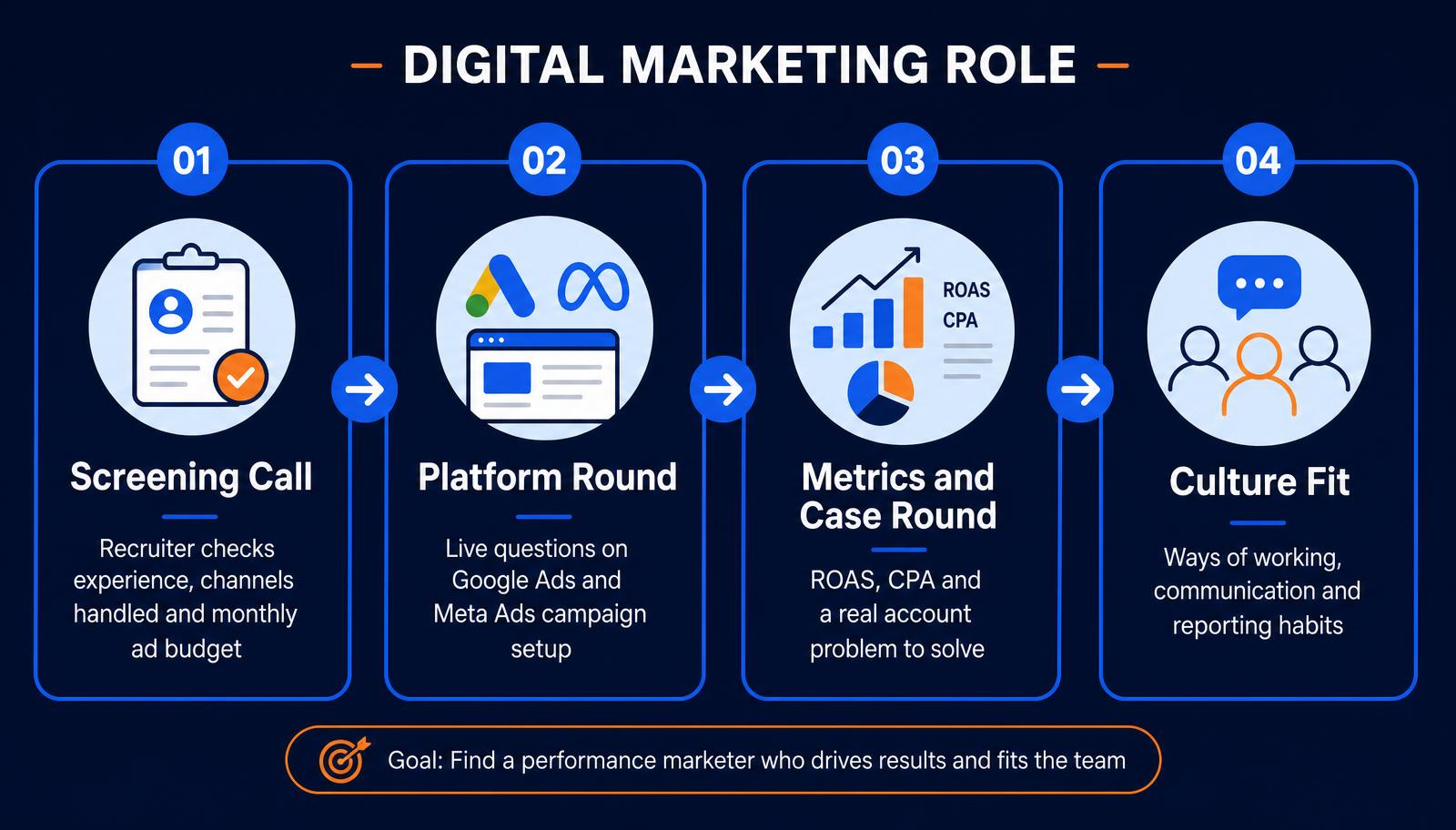
Most hiring processes run four rounds:
- Screening call (20–30 min). A recruiter confirms your channels, the monthly ad budget you have managed, notice period and salary expectation. Have one number ready for each.
- Platform round (45–60 min). A senior marketer tests Google Ads and Meta Ads depth. This is where most candidates are filtered out.
- Metrics and case round (45–60 min). Live maths plus one or two real account problems. Often includes a take-home audit or media plan.
- Culture and closing round. Ways of working, reporting habits, how you handle a client or founder pushing back on data.
In every round, quantify. "I managed Meta Ads" is forgettable. "I managed ₹8 lakh a month across Meta and Google for a D2C skincare brand at a 3.4x blended ROAS" gets you to the next round.
Section 1 — Fundamentals and basics
1. What is performance marketing? Performance marketing is paid marketing where you pay for and optimise towards a measurable action — a click, lead, install or purchase — rather than for exposure. Every rupee is tied to a tracked outcome, which is why the discipline is built around measurement as much as media buying. For a longer explanation, see our guide on what performance marketing is.
2. How is performance marketing different from brand marketing? Brand marketing builds memory and preference over months and is measured with surveys, share of search and recall. Performance marketing buys action now and is measured with CPA and ROAS. Mature companies run both: brand lowers the cost of performance over time by making the ad familiar before the click.
3. Explain CPC, CPM, CPA and CPL. CPC is cost per click, CPM is cost per thousand impressions, CPA is cost per acquisition, and CPL is cost per lead. CPM is what you buy, CPC is what you pay for attention, and CPA or CPL is what the business actually cares about. A cheap CPM with a terrible CPA is a bad campaign.
4. Walk me through the marketing funnel you use. Awareness (broad reach, video views, cheap CPM), consideration (traffic, engagement, remarketing lists building), and conversion (search intent, retargeting, offer-led creative). The honest version of this answer names the metric you judge each stage on — reach and CPM at the top, CTR and cost per landing page view in the middle, CPA and ROAS at the bottom.
5. Which channel would you start with for a new D2C brand with ₹1 lakh a month? Start where intent or scale is cheapest for that category. For a product people already search for, Google Search with a tight branded plus high-intent non-brand structure. For a product that must be demonstrated, Meta Advantage+ with three to five creative angles. Whichever you pick, spend the first two weeks on tracking and creative volume, not on bid tinkering.
6. What is a conversion, and who defines it? A conversion is the action the business agrees is worth paying for. The marketer proposes it; the business owner signs off. Weak candidates treat conversions as a platform setting. Strong candidates ask whether a form fill, a qualified lead or a closed sale is the true conversion, and then push tracking as close to revenue as possible.
7. What is remarketing and when does it stop working? Remarketing shows ads to people who already interacted with you. It stops working when the audience pool is too small to refresh, when frequency climbs past what the offer can support, or when it is credited with sales that would have happened anyway — which is why remarketing ROAS should never be read on its own.
8. What is incrementality? Incrementality is the number of conversions your ads actually caused. Platform ROAS answers "what did the ads get credit for"; incrementality answers "what would we have lost if we turned the ads off". Holdout tests and geo splits are the practical ways to measure it.
9. What is A/B testing in paid media, and what makes a test invalid? A/B testing compares two variants with one deliberate difference. A test is invalid when volume is too low for a meaningful result, when multiple things changed at once, when audiences overlap, or when you stop the test the moment one variant looks better.
10. Which paid channels have you worked on, and how deep? Answer honestly and rank them: primary channel, secondary channel, exposure only. Overclaiming is caught within two follow-up questions.
Section 2 — Google Ads interview questions
11. What is Quality Score made of? Expected click-through rate, ad relevance and landing page experience, reported on a 1–10 scale at keyword level. It is a diagnostic, not a lever you optimise directly — improve the three components and it follows. Google documents this in the Quality Score help article.
12. Explain keyword match types. Broad match reaches the widest set of related searches and leans on Smart Bidding and audience signals. Phrase match requires the meaning of the phrase to be present. Exact match matches the same meaning as the term. In 2026 most accounts run exact and phrase for control plus a broad-match campaign with strong conversion data and aggressive negatives.
13. Why are negative keywords important? They stop spend on searches that will never convert — job seekers, "free", competitor names you do not want, and irrelevant contexts. In most neglected accounts, a search terms review recovers a meaningful share of wasted spend within the first week.
14. What is Performance Max, and when should you not use it? Performance Max runs a single campaign across Search, Shopping, Display, YouTube, Discover, Gmail and Maps using asset groups and audience signals. Avoid it when you have almost no conversion data, when you need channel-level control for diagnosis, or when brand traffic would be absorbed and inflate reported performance without adding sales. Google's own Performance Max overview is the reference for its structure.
15. Compare Smart Bidding strategies. Maximise Clicks buys traffic and suits new accounts gathering data. Maximise Conversions and Target CPA optimise for volume and cost per action. Maximise Conversion Value and Target ROAS optimise for revenue and need reliable value tracking. Manual CPC survives only in tiny or highly constrained accounts.
16. What is Impression Share, and what do the "lost" metrics tell you? Impression Share is the share of available impressions you received. Lost IS (budget) means you ran out of money; lost IS (rank) means your ad rank was not competitive. The two point to completely different fixes, and confusing them is a common junior mistake.
17. How do you structure a Search account? Separate brand and non-brand, group keywords by intent and landing page rather than by arbitrary theme, keep enough volume per campaign for Smart Bidding to learn, and align ad copy to the search intent and the landing page headline.
18. A Search campaign spends its full budget with zero conversions. What do you check? In order: is conversion tracking firing at all; are the search terms relevant; is the landing page loading and matching the ad; is the offer competitive; is the audience geography and device mix sensible; only then bidding and budget. Tracking first, always.
19. What are Enhanced Conversions and why do they matter? Enhanced Conversions send hashed first-party data such as email alongside the conversion so Google can match conversions that browser-only tracking loses. They typically recover conversions that would otherwise be invisible, which improves both reporting and Smart Bidding. See Google's Enhanced Conversions documentation.
20. What is ad rank? Ad rank determines position and whether your ad shows. It combines your bid, ad and landing page quality, the auction context, expected impact of assets and formats, and the ad rank thresholds. A higher-quality ad can beat a higher bid.
21. How do you handle budget pacing across a month? Set daily budgets against a monthly target, monitor pacing at least twice a week, and hold back a reserve for high-performing days or an end-of-month push. Never let a Smart Bidding campaign lose learning by swinging budgets by large amounts overnight.
22. What reporting do you send a client on a Google Ads account? Spend, conversions, CPA, ROAS or pipeline value, week-on-week change, what you changed, what you learned, and what you will do next. A report without the last three lines is a data dump, not reporting.
Ready to practise these on a real account? The performance marketing course at PMAcademy runs live Google Ads and Meta Ads campaigns with real budgets — which is exactly the experience these questions are testing for. Join the free masterclass on 2nd October to see how it works.
Section 3 — Meta Ads interview questions
23. Explain Meta's campaign structure. Campaign holds the objective and budget strategy, ad set holds audience, placement, optimisation event and schedule, and ad holds the creative. Most performance decisions live at ad set and creative level.
24. What is the learning phase? After creation or a significant edit, an ad set delivers unstably while the system gathers conversion data. Meta's guidance is documented in its learning phase help article. The practical rule is to avoid frequent edits and to keep enough weekly conversions per ad set for delivery to stabilise.
25. What is Advantage+ and when do you still use manual ad sets? Advantage+ automates audience, placement and creative combinations. It usually wins on scale and simplicity. Manual ad sets still matter when you need strict audience separation for a test, when compliance requires specific targeting, or when you are validating an audience hypothesis rather than maximising output.
26. What is audience overlap and why does it hurt? When multiple ad sets target overlapping people, they compete in the same auction, split learning and raise costs. Consolidate ad sets rather than slicing an audience into many small ones.
27. How do you structure a creative test? Test one variable at a time — hook, format, offer or angle — with enough budget per variant to exit the learning phase, run it for a full week to cover the weekly cycle, and judge on cost per result rather than CTR alone.
28. What is creative fatigue and how do you spot it? Fatigue shows as rising frequency with falling CTR and rising CPA on a creative that previously performed. The fix is new angles, not just new colours on the same concept.
29. What is the Conversions API, and why is it not optional? The Conversions API sends events from your server to Meta, recovering conversions lost to browser restrictions and blockers. Running browser pixel plus CAPI with proper event deduplication is standard practice; Meta's Conversions API docs cover the implementation.
30. How do you build audiences without third-party data? First-party lists (customers, subscribers, cart abandoners), engagement audiences (video viewers, profile engagers, lead form openers), lookalikes from high-value segments, and broad targeting with strong creative doing the qualifying.
31. Meta reports 40 purchases, Shopify reports 25. What is happening? Attribution differences. Meta credits 7-day click and 1-day view conversions within its own model; the store counts orders. Both can be right in their own frame. Pick one source of truth for business reporting, use platform numbers only for in-platform optimisation, and sanity check with a blended view of total revenue over total spend.
32. Your CPM doubled but CTR is unchanged. What happened? Usually auction pressure — a seasonal event, more competitors, a narrower audience, or a placement mix shift. Check placement breakdown and audience size before blaming creative, because CTR holding steady suggests the ad is still resonating.
Section 4 — Tracking and analytics questions
33. Explain the GA4 event model. GA4 records everything as events with parameters, rather than the session and category-action-label model of Universal Analytics. Key conversions are events marked as key events, and reporting is built on those. See the GA4 events documentation.
34. What is the dataLayer in Google Tag Manager? A JavaScript object that holds structured data — a purchase value, item list, form name — which GTM reads and passes to tags. It is what makes reliable, developer-supported tracking possible instead of fragile click-selector tracking.
35. Walk me through how a purchase event reaches Meta and Google. The site pushes purchase data into the dataLayer, GTM fires the GA4 event, the Google Ads conversion and the Meta pixel, and the server sends a parallel CAPI event with the same event ID for deduplication. Enhanced Conversions attach hashed first-party data to the Google conversion.
36. What is server-side tagging and what problem does it solve? Server-side tagging routes events through your own server container instead of firing everything from the browser. It improves data durability against blockers and cookie limits, gives you control over what is shared, and can improve page performance.
37. What is an attribution window? The period after a click or view in which a conversion is credited to an ad. Different platforms use different defaults, which is why the same sale is often claimed twice across Meta and Google.
38. How do you validate that tracking is correct? Fire a real test conversion, then confirm it appears in GTM preview, in GA4 realtime with the right value, in the ad platform, and in the backend order or CRM record. If any of the four disagrees, fix that before optimising anything.
39. What UTM discipline do you enforce? A documented, lower-case, consistent naming convention for source, medium and campaign, applied to every paid link including partner and email placements. Inconsistent UTMs quietly destroy channel reporting.
40. How do you report when platform data and GA4 disagree? Report both, name the source of truth for business decisions, and explain the gap rather than hiding it. Interviewers are specifically listening for whether you can hold two numbers without panicking.
Section 5 — Metrics and maths questions
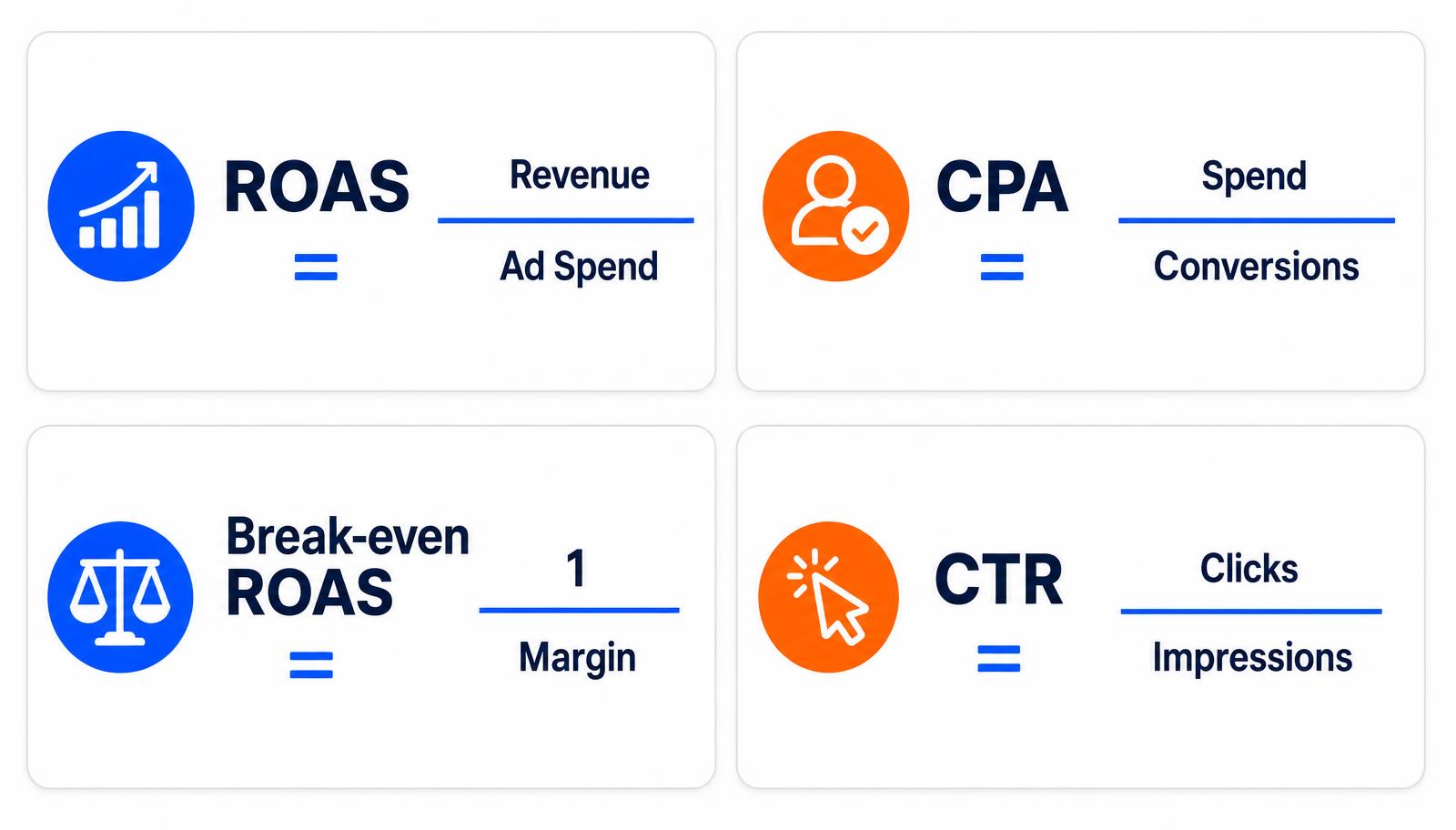
Expect these to be asked as live calculations. Practise with round numbers so you can answer without a calculator.
41. What is ROAS and how do you calculate it? ROAS is revenue from ads divided by ad spend. Spend ₹50,000, generate ₹2,00,000, ROAS is 4. Our ROAS formula guide works through the variations in detail.
42. What is break-even ROAS? Break-even ROAS is 1 divided by gross margin. At a 40% margin, break-even ROAS is 2.5 — below that, every sale loses money regardless of how good the campaign looks.
43. Calculate: ₹80,000 spend, 400 conversions. What is CPA? ₹200. If the product margin is ₹150, the campaign is unprofitable even though the CPA sounds low, which is the point of the question.
44. Calculate: 2,00,000 impressions, 4,000 clicks, 200 conversions. Give me CTR and CVR. CTR is 2% and CVR is 5%. Follow-up: if you doubled CVR to 10%, CPA halves — which is usually cheaper to achieve than halving CPC.
45. What is a good ROAS? Whatever comfortably exceeds your break-even ROAS. Benchmarks are only useful as sanity checks: D2C prospecting often sits at 2–4x, search-led ecommerce higher, and lead-gen businesses track pipeline value instead.
46. What is LTV:CAC and what ratio is healthy? Customer lifetime value divided by customer acquisition cost. Around 3:1 is a common health marker for subscription businesses, though the right number depends on payback period and cash position.
47. Blended ROAS versus platform ROAS — which do you trust? Blended ROAS (total revenue over total ad spend) is harder to fool and better for business decisions. Platform ROAS is better for deciding which ad set to scale. Use both for their intended job.
48. Budget doubles from ₹5 lakh to ₹10 lakh next month. What happens to CPA? Usually it rises, because you move beyond the cheapest available demand. Plan for it: state an expected CPA band at the new spend, scale in increments rather than overnight, and add new audiences, geographies or channels rather than pushing the same ad set harder.
Section 6 — Scenario and case questions
These carry the most weight. Answer them in the order metric → diagnosis → action → result.
49. ROAS dropped 40% overnight. What do you check first? Tracking. Confirm conversions are still firing and no site or checkout change broke the event. Then check whether spend shifted to a new campaign or placement, whether a competitor or seasonal event raised CPMs, whether creative frequency spiked, and whether the landing page or stock availability changed. Only after all of that do you touch bids.
50. CPL has risen 30% over three weeks but lead quality is the same. What do you do? Look for gradual causes rather than a single break: creative fatigue, audience saturation, rising auction pressure, or a landing page slowdown. Refresh creative angles, widen or rebuild audiences, and test a lighter form to raise conversion rate before increasing bids.
51. The client wants to pause the "worst" campaign. It is the top-of-funnel campaign. How do you respond? Show the assisted-conversion and blended view, propose a two-week holdout test instead of an outright pause, and agree in advance what result would justify the pause. Never argue from opinion when you can argue from a test.
52. You inherit an account with no documentation. What are your first 48 hours? Verify tracking end to end, map account structure and spend distribution, pull a 90-day performance baseline, review search terms and placement waste, check landing page speed and offer, and produce a prioritised list of fixes with expected impact.
53. A campaign has too little conversion volume for Smart Bidding. What do you do? Optimise for a higher-volume upstream event temporarily, consolidate ad sets or campaigns to pool data, widen targeting, and switch to value-based bidding only once volume supports it.
54. Your best-performing ad has been running for four months. Would you keep it? Keep it running while systematically building the next winner. Fatigue is inevitable, so the failure mode to avoid is having no tested replacement when performance drops.
Section 7 — Behavioural and closing questions
55. Tell me about a campaign that failed. Pick a real one, state what you expected, what happened, what you learned, and what you now do differently. Candidates who claim no failures are either inexperienced or not credible.
56. How do you prioritise when you run five accounts? By spend at risk and reversibility. Broken tracking on a large account beats a creative refresh on a small one every time.
57. How do you explain a bad month to a founder? Lead with the number, name the cause, show the action already taken, and give a dated expectation for recovery. Do not bury the number under context.
58. How do you stay current? Name specific sources and, more importantly, what you changed in an account because of something you learned recently.
59. Where do you want to be in three years? Tie it to the role: deeper account ownership, larger budgets, and eventually strategy or team leadership. Vague ambition reads as low intent.
60. What questions do you have for us? Ask who owns the budget and how large it is, what the reporting stack looks like, how success is measured in the first 90 days, how creative is produced, and what happens when platform data and analytics disagree. These signal that you have done the job before.
Fresher versus 2–5 years experience
| Area | Fresher expectation | 2–5 years expectation |
|---|---|---|
| Platforms | Can explain structure and set up a basic campaign | Has scaled and troubleshot live accounts |
| Metrics | Knows formulas and can calculate | Uses metrics to argue for budget decisions |
| Tracking | Understands what GA4 and the pixel do | Has implemented GTM, CAPI and Enhanced Conversions |
| Scenarios | Reasonable diagnostic order | Specific stories with numbers and outcomes |
| Proof | Personal or portfolio campaigns | Case studies with spend, result and role clarified |
Freshers are not rejected for lack of experience. They are rejected for having no evidence. One ₹5,000 campaign you ran yourself, documented properly, beats three certificates.
Salary expectations in India (2026 market ranges)
These are typical ranges, not guarantees — actual offers depend on city, company type, and the ad budgets you have handled.
| Role | Experience | Typical range |
|---|---|---|
| Performance Marketing Executive | 0–1 year | ₹3–5 LPA |
| Performance Marketing Specialist | 2–3 years | ₹6–10 LPA |
| Performance Marketing Manager | 4–6 years | ₹10–18 LPA |
| Lead / Head of Performance | 7+ years | ₹18 LPA and above |
Budget responsibility moves these numbers more than years do. Someone who has genuinely owned ₹50 lakh a month in spend negotiates from a different position than someone with the same tenure and a ₹2 lakh budget. You can see current openings and their stated ranges on our performance marketing jobs board.
Your 7-day preparation plan
- Day 1 — Metric fluency. Write every formula from memory and solve ten problems out loud.
- Day 2 — Google Ads audit. Review one real account and list three changes you would make.
- Day 3 — Meta Ads audit. Review structure, overlap, creative volume and learning phase.
- Day 4 — Tracking rehearsal. Explain the full event journey aloud, GTM to GA4 to CAPI.
- Day 5 — Scenario practice. Six scenarios, using metric → diagnosis → action → result.
- Day 6 — One-page case study. Objective, spend, changes, result. Bring it to the interview.
- Day 7 — Mock interview. Full run-through plus your five questions for the employer.
From interview prep to job offer
The uncomfortable truth about these questions is that reading answers is not the same as having them. Interviewers can tell within two follow-ups whether you have opened the platform yourself.
That gap is exactly what the AI-powered performance marketing course at PMAcademy closes — live Google Ads and Meta Ads campaigns with real budgets, GA4 and GTM tracking set up end to end, and mock interviews with feedback. Also read: SEO Interview Questions for Experienced (3–7 Years) if your role covers organic too, Digital Marketing Interview Questions and Answers for the broad whole-discipline round, Google Ads Interview Questions and Answers for the deep Google Ads round, What is Performance Marketing? and the ROAS formula explained for the two topics that come up in every single interview.
Join the free masterclass on 2nd October to see the curriculum and ask questions live.
For the Meta side of the interview in more depth, read these 60+ Facebook Ads interview questions with detailed answers.
Glossary
- ROAS
- Return on ad spend: revenue from ads divided by the cost of those ads. A ROAS of 4 means ₹4 of revenue for every ₹1 spent.
- CPA
- Cost per acquisition: total ad spend divided by the number of conversions such as a lead, sale or install.
- CPC
- Cost per click: what you pay each time someone clicks your ad, calculated as spend divided by clicks.
- CTR
- Click-through rate: clicks divided by impressions, expressed as a percentage. A relevance signal on both Google and Meta.
- CVR
- Conversion rate: conversions divided by clicks or sessions. Measures how well the landing page and offer convert traffic.
- Quality Score
- Google Ads' 1–10 diagnostic combining expected CTR, ad relevance and landing page experience. It influences ad rank and CPC.
- Learning Phase
- The period after a Meta ad set is created or significantly edited during which delivery is unstable while the system gathers conversion data.
- Conversions API (CAPI)
- Meta's server-side method of sending conversion events directly from your server, reducing loss from browser tracking restrictions.
- Enhanced Conversions
- A Google Ads feature that sends hashed first-party data such as email with a conversion to improve conversion measurement accuracy.
- LTV:CAC
- The ratio of customer lifetime value to customer acquisition cost. A common health benchmark for subscription and D2C businesses.
- Attribution Window
- The time period after a click or view during which a conversion is credited to an ad, for example Meta's 7-day click, 1-day view default.
- Incrementality
- The additional conversions caused by advertising that would not have happened otherwise, usually measured with holdout or geo tests.
Sources & Further Reading
Frequently Asked Questions
What questions are asked in a performance marketing interview?+
Performance marketing interviews cover platform knowledge (Google Ads and Meta Ads campaign structure, bidding, troubleshooting), tracking and analytics (GA4, GTM, Meta CAPI, Enhanced Conversions), metric maths (ROAS, CPA, break-even ROAS), and scenario questions where you diagnose a real account problem such as a sudden ROAS drop.
How do I prepare for a performance marketing interview as a fresher?+
Learn the metric formulas cold, run at least one small campaign with your own money so you can speak from experience, set up GA4 and Google Tag Manager on any website, and prepare a one-page case study. Freshers are hired on demonstrated hands-on work, not certificates alone.
What is the most common performance marketing interview question?+
The most common question is a scenario: 'Your ROAS dropped sharply this week — what do you check first?' The expected answer starts with verifying tracking and data integrity, then checks auction and delivery changes, then creative fatigue and landing page issues, before touching bids or budgets.
What skills should a performance marketing manager have?+
A performance marketing manager needs Google Ads and Meta Ads depth, GA4 and GTM tracking ability, budget planning and forecasting, creative briefing, reporting and stakeholder communication, and enough SQL or spreadsheet skill to analyse data outside the ad platforms.
What salary can I expect in performance marketing in India?+
Typical market ranges in 2026 are roughly ₹3–5 LPA for a fresher or executive, ₹6–10 LPA for a specialist with 2–3 years, ₹10–18 LPA for a manager with 4–6 years, and higher for lead or head roles at large brands and agencies. Actual offers vary by city, company type and the ad budgets you have handled.
Do performance marketing interviews include a practical test?+
Many do. Common formats include auditing a screenshot of a campaign, building a media plan for a given budget, calculating break-even ROAS for a product, or writing ad copy variations for a landing page. Assignments are usually one to three hours.
What are good Google Ads interview questions to expect?+
Expect Quality Score components, keyword match types and negative keywords, Performance Max versus Search structure, Smart Bidding strategies and when each fits, budget pacing and impression share, and how you diagnose a campaign that spends without converting.
What questions should I ask the interviewer?+
Ask who owns the budget and how much it is, what the reporting stack looks like, how success is measured in the first 90 days, how creative is produced, and how decisions are made when platform data and analytics data disagree.
Join our live training program and become a performance marketing professional.
Instant-download resources from the PMAcademy shop that pair with this guide.
- Interview PrepMeta Ads Interview Kit: 150 Q&A + Formulas, Case Studies, Policy Guide & Templates150 interview questions with answers, plus 4 companion guides₹299
- Interview PrepGoogle Ads Interview Q&A Guide (Instant Download)150+ questions covering Search, PMax, Shopping & YouTube₹299
- TemplatesThe Complete LinkedIn Job-Search Toolkit: 11 Profile Prompts, 71 Outreach Templates & a Tracker to Land Your Next RoleRewrite your headline, About, and Experience section, message any recruiter with confidence, and never lose track of an opportunity again — all in one downloadable kit.₹149