Google Ads Interview Questions and Answers (2026)
70+ real Google Ads interview questions and answers — keywords and match types, Performance Max, Smart Bidding, Quality Score, Shopping, conversion tracking, PPC scenario rounds, salary ranges in India and a 7-day prep plan.

- 01How a Google Ads interview is structured
- 02Section 1 — Google Ads fundamentals
- 03Section 2 — Keywords and match types
- 04Section 3 — Campaign types and Performance Max
- 05Section 4 — Bidding and budgets
- 06Section 5 — Ads, assets and landing pages
- 07Section 6 — Shopping and Merchant Center
- 08Section 7 — Conversion tracking and measurement
- 09Section 8 — Metrics and maths questions
- 10Section 9 — Troubleshooting and scenario questions
- 11Section 10 — PPC and client-facing questions
- 12Freshers versus 2–5 years experience
- 13Google Ads salary ranges in India (2026)
- 14Your 7-day Google Ads interview prep plan
- 15From interview prep to job offer
We'll email you our Performance Marketing Setup Checklist instantly.
No spam. Unsubscribe anytime.
Google Ads interviews are practical. Interviewers rarely want textbook definitions for an hour — they hand you an account screenshot, ask you to explain what is wrong with it, and listen for whether you have actually opened the platform or only watched tutorials about it.
This guide collects the Google Ads and PPC interview questions that come up most often in Indian agency and in-house hiring, with model answers you can adapt. Treat it as a preparation checklist, not a script to memorise. Pair it with our performance marketing interview questions guide, and if you are planning the career path itself, see our full guide on career in performance marketing.
How a Google Ads interview is structured
Most hiring processes run four rounds:
- Screening call (20–30 min). A recruiter confirms which platforms you have run, the monthly budget you have managed, notice period and salary expectation. Have one clear number for each.
- Platform round (45–60 min). A senior PPC marketer tests Google Ads depth. This is where most candidates are filtered out.
- Account audit or case round (45–60 min). A live account walkthrough, a media plan for a stated budget, or maths out loud. Often includes a short take-home assignment.
- Culture and closing round. Reporting habits, how you work with clients or founders, how you handle being challenged on data.
Quantify everything. "I ran Google Ads" is forgettable. "I ran ₹6 lakh a month across Search, Shopping and Performance Max for a D2C footwear brand at a 4.1x account ROAS" moves you to the next round.
Section 1 — Google Ads fundamentals
1. What is Google Ads and how does it make money for an advertiser? Google Ads is an auction-based advertising platform that places your ads on Search, Maps, Shopping, YouTube, Gmail, Discover and the Display Network. You pay per click, per impression or per conversion depending on the campaign, and the advertiser profits when the value of the actions bought exceeds the media cost.
2. Explain the Google Ads auction in simple terms. Every time someone searches, Google runs an auction among eligible ads. Each ad is given an ad rank; the highest ad ranks win the available positions, and the price you pay is based on what was needed to beat the ad below you, not your maximum bid. This is why a lower bid with better quality can outrank a higher bid.
3. What is ad rank made of?
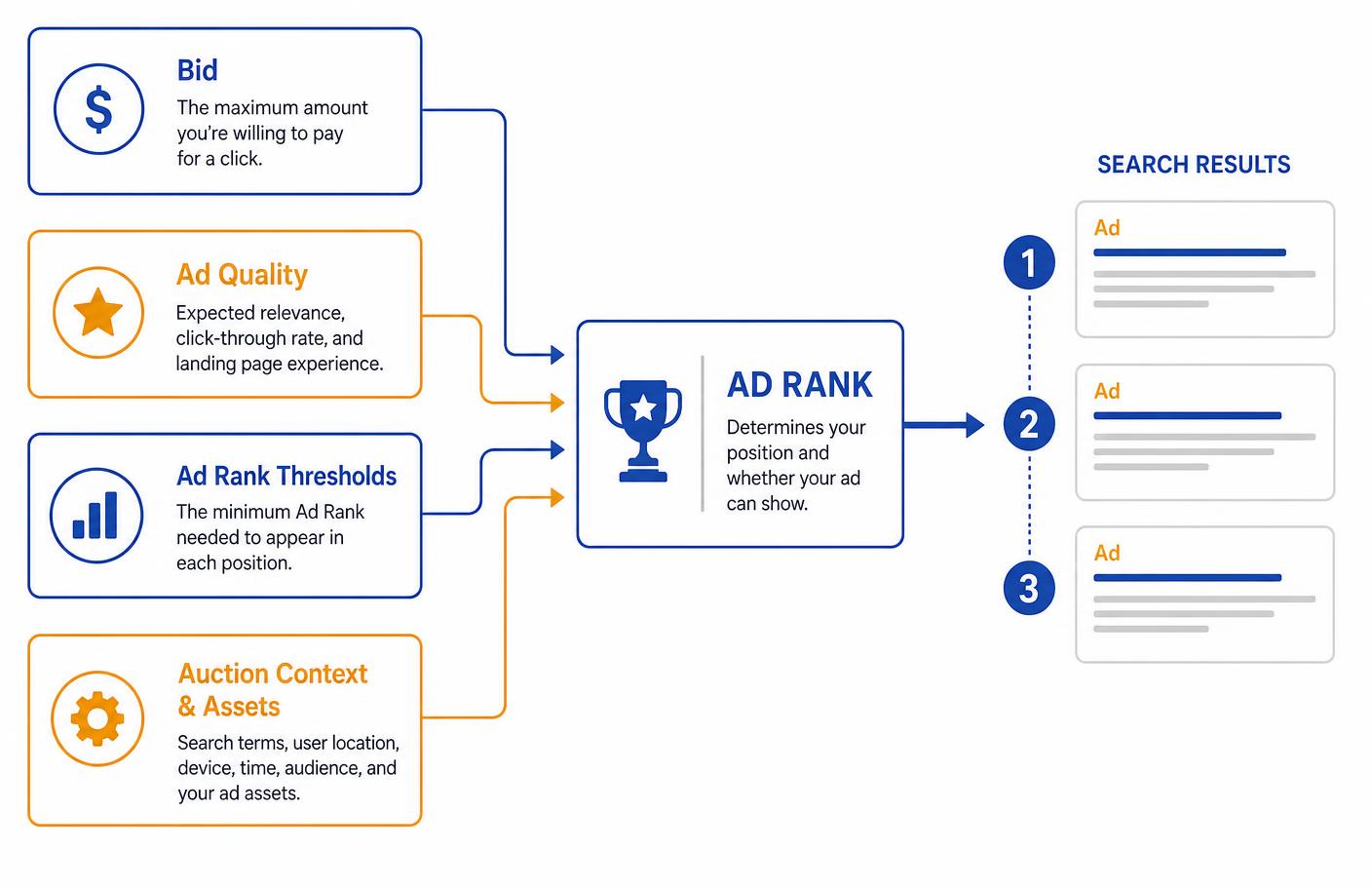
Ad rank combines your bid, ad and landing page quality, the ad rank thresholds, the context of the search (device, location, time, intent), and the expected impact of your assets and formats. Google documents this in its Ad Rank help article.
4. What is Quality Score and what is it made of? Quality Score is a 1–10 keyword-level diagnostic combining expected click-through rate, ad relevance and landing page experience. It is not a lever you pull directly — you improve the three components and the score follows. Google explains the components in the Quality Score documentation.
5. What is the difference between Quality Score and Ad Strength? Quality Score is an auction-related diagnostic at keyword level. Ad Strength is a build-time feedback score on how many and how varied your responsive search ad assets are. An "Excellent" Ad Strength with irrelevant assets does not save a poor Quality Score.
6. Name the main Google Ads campaign types and when you use each. Search for existing demand, Shopping for retail product intent, Performance Max for goal-based cross-network reach, Demand Gen for visual discovery on YouTube, Discover and Gmail, Video for reach and consideration on YouTube, Display for cheap reach and remarketing, and App for installs and in-app events.
7. What is the difference between a keyword and a search term? A keyword is what you bid on; a search term is what the person actually typed. The gap between the two is where money is wasted, which is why the search terms report and negative keywords are the first place any competent auditor looks.
8. What is CPC, and how is actual CPC different from max CPC? Max CPC is the most you are willing to pay for a click. Actual CPC is what you are charged, which is generally the minimum needed to hold your position against the ad below you. Actual CPC is almost always lower than max CPC.
9. What is conversion tracking and why is it the first thing you check? Conversion tracking records the actions people take after clicking an ad. Everything else — Smart Bidding, reporting, optimisation decisions — is built on it. If tracking is wrong, every conversation about performance afterwards is fiction.
10. What is remarketing in Google Ads? Remarketing shows ads to people who already visited your site or engaged with your content, using audience lists built in Google Ads or imported from GA4. It works well when the audience pool is refreshed by new traffic, and it starts to mislead when it takes credit for sales that would have happened anyway.
Section 2 — Keywords and match types
11. Explain the three keyword match types. Broad match reaches the widest set of related searches and leans heavily on Smart Bidding and audience signals. Phrase match requires the meaning of your phrase to be present in the query. Exact match matches the same meaning as your term. Google's keyword matching documentation is the reference.
12. When would you actually use broad match? When conversion tracking is solid, Smart Bidding has enough data, and a strong negative keyword list is already in place. Broad match without those three conditions is just an expensive discovery exercise.
13. Why are negative keywords important? They stop spend on searches that will never convert — "free", "jobs", "salary", competitor names you do not want, and irrelevant contexts. In most neglected accounts, one thorough search terms review recovers a meaningful share of wasted spend inside a week.
14. What is the difference between a negative keyword list at account, campaign and ad group level? Account-level lists apply everywhere and are best for universal exclusions such as job-seeker queries. Campaign level scopes exclusions to one strategy. Ad group level is used mainly to steer traffic between ad groups rather than to block it entirely.
15. How do negative keyword match types behave differently? Negative keywords do not use close variants. A negative exact keyword blocks only that exact query, negative phrase blocks queries containing that phrase in order, and negative broad blocks queries containing all the words in any order. Misspellings and plurals are not automatically blocked.
16. What is keyword cannibalisation and how do you fix it? It happens when several ad groups or campaigns compete for the same query, splitting data and raising costs. Fix it by consolidating, by using negatives to route traffic deliberately, or by separating brand and non-brand cleanly.
17. SKAGs or consolidated ad groups — what is your view? Single keyword ad groups made sense when match types were literal and manual bidding dominated. With close variants and Smart Bidding, fragmentation starves campaigns of data. The current default is fewer, better-fed ad groups grouped by intent and landing page.
18. How do you build a keyword list for a new client? Start with the client's own language, then the search terms report of any existing account, then Keyword Planner and competitor terms, then segment by intent: brand, high-intent commercial, category, informational. Price the informational terms carefully — they rarely convert directly.
Section 3 — Campaign types and Performance Max
19. What is Performance Max and how is it structured? Performance Max is a single goal-based campaign that runs across Search, Shopping, Display, YouTube, Discover, Gmail and Maps. Instead of ad groups it uses asset groups, plus audience signals and, where relevant, a product feed. Google's Performance Max overview describes its structure.
20. When would you not use Performance Max? When the account has almost no conversion data, when you need channel-level control to diagnose a problem, when brand traffic would be absorbed and inflate reported performance without adding sales, or when creative assets are too thin to fill an asset group properly.
21. How do you stop Performance Max from eating brand search? Apply brand exclusions, keep a dedicated brand Search campaign running, and compare brand and non-brand conversion volume before and after launch. If total conversions did not move but PMax reports a lot of them, you are paying for traffic you already had.
22. What are audience signals in Performance Max? Audience signals are suggestions, not targeting. They tell the system where to start looking — customer lists, remarketing audiences, custom segments built on search behaviour — after which delivery expands based on performance.
23. Search versus Shopping for an ecommerce client — how do you split budget? Shopping usually carries the high-intent product queries efficiently and should be funded first for a retailer. Search covers category and problem-led queries plus brand defence. Judge the split on incremental revenue per rupee, not on ROAS in isolation, because brand and Shopping always flatter ROAS.
24. What is Demand Gen and how is it different from Display? Demand Gen serves visually across YouTube, Shorts, Discover and Gmail and is built for demand creation with strong creative. Display is cheaper reach across the Display Network and is used mostly for remarketing. Demand Gen is judged on assisted conversions and lift, not last-click ROAS alone.
25. How do you structure a lead-generation Search account? Separate brand and non-brand, group keywords by intent and landing page, run one campaign per major service or geography where budget control matters, keep enough volume for Smart Bidding to learn, and route each ad group to a page that repeats the search intent in the headline.
26. What are the common causes of a Display campaign wasting budget? Unfiltered placements including mobile apps, over-broad audience expansion, no frequency management, and remarketing lists with no exclusions for converters. Placement exclusions and content suitability settings fix most of it.
27. How do you handle a very small budget, say ₹30,000 a month? Concentrate. One campaign, tight exact and phrase keywords on the highest-intent terms, one strong landing page, conversion tracking verified, and a bidding strategy that will not starve for data. Spreading a small budget across five campaign types guarantees that none of them learns.
28. What is a portfolio bid strategy and when is it useful? A portfolio strategy applies one Smart Bidding goal across several campaigns so they share conversion data. It is useful when individual campaigns are too small to learn on their own but share the same commercial goal.
Ready to practise these on a live account? The AI-powered performance marketing course at PMAcademy runs real Google Ads campaigns with real budgets, which is exactly the experience these questions test for. Join the free masterclass to see how it works.
Section 4 — Bidding and budgets
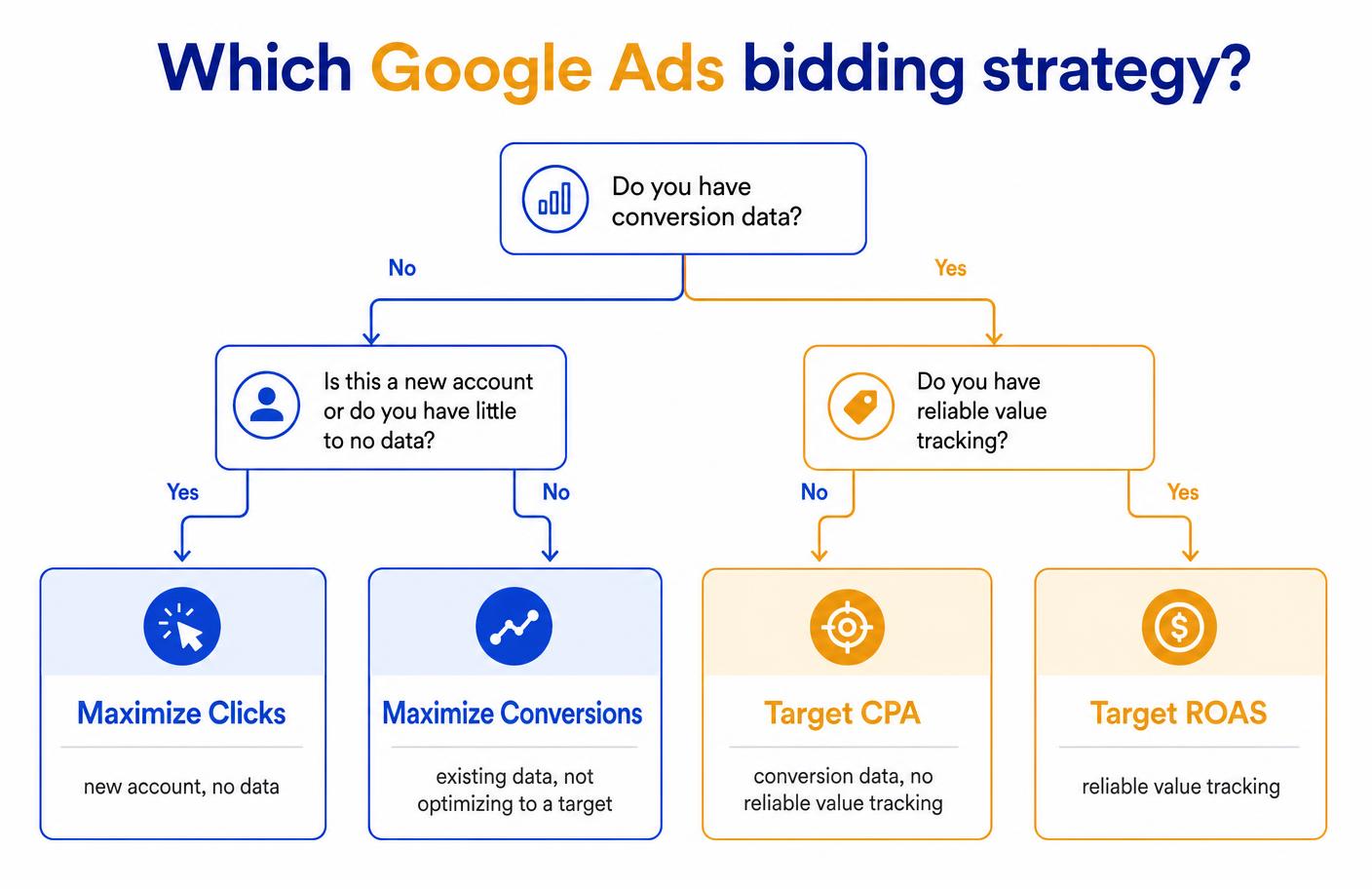
29. Compare the main Smart Bidding strategies. Maximise Clicks buys traffic and suits new accounts collecting data. Maximise Conversions targets volume. Target CPA controls average cost per action. Maximise Conversion Value and Target ROAS optimise revenue and need reliable value tracking. Google's Smart Bidding documentation covers the mechanics.
30. When is manual CPC still defensible? In very small accounts with almost no conversions, in tightly controlled brand campaigns, and in short-term situations where you need predictable cost per click rather than optimised outcomes. Manual bidding is a fallback, not a strategy.
31. What happens when you change a bid strategy? The campaign re-enters a learning period during which performance is unstable. Judge results only after the period ends and enough conversions have accumulated; reacting to day-three data is the most common self-inflicted wound in PPC.
32. How do you set a Target CPA for a new campaign? Start from the business's allowable CPA derived from margin and close rate, then set an initial target near recent actual CPA rather than the ideal one, and move it in steps of no more than 15–20% so the strategy does not lose delivery.
33. What is break-even ROAS and how do you calculate it? Break-even ROAS is 1 divided by the gross margin. At a 40% margin, break-even ROAS is 2.5, so any ROAS above 2.5 makes money on that transaction before overheads. Our ROAS formula guide works through this with examples.
34. What is impression share, and what do lost IS metrics tell you? Impression share is the proportion of available impressions you received. Lost IS (budget) means you ran out of money; lost IS (rank) means your ad rank was not competitive. They point to completely different fixes, and confusing them is the classic junior mistake.
35. How do you pace a monthly budget? Convert the monthly target into a daily budget, review pacing at least twice a week, account for weekday and seasonal patterns, and keep a reserve for high-performing days. Avoid large overnight swings on Smart Bidding campaigns.
36. A campaign is limited by budget with a good ROAS. What do you do? Make the case for more budget with numbers: current ROAS, lost impression share by budget, and the projected additional revenue at the current efficiency. Then increase in controlled steps and watch marginal ROAS, not average ROAS.
37. What is a shared budget and what is the risk? A shared budget lets several campaigns draw from one pool. The risk is that a high-volume, low-quality campaign consumes the budget before your best campaign gets a chance to spend.
38. How do seasonality adjustments work? Seasonality adjustments tell Smart Bidding to expect a short-term conversion rate change, for example during a sale. They are for brief, predictable events — not for gradual trends, which the system learns by itself.
Section 5 — Ads, assets and landing pages
39. What is a responsive search ad and how many assets should you provide? An RSA mixes headlines and descriptions into combinations. Provide the full complement of distinct headlines covering different angles — offer, benefit, proof, feature, call to action — plus descriptions that are not variations of the same sentence. Diversity matters more than quantity.
40. What is pinning and when is it justified? Pinning locks an asset to a specific position. It is justified for legal or compliance text and for brand mandatories. Over-pinning removes the combinations the system needs to optimise, so keep it minimal.
41. What ad assets (extensions) do you always add? Sitelinks, callouts, structured snippets, call and location where relevant, lead forms for lead-gen, and image assets. Assets increase real estate and expected impact on ad rank, which can lower CPC at the same position.
42. How do you write ad copy that improves Quality Score? Repeat the search intent in the headline, match the landing page headline to the ad, use one specific proof point rather than generic superlatives, and state the offer clearly. Relevance across query, ad and page is the whole game.
43. What makes a good landing page for paid search? Message match with the ad, one primary action, fast mobile load, proof close to the form, and no navigation distractions. A landing page that takes five seconds to load on 4G undoes even a perfect campaign.
44. How do you test ads properly? Change one variable at a time, run for a full week or more to cover the weekly cycle, give each variant enough impressions and conversions to be meaningful, and judge on conversions or conversion value rather than CTR alone.
45. Why can CTR go up while conversions go down? Because you attracted more clicks from a less qualified audience — a broader promise in the ad, a discount hook that pulls bargain hunters, or a match type change that widened the query set. Always read CTR next to conversion rate.
46. What is ad relevance in the Quality Score breakdown? Ad relevance measures how closely your ad matches the intent behind the keyword. "Below average" ad relevance almost always means the ad group is too broad and needs splitting by intent.
Section 6 — Shopping and Merchant Center
47. How does a Shopping campaign decide when to show? There are no keywords. Google matches queries against your product feed, so feed quality — title, description, product type, GTIN, attributes — is your targeting. The product data specification defines the required fields.
48. How do you optimise a product feed? Front-load the important attributes in the title (brand, product type, key attribute, size or colour), fill the optional attributes, use clean images, keep price and availability accurate, and fix disapprovals promptly.
49. What are the most common causes of product disapproval? Price or availability mismatch between the feed and the landing page, missing GTIN or brand, policy-restricted content, image issues such as promotional overlays, and a missing or unreachable returns and refund policy on the site.
50. How do you control which products get spend? Use custom labels to segment by margin, price band, bestseller status or seasonality, then split campaigns or asset groups so your profitable products are not starved by low-margin volume.
51. What is a feed rule and why use it? Feed rules transform data between your source feed and Merchant Center — appending attributes to titles, mapping product types, setting defaults — without needing developer changes on the website.
Section 7 — Conversion tracking and measurement
52. Explain the difference between the Google tag and Google Tag Manager. The Google tag is the base measurement snippet that sends data to Google Ads and GA4. Google Tag Manager is a container that manages tags, triggers and variables without editing site code. GTM is a delivery mechanism; the Google tag is what is delivered.
53. Walk me through implementing a purchase conversion. Confirm the business definition of the conversion, push a purchase event with value and currency to the dataLayer at the confirmation step, fire the Google Ads conversion tag and the GA4 event through GTM triggers, verify in preview mode and in the diagnostics of both platforms, then check that the value matches the order value in the backend.
54. What are Enhanced Conversions and why do they matter? Enhanced Conversions send hashed first-party data such as email alongside the conversion so Google can match conversions that browser-only measurement loses. They typically recover conversions that would otherwise be invisible, which improves both reporting and Smart Bidding. See the Enhanced Conversions documentation.
55. Why do Google Ads and GA4 conversion numbers disagree? Because they attribute differently. Google Ads credits the conversion to the click date and uses ad-platform attribution, while GA4 reports on the conversion date with its own model and session logic. Different conversion windows, cross-device matching and consent handling add to the gap. Explaining this calmly to a client is itself an interview test.
56. What is a conversion window and how do you choose it? The conversion window is how long after a click a conversion still counts. Set it to match the real buying cycle — a short window for impulse ecommerce, a longer one for considered B2B purchases. Changing it changes reported performance, so change it deliberately.
57. Which attribution model would you use and why? Data-driven attribution is the default where enough data exists, because it distributes credit across the path rather than dumping it on the last click. Last-click still has a role for quick diagnosis and for accounts too small for a modelled approach.
58. What is consent mode and why does it matter? Consent mode adjusts tag behaviour based on the user's consent choices and lets Google model conversions that cannot be measured directly. For advertisers serving regions with consent requirements, an incorrect implementation silently deletes conversion data.
59. How do you import GA4 conversions into Google Ads? Link the GA4 property to Google Ads, mark the key event in GA4, then import it as a conversion action. Avoid double counting by choosing one source of truth per action rather than importing an event you already track natively.
60. How do you track offline conversions for a lead-gen client? Capture the GCLID with the lead, store it in the CRM, and upload the qualified or closed status back to Google Ads as an offline conversion. This is what allows bidding to optimise for revenue rather than for form fills.
Section 8 — Metrics and maths questions
Expect to answer these out loud, without a calculator.
61. Spend ₹40,000, clicks 8,000. What is CPC? ₹5. Spend divided by clicks.
62. 8,000 clicks and 160 conversions. What is conversion rate and CPA? Conversion rate is 2%. CPA is ₹40,000 divided by 160, or ₹250.
63. Revenue ₹1,60,000 on ₹40,000 spend. What is ROAS? 4x, or 400%. Revenue divided by spend.
64. Product margin is 25%. What is break-even ROAS? 4. One divided by 0.25. Anything below 4 loses money on that sale.
65. You need a ₹500 CPA at a 2% conversion rate. What is your maximum CPC? ₹10. Max CPC equals target CPA multiplied by conversion rate.
66. Impressions 200,000, clicks 4,000. What is CTR? 2%. Clicks divided by impressions.
67. Which do you optimise first — CPC or conversion rate? Usually conversion rate, because the range of possible improvement is far larger and the gain compounds across the whole account. CPC reduction is capped by the auction; a landing page that converts twice as well halves CPA immediately.
68. Your ROAS is 6x but the business is losing money. How? Because ROAS is measured on revenue, not profit, and often on platform-attributed revenue at that. Discounts, returns, shipping, COD failures, and brand traffic being credited to ads all break the link between a high ROAS and a healthy P&L.
Section 9 — Troubleshooting and scenario questions
These carry the most weight. Answer in the shape: metric → diagnosis → action → result.
69. A Search campaign spends its full budget with zero conversions. What do you check? In order: is conversion tracking firing at all; are the search terms actually relevant; does the landing page load and match the ad; is the offer competitive; are geography, device and schedule sensible; and only then bidding and budget. Tracking first, always.
70. CPCs have doubled in a month. What happened? Check for new competitors in the auction insights report, a match type or bid strategy change, a drop in Quality Score components, a shift in the query mix toward more expensive terms, or seasonality such as a sale period. Auction insights and the search terms report answer this within minutes.
71. Conversions stopped completely three days ago. Assume a tracking break until proven otherwise. Check the conversion action status and recent site deployments, test the form or checkout yourself, verify the tag in preview mode, and look at whether GA4 also shows the drop. If GA4 still records the event and Google Ads does not, the problem is in the conversion action, not the site.
72. Performance Max is reporting a great ROAS but total revenue is flat. This is usually brand absorption or remarketing cannibalisation. Compare total business revenue before and after launch, apply brand exclusions, and run a holdout or geo test if the budget justifies it. Report incremental revenue, not platform ROAS.
73. Impression share is 30% and lost IS (rank) is 55%. The account is not competitive in the auction rather than short of money. Improve expected CTR through better ads, improve landing page experience, tighten keyword-to-ad relevance, and raise bids on the specific terms that convert, rather than uniformly.
74. A client says leads are poor quality even though CPL dropped. Cheap leads usually mean broader traffic. Review the search terms report for informational or off-target queries, add negatives, tighten match types, add qualifying fields to the form, and switch the optimisation target to a downstream event such as a qualified lead uploaded from the CRM.
75. Your best campaign has been running well for six months and is slowly declining. Look for creative and offer fatigue, competitor entry, landing page decay such as a slower page or a changed price, and audience saturation. Slow declines rarely have a single cause — separate the auction-side causes from the site-side causes before acting.
Section 10 — PPC and client-facing questions
76. What goes into a monthly PPC report? Spend, conversions, CPA, ROAS or pipeline value, week-on-week and month-on-month change, what you changed, what you learned, and what you will do next. A report without the last three lines is a data dump.
77. How do you prioritise across five accounts? By spend at risk and reversibility. Broken tracking on a large account outranks a creative refresh on a small one, always.
78. How do you explain a bad month to a client? Lead with the number, name the cause, show the action already taken, and give a dated expectation for recovery. Do not bury the number under context.
79. How do you pitch a budget increase? With marginal maths: current CPA or ROAS, lost impression share by budget, the projected additional conversions at the extra spend, and the point at which efficiency will start to fall.
80. What questions do you have for us? Ask who owns the budget and how large it is, what the measurement stack looks like, how success is judged in the first 90 days, who produces creative, and what happens when GA4 and Google Ads disagree. These signal that you have done the job.
Freshers versus 2–5 years experience
| Area | Fresher expectation | 2–5 years expectation |
|---|---|---|
| Fundamentals | Can explain ad rank, match types, campaign types | Uses them to justify structural decisions |
| Structure | Can set up a basic Search campaign | Has restructured a live account and can explain why |
| Bidding | Knows what each strategy does | Has migrated strategies and managed the learning period |
| Measurement | Understands what the tag and GA4 do | Has implemented GTM, Enhanced Conversions, offline imports |
| Scenarios | Sensible diagnostic order | Specific stories with spend, action and outcome |
| Proof | Personal or portfolio campaigns | Case studies with budget and role clearly stated |
Freshers are not rejected for lack of experience. They are rejected for having no evidence. One ₹5,000 Search campaign you ran and documented properly beats three certificates.
Google Ads salary ranges in India (2026)
These are typical market ranges, not guarantees. Actual offers depend on city, company type and the ad budgets you have handled.
| Role | Experience | Typical range |
|---|---|---|
| Google Ads / PPC Executive | 0–1 year | ₹3–5 LPA |
| Google Ads Specialist | 2–3 years | ₹6–10 LPA |
| Performance Marketing Manager (Paid Search) | 4–6 years | ₹10–18 LPA |
| Lead / Head of Paid Media | 7+ years | ₹18 LPA and above |
Budget responsibility moves these numbers more than years do. Someone who has genuinely owned ₹50 lakh a month in spend negotiates from a different position than someone with the same tenure and a ₹2 lakh budget. You can see current openings and their stated ranges on our performance marketing jobs board.
Your 7-day Google Ads interview prep plan
- Day 1 — Fundamentals. Ad rank, Quality Score, match types, impression share, campaign types, all from memory.
- Day 2 — Audit a real account. Structure, search terms, negatives, ad strength. Write three changes and why.
- Day 3 — Bidding and budgets. When each strategy fits, learning periods, pacing, lost IS by budget versus rank.
- Day 4 — Performance Max and Shopping. Asset groups, audience signals, brand exclusions, feed basics, disapprovals.
- Day 5 — Measurement. Explain the full journey from click to Google Ads and GA4 out loud, including Enhanced Conversions.
- Day 6 — Maths and scenarios. Ten calculations and six troubleshooting scenarios, spoken not written.
- Day 7 — Mock interview. Full run-through, a one-page case study, and your five questions for the employer.
From interview prep to job offer
The uncomfortable truth about these questions is that reading the answers is not the same as owning them. A good interviewer can tell within two follow-ups whether you have opened the platform yourself or just revised for the conversation.
That gap is what the dedicated Google Ads course online at PMAcademy closes — live Google Ads campaigns with real budgets, GA4 and Google Tag Manager set up end to end, Performance Max and Shopping built from scratch, plus mock interviews with feedback. Also read: Digital Marketing Interview Questions and Answers for the broad whole-discipline round, Performance Marketing Interview Questions & Answers for the wider paid-media round, ROAS Formula Explained for the maths, and What is Performance Marketing? for fundamentals.
Join the free masterclass to see the curriculum and ask questions live.
Looking for openings? Read Google Ads jobs in India for roles, salaries and a 90-day plan.
Many roles test both platforms, so pair this with our guide to Meta Ads interview questions.
Glossary
- Ad Rank
- The score that decides whether your ad shows and in what position, combining bid, ad and landing page quality, ad rank thresholds, auction context and expected asset impact.
- Quality Score
- A 1–10 keyword-level diagnostic built from expected click-through rate, ad relevance and landing page experience.
- Match Type
- The rule that decides which searches a keyword can match: broad, phrase or exact.
- Search Terms Report
- The report showing the actual queries people typed before seeing your ad, used to add negatives and find new keywords.
- Impression Share
- The percentage of available impressions your ads received, with lost share attributed to either budget or ad rank.
- Performance Max
- A goal-based Google Ads campaign type that runs across Search, Shopping, Display, YouTube, Discover, Gmail and Maps from a single campaign using asset groups and audience signals.
- Target CPA (tCPA)
- A Smart Bidding strategy that sets bids to get as many conversions as possible at your chosen average cost per acquisition.
- Target ROAS (tROAS)
- A Smart Bidding strategy that sets bids to reach a chosen average return on ad spend, requiring reliable conversion value tracking.
- Enhanced Conversions
- A Google Ads feature that sends hashed first-party data such as email with a conversion to recover measurement lost by browser restrictions.
- Break-even ROAS
- The return on ad spend at which advertising neither makes nor loses money, calculated as 1 divided by the gross profit margin.
Sources & Further Reading
- Google Ads Help — About Ad Rank
- Google Ads Help — About Quality Score
- Google Ads Help — About keyword matching options
- Google Ads Help — About Performance Max campaigns
- Google Ads Help — About Smart Bidding
- Google Ads Help — About Enhanced Conversions
- Google Merchant Center Help — Product data specification
- Google Analytics Help — GA4 conversions and key events
Frequently Asked Questions
What questions are asked in a Google Ads interview?+
Google Ads interviews cover fundamentals (ad rank, the auction, campaign types), keywords and match types, negative keywords and the search terms report, Performance Max and Smart Bidding, Quality Score and responsive search ads, conversion tracking with the Google tag, GTM, GA4 and Enhanced Conversions, plus metric maths and troubleshooting scenarios from real accounts.
How do I prepare for a Google Ads interview as a fresher?+
Learn ad rank, Quality Score and match types cold, run at least one small Search campaign with your own money, set up conversion tracking through Google Tag Manager and GA4 on any website, practise CPC, CPA and ROAS maths out loud, and document one campaign as a one-page case study. Freshers are hired on demonstrated hands-on work, not certificates alone.
What is the most common Google Ads interview question?+
The most common question is a troubleshooting scenario: 'A Search campaign is spending its full budget with no conversions — what do you check first?' The expected answer starts with verifying that conversion tracking fires, then reviews search terms relevance, landing page experience and offer, and only then touches bids and budgets.
What are the most important PPC interview questions?+
Beyond platform mechanics, PPC interview questions focus on client-facing judgement: how you structure reporting, how you justify a budget increase, how you prioritise across several accounts, how you handle a month that missed target, and how you decide between fixing tracking, creative or bidding first.
What is the difference between Quality Score and Ad Strength?+
Quality Score is a keyword-level 1–10 diagnostic of expected click-through rate, ad relevance and landing page experience, and it relates to the auction. Ad Strength is a feedback score on responsive search ad asset quantity and diversity. Ad Strength is guidance for the ad build; Quality Score is a diagnostic of auction competitiveness.
Do Google Ads interviews include a practical test?+
Many do. Common formats include auditing a screenshot or read-only account, building a keyword list and campaign structure for a given business, writing responsive search ad headlines, calculating break-even ROAS for a product, or producing a media plan for a stated monthly budget. Assignments usually take one to three hours.
What salary can a Google Ads specialist expect in India?+
Typical market ranges in 2026 are roughly ₹3–5 LPA for an executive with 0–1 year, ₹6–10 LPA for a specialist with 2–3 years, ₹10–18 LPA for a manager with 4–6 years, and higher for lead roles. Actual offers depend on city, company type and the monthly ad budget you have genuinely owned.
Which Google Ads certification helps in interviews?+
The Google Ads Search, Display, Shopping, Video and Measurement certifications through Skillshop are free and worth listing, but interviewers treat them as a baseline rather than proof. A documented account you have actually run carries far more weight than any certificate.
Join our live training program and become a performance marketing professional.
Instant-download resources from the PMAcademy shop that pair with this guide.
- Interview PrepGoogle Ads Interview Q&A Guide (Instant Download)150+ questions covering Search, PMax, Shopping & YouTube₹299
- Trackers & SheetsAd Budget Split Calculator (Instant Download)Decide where every rupee should go₹149
- Trackers & SheetsCPL & ROAS Tracking Sheet (Instant Download)See which campaign is actually making you money₹199