Digital Marketing Interview Questions and Answers (2026)
65+ real digital marketing interview questions and answers — fundamentals, SEO, Google Ads, Meta Ads, content and email marketing, GA4 analytics, metric maths, scenario rounds, India salary ranges and a 7-day prep plan.

- 01How a digital marketing interview is structured
- 02Section 1 — Digital marketing fundamentals
- 03Section 2 — SEO interview questions
- 04Section 3 — Google Ads questions
- 05Section 4 — Meta Ads and social media questions
- 06Section 5 — Content and email marketing
- 07Section 6 — Analytics and tracking
- 08Section 7 — Metrics and maths questions
- 09Section 8 — Scenario and behavioural questions
- 10Freshers vs experienced: what changes
- 11Salary ranges in India (2026)
- 12How to prepare in 7 days
- 13Frequently asked questions
We'll email you our Performance Marketing Setup Checklist instantly.
No spam. Unsubscribe anytime.
Digital marketing interviews are broad by design. The role touches SEO, paid ads, social media, content, email and analytics, so interviewers test whether you understand the whole system — and then probe the one channel you claim to know best until they find the edge of your knowledge.
This guide collects the digital marketing interview questions that come up most often in Indian agency, brand and startup hiring, with model answers you can adapt. Where a topic has a dedicated deep-dive on this blog, we link to it rather than repeat it: see our performance marketing interview questions guide for platform and metrics depth, our Google Ads interview questions guide for paid search rounds, and our guide to building a career in performance marketing for the long-term path.
How a digital marketing interview is structured
Most hiring processes run four rounds:
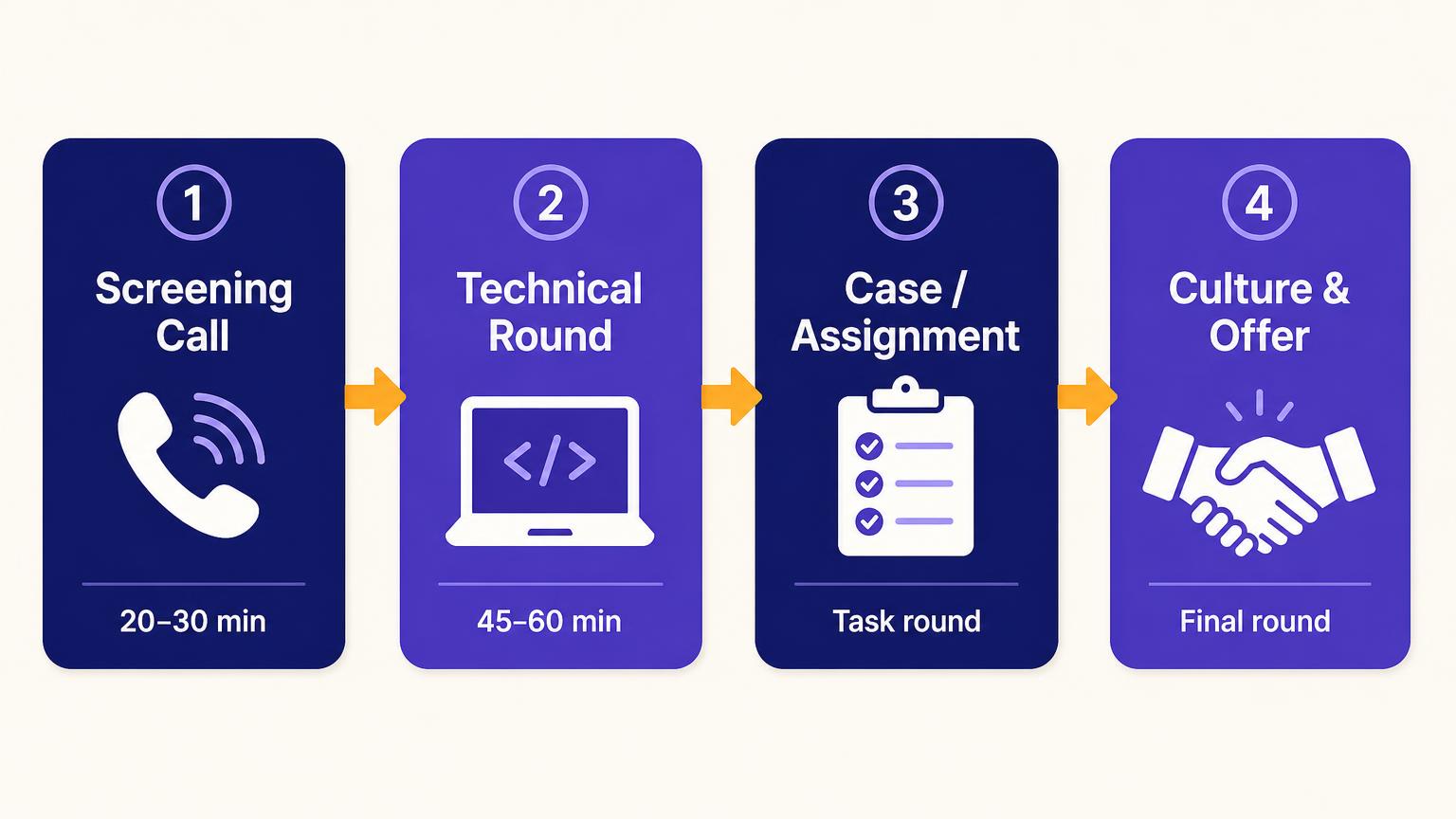
- Screening call (20–30 min). A recruiter confirms which channels you have worked on, the results you can point to, notice period and salary expectation. Have one clear answer for each.
- Technical round (45–60 min). A senior marketer tests your fundamentals and then goes deep on your strongest channel. This is where most candidates are filtered out.
- Case or assignment round. A take-home task — audit a website, build a campaign structure, write ad copy, or analyse a dataset — usually one to three hours of work.
- Culture and closing round. Communication, how you handle feedback on creative or data, and how you prioritise when everything is urgent.
Quantify everything. "I did SEO" is forgettable. "I grew organic traffic for an edtech blog from 4,000 to 11,000 monthly sessions in six months by fixing technical issues and publishing two keyword-mapped articles a week" gets you to the next round.
Section 1 — Digital marketing fundamentals
1. What is digital marketing? Digital marketing is the promotion of products or services through digital channels such as search engines, websites, social media, email and mobile apps. Unlike traditional marketing, every interaction is measurable, which lets marketers optimise spend toward the channels and messages that produce results.
2. What are the main types of digital marketing? The core types are search engine optimisation (SEO), paid search or PPC advertising, social media marketing both organic and paid, content marketing, email marketing, affiliate and influencer marketing, and display and video advertising. Most roles combine two or three of these rather than all of them.
3. What is the difference between digital marketing and traditional marketing? Traditional marketing uses offline channels such as print, TV, radio and hoardings, with broad reach but limited measurement. Digital marketing uses online channels with precise targeting, real-time measurement and the ability to change campaigns mid-flight. The trade-off is that digital demands continuous optimisation, while traditional buys sustained visibility.
4. Explain paid, owned and earned media. Paid media is exposure you buy — ads on Google, Meta, YouTube or sponsored placements. Owned media is property you control — your website, blog, email list and social profiles. Earned media is coverage you receive without paying — press mentions, reviews, shares and organic backlinks. Strong strategies use paid to spark attention, owned to convert it, and earned to compound trust.
5. What is a marketing funnel? A marketing funnel describes the journey from first hearing about a brand to becoming a customer, typically in three stages: awareness (the person discovers you), consideration (they compare options), and conversion (they buy or enquire). Different channels serve different stages — display and social build awareness, search captures intent, and email and remarketing close the sale.
6. What is a target audience and how do you define one? A target audience is the specific group of people most likely to buy your product, defined by demographics, location, interests, behaviours and intent. You define one from customer data, market research and platform insights, then validate it by testing — the audience that converts profitably is the real one, not the one in the deck.
7. What is a USP and why does it matter in digital marketing? A unique selling proposition is the one reason a customer should choose you over alternatives. It matters because every ad, landing page and email performs better when it leads with a clear, differentiated promise. Without a USP, campaigns compete on price and generic claims, which raises acquisition costs.
8. What is inbound vs outbound marketing? Inbound marketing attracts customers to you through content, SEO and social media — people find you when they are already looking. Outbound marketing pushes messages out — cold email, cold calls, display ads — to people who were not actively searching. Inbound compounds over time; outbound produces immediate but interruptive reach.
9. What is remarketing? Remarketing is showing ads to people who have already interacted with your website, app or content but did not convert. Because these audiences already know the brand, remarketing campaigns typically deliver higher conversion rates and lower acquisition costs than cold prospecting. It works through platform pixels, tags and customer list uploads.
10. What is a conversion? A conversion is the valuable action you want a visitor to take — a purchase, a lead form submission, a signup or a call. Defining it precisely matters because every optimisation decision in digital marketing flows from which action you are counting and what it is worth.
Section 2 — SEO interview questions
11. What is SEO and why is it important? SEO is the practice of improving a website so it ranks higher in unpaid search results for relevant queries. It matters because organic search is usually the largest and most cost-efficient source of high-intent traffic, and unlike paid ads, the traffic does not stop the day you stop paying.
12. What is the difference between on-page, off-page and technical SEO? On-page SEO covers everything on the page itself — keyword-targeted content, titles, headings, internal links and search intent match. Off-page SEO covers authority signals from outside the site, primarily backlinks and brand mentions. Technical SEO covers crawlability, indexation, site speed, mobile usability and structured data. A page needs all three: great content on a site Google cannot crawl will not rank.
13. How does a search engine work? Search engines work in three steps: crawling (bots discover pages by following links and sitemaps), indexing (pages are analysed and stored in a database), and ranking (when someone searches, the engine matches the query to indexed pages and orders them by relevance and quality signals). If a page is not crawled and indexed, nothing else matters.
14. What is keyword research? Keyword research is finding the exact phrases your target audience types into search engines, then mapping them to pages based on search volume, ranking difficulty and intent. Good keyword research starts from customer language and competitor gaps, not from what the business wants to say.
15. What are backlinks and why do they matter? Backlinks are links from other websites to yours. Search engines treat them as votes of authority — a link from a trusted, relevant site signals that your content is worth ranking. Quality matters far more than quantity: one link from a respected industry publication outweighs hundreds from low-quality directories.
16. What is E-E-A-T? E-E-A-T stands for Experience, Expertise, Authoritativeness and Trustworthiness — the framework Google's quality raters use to judge content credibility. In practice it means content should be written by people with demonstrable experience, published on a site with a real identity, and supported by accurate, verifiable information. It matters most for topics that affect money or health.
17. What are Core Web Vitals? Core Web Vitals are Google's page experience metrics: LCP measures loading speed, INP measures responsiveness to interaction, and CLS measures visual stability. They are a minor ranking factor, but a major conversion factor — slow, jumpy pages lose both rankings and customers.
18. What is the difference between a dofollow and nofollow link? A dofollow link passes ranking authority to the linked page. A nofollow link carries an attribute telling search engines not to pass authority, and is used for paid links, user-generated content and untrusted sources. A natural backlink profile contains both, and nofollow links still drive referral traffic and brand visibility.
Section 3 — Google Ads questions
Google Ads is the most common paid channel tested in digital marketing interviews. These are the eight questions that come up in generalist rounds — if the role is paid-media-heavy, study our dedicated Google Ads interview questions guide as well.
19. What is Google Ads and how does the auction work? Google Ads is an auction-based advertising platform across Search, Shopping, YouTube, Gmail, Discover and the Display Network. Every search triggers an auction among eligible ads: each ad receives an ad rank from its bid and quality, the highest ranks win the available positions, and you pay roughly what is needed to beat the ad below you — not your maximum bid.
20. What is Quality Score? Quality Score is Google Ads' 1–10 keyword-level diagnostic built from expected click-through rate, ad relevance and landing page experience. Higher quality lowers the bid needed to win a position, so improving Quality Score is one of the few ways to pay less for the same traffic.
21. What are keyword match types? Match types control which searches a keyword can trigger. Exact match limits you to close variants of the keyword, phrase match allows the meaning with additional words, and broad match lets Google's systems expand to related queries, usually paired with Smart Bidding. The practical skill is balancing reach against relevance — and using negative keywords to cut waste.
22. What are negative keywords? Negative keywords are terms you exclude so your ads do not show, for example blocking "free" and "jobs" when selling a paid course. They are maintained continuously from the search terms report, and are usually the single biggest source of wasted spend in a neglected account.
23. What is Performance Max? Performance Max is a goal-based campaign type that runs across all Google inventory — Search, Shopping, Display, YouTube, Discover, Gmail and Maps — from one campaign using asset groups and audience signals. It automates placement and bidding, which makes it powerful but also able to absorb brand search quietly, so experienced advertisers watch its search term insights and use brand exclusions deliberately.
24. When would you choose Target CPA over Maximize Conversions? Maximize Conversions spends the budget to get the most conversions at whatever cost results, so it fits when volume matters more than efficiency. Target CPA adds a cost ceiling, so it fits when a lead or sale has a known economic value and efficiency matters. You need reliable conversion tracking for either, and roughly 30 or more conversions a month for Target CPA to learn well.
25. What is the difference between SEO and SEM? SEO earns unpaid visibility in organic search results through content, technical health and authority. SEM — search engine marketing — in industry usage usually means paid search advertising on Google Ads. SEO compounds slowly and sustains; SEM starts immediately and stops when the budget stops. Most businesses need both.
26. A Google Ads campaign gets clicks but no conversions. What do you check? First, verify conversion tracking actually fires — a broken tag is the most common cause. Then check search terms for irrelevant traffic, the landing page for message match and load speed, and the offer itself against competitors. Only after those three would I touch bids, because bid changes cannot fix a measurement or page problem.
Section 4 — Meta Ads and social media questions
27. What are Meta Ads campaign objectives and why do they matter? Meta asks you to choose an objective — awareness, traffic, engagement, leads or sales — and then optimises delivery toward people likely to take that action. Choosing traffic when you want sales is the classic beginner mistake: Meta will find cheap clickers, not buyers, and the campaign will report good CTR with no revenue.
28. What is the learning phase? The learning phase is the unstable delivery period after an ad set is created or significantly edited, while Meta's system gathers conversion data to learn who to show ads to. Performance fluctuates until roughly 50 optimisation events per ad set per week are reached. Frequent edits reset learning, so experienced advertisers batch changes and avoid tinkering.
29. What is Advantage+ and how is it different from manual campaigns? Advantage+ is Meta's automated campaign format where the system handles most targeting, placement and budget decisions, with the advertiser supplying creative, budget and guardrails. Manual campaigns give you control over audiences and placements. In practice, Advantage+ often wins for ecommerce sales, while manual structures still make sense for testing audiences and controlling spend tightly.
30. What is the difference between organic and paid social media marketing? Organic social builds an audience and community through unpaid content, compounding trust and brand recall over time. Paid social buys reach and conversions through ads with precise targeting. Organic reach on most platforms is limited to a small fraction of followers, so businesses use organic for credibility and retention, and paid for scalable acquisition.
31. How do you build a content calendar? Start from business goals and audience questions, not from dates. Define three to five content pillars — for example education, proof, product and culture — assign a cadence per platform, batch-produce weekly, and leave slots open for timely content. Review monthly: double down on formats that drive saves, shares and enquiries, and cut what only fills the grid.
32. Which social media metrics actually matter? It depends on the goal. For awareness: reach and video watch time. For engagement: saves and shares, which signal value far better than likes. For business results: profile actions, link clicks, leads and attributed revenue. Follower count alone is a vanity metric unless it converts into reach or pipeline.
33. How would you handle a negative comment or review on a brand page? Respond quickly, publicly and without defensiveness: acknowledge the concern, apologise where appropriate, and move resolution to a private channel. Never delete criticism unless it violates platform rules — a well-handled complaint visible on the page builds more trust than a wall of praise. Then report recurring complaints internally, because they are product feedback.
34. What is social listening? Social listening is monitoring social platforms for mentions of your brand, competitors and category keywords to understand sentiment and spot trends. It informs content topics, crisis response and product decisions. It differs from social monitoring, which is tracking and responding to direct mentions and messages.
Section 5 — Content and email marketing
35. What is content marketing? Content marketing is creating and distributing valuable content — articles, videos, guides, tools — that attracts and retains a defined audience, with the goal of driving profitable action eventually rather than selling immediately. It works by earning attention and trust before asking for the sale.
36. How do you measure content marketing success? By stage. Top-of-funnel content is measured on organic traffic, rankings and engagement. Middle-of-funnel content on email signups and returning visitors. Bottom-of-funnel content on assisted conversions and influenced pipeline. The mistake is judging a blog post written for awareness by last-click sales it was never designed to produce.
37. What is a lead magnet? A lead magnet is a free, specific resource — a checklist, template, calculator or webinar — exchanged for an email address. Good lead magnets solve one narrow problem completely; bad ones are generic ebooks nobody opens. The magnet's topic should qualify the subscriber for whatever you sell next.
38. What email metrics do you track? Open rate indicates subject line and sender reputation, though privacy features have inflated it. Click-through rate indicates content relevance. Conversion rate indicates whether the email drove business results. And list health metrics — bounce rate, spam complaints and unsubscribes — indicate deliverability risk. If I could watch only one, it would be click-to-conversion, because that is revenue.
39. What is email segmentation? Segmentation is dividing an email list into groups by behaviour, lifecycle stage or attributes so each group receives more relevant messages. Even simple segmentation — new subscribers vs customers vs inactive — outperforms one blast to everyone, because relevance drives opens, clicks and deliverability.
40. What affects email deliverability? Deliverability depends on sender reputation (spam complaints, bounce rates, engagement), authentication (SPF, DKIM and DMARC records), list hygiene (removing inactive and invalid addresses), and content (spam-trigger patterns, image-to-text balance). The fastest way to destroy it is buying a list; the fastest way to build it is sending wanted email consistently.
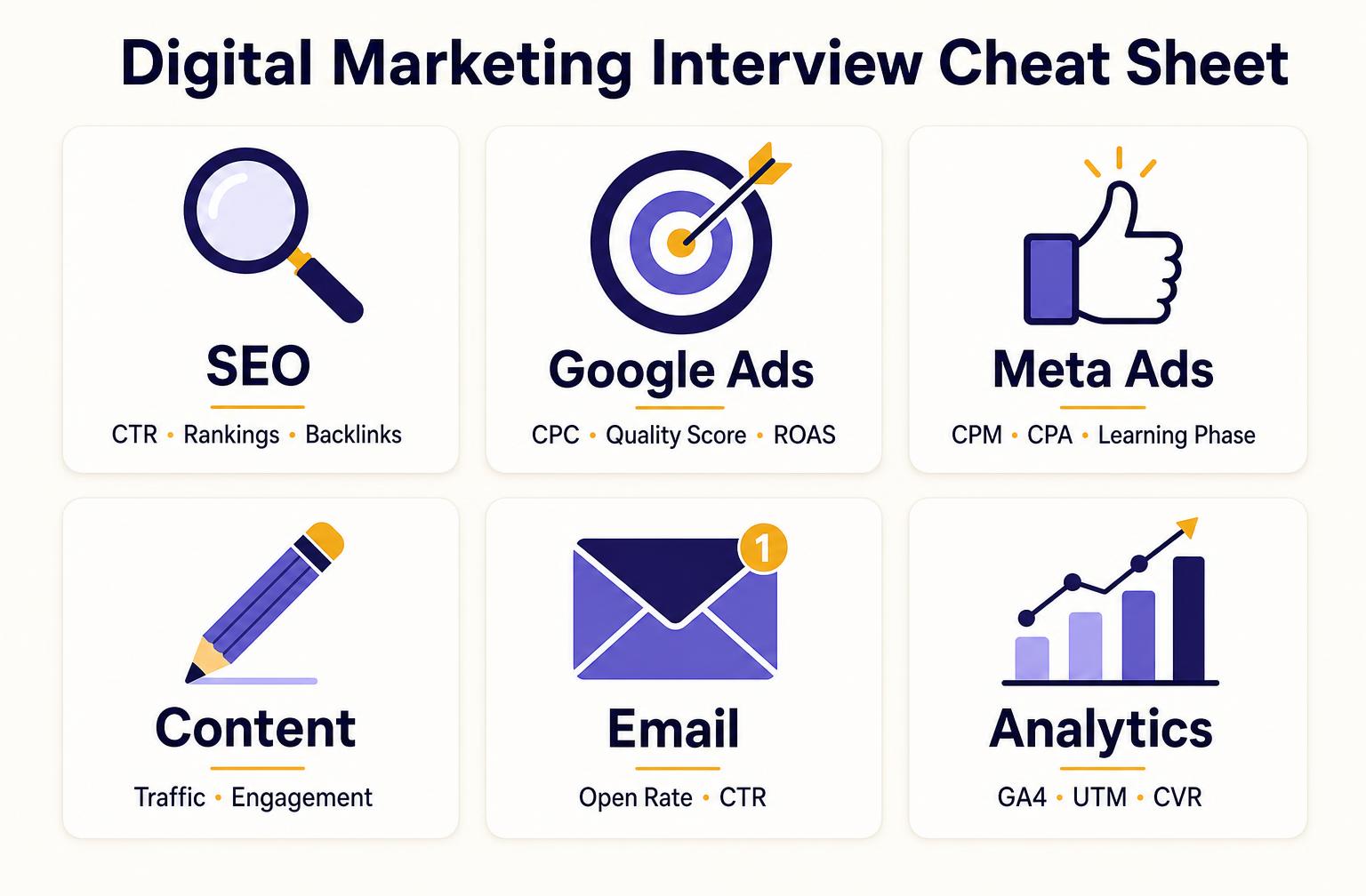
Section 6 — Analytics and tracking
41. What is Google Analytics 4 and how is it different from the old version? GA4 is Google's event-based analytics platform. Where Universal Analytics organised data around sessions and pageviews, GA4 treats every interaction — pageview, scroll, click, purchase — as an event with parameters. This makes it more flexible across websites and apps, but it means reports are built from events and key events rather than the old goal and session model.
42. What is Google Tag Manager? Google Tag Manager is a tag management system that lets you deploy and update tracking codes — GA4, ad platform pixels, conversion tags — through a web interface without editing site code for every change. It uses tags (what fires), triggers (when) and variables (with what data). It reduces developer dependency and keeps tracking organised.
43. What are UTM parameters? UTM parameters are tags appended to a URL — utm_source, utm_medium, utm_campaign, and optionally term and content — so analytics tools can attribute sessions and conversions to the right campaign. Without them, a paid social click can look like generic social traffic. The discipline that matters is a consistent naming convention, because "Facebook", "facebook" and "fb" split into three sources in reports.
44. What is the difference between a user, a session and an event? A user is a distinct person visiting, a session is one continuous period of engagement, and an event is a single interaction inside it. One user can generate many sessions, and one session many events. Most GA4 reporting is built from events; user and session counts summarise them.
45. What is a key event (conversion) in GA4? A key event is any event you mark as business-important — a purchase, form submission or signup — so it appears in conversion reporting and can be imported into Google Ads. Marking the wrong event as a key event corrupts every downstream optimisation decision, so it should reflect real value.
46. What is attribution? Attribution is the set of rules for crediting conversions to marketing touchpoints. Last-click gives all credit to the final touchpoint; data-driven models distribute credit based on measured contribution. Attribution matters because channels like social and display assist conversions that search later closes — judging them only on last-click underfunds the top of the funnel.
47. What is a good bounce rate / engagement rate? GA4 replaced bounce rate with engagement rate — the share of sessions lasting over ten seconds, having a conversion, or viewing multiple pages. What counts as good depends on page type: a blog post naturally engages less deeply than a product page. Benchmark against your own page types over time, not a universal number.
48. How do you report marketing results to a manager or client? Lead with the business outcome — spend, leads or revenue, cost per result, and the trend versus last period. Then one or two diagnostic metrics explaining why, then what you will do next. A report that lists forty metrics without a recommendation is noise; a good report fits on one page and ends with decisions.
Section 7 — Metrics and maths questions
Interviewers ask these out loud, without a calculator. Practise until the arithmetic is automatic.
49. An ad got 2,00,000 impressions and 4,000 clicks. What is the CTR? CTR is clicks divided by impressions: 4,000 ÷ 2,00,000 = 2%. Whether 2% is good depends on the channel and placement — strong for display, average for search, weak for brand search.
50. You spent ₹50,000 and got 1,000 clicks. What is the CPC? CPC is spend divided by clicks: ₹50,000 ÷ 1,000 = ₹50 per click.
51. You spent ₹1,00,000 on ads and generated 200 leads. What is the cost per lead? Cost per lead is spend divided by conversions: ₹1,00,000 ÷ 200 = ₹500 per lead. The follow-up question is always what a lead is worth — if 10% of leads buy at ₹20,000 average order value, each lead is worth roughly ₹2,000 in revenue, so ₹500 is healthy.
52. A landing page got 5,000 visitors and 150 signups. What is the conversion rate? Conversion rate is conversions divided by visitors: 150 ÷ 5,000 = 3%. If asked how to improve it, talk about message match between ad and page, page speed, form length and proof elements — not colour tweaks first.
53. You spent ₹80,000 on ads which produced ₹3,20,000 in revenue. What is the ROAS? ROAS is revenue divided by ad spend: ₹3,20,000 ÷ ₹80,000 = 4x. Always clarify whether this is platform-reported or blended, because platform ROAS usually overstates by double-counting view-through and branded demand.
54. A product sells at ₹2,000 with 50% gross margin. What is the break-even ROAS? Break-even ROAS is 1 divided by gross margin: 1 ÷ 0.5 = 2x. Below 2x the ads lose money on every sale; above it they contribute profit before fixed costs. Knowing a client's break-even before touching bids is what separates an operator from a button-pusher.
Section 8 — Scenario and behavioural questions
55. Your website's organic traffic dropped 30% after a search algorithm update. What do you do? First confirm the drop is real — check whether it is one section of the site, one device type or everything, using Search Console data rather than analytics alone. Then review what the update targeted and audit the affected pages against it: thin or unhelpful content, over-optimisation, or technical regressions. Present a recovery plan with priorities and timelines, and resist the urge to change everything at once, because then nothing is diagnosable.
56. A client says "leads are coming but sales says they're junk." What do you check? Start by defining "junk" with sales — wrong geography, no budget, students, competitors? Then trace it: are ads over-promising, is the form too easy, is targeting too broad, is the offer attracting freebie-seekers? The fix usually sits in ad messaging, qualifying questions on the form, or tighter audience and keyword intent. Report lead quality by source, not just lead volume.
57. A campaign has a high CTR but no sales. What is wrong? High CTR with no sales means the ad is winning attention but something downstream is broken: the landing page does not match the ad's promise, the page is slow or broken on mobile, the price or offer disappoints, or checkout has friction. It can also mean the ad attracts the curious rather than buyers — clickbait creative. Diagnose with funnel drop-off data before changing anything.
58. Your manager asks you to double leads next month with the same budget. How do you respond? Do not say yes immediately and do not say impossible. Present the options with trade-offs: cut the worst 20% of spend and reallocate, improve landing page conversion rate, expand to cheaper intent such as competitor or long-tail terms, or renegotiate the target. Doubling on flat budget means finding 2x efficiency somewhere — show where you would look first and what you would test in week one.
59. Tell me about a campaign that failed. What did you do? Pick a real failure with a real lesson. Structure it as: what the goal was, what you tried, what the data showed, what you changed or decided, and what you now do differently. Interviewers ask this to see ownership — blaming the algorithm, the client or the budget is the red flag they are listening for.
60. How do you stay updated with digital marketing changes? Name specific, credible sources: platform official blogs and release notes, Google's Search Central documentation, industry publications, and — most credibly — your own testing. Then prove it with an example: a recent change you noticed and how you adapted a campaign or page because of it. "I follow some pages on Instagram" is not an answer.
Freshers vs experienced: what changes
| Fresher (0–1 yr) | Experienced (2–5 yrs) | |
|---|---|---|
| Fundamentals | Definitions and formulas | When textbook answers break in practice |
| Channels | One channel in reasonable depth | Two-plus channels with budget ownership |
| Evidence | Personal projects, internships, freelance gigs | Accounts and budgets you ran with numbers |
| Maths | CPC, CTR, CPA, ROAS on round numbers | Unit economics: LTV, margins, break-even |
| Scenarios | Structured thinking is enough | Expected to have lived the scenario |
| Questions back | "What will I work on in the first 90 days?" | "Who owns budget decisions and reporting?" |
If you are a fresher, the single highest-leverage preparation is doing one real thing — a small ad campaign, a ranked page, a tracked website — and documenting it. A live job market for these roles is on our performance marketing jobs board, which shows what employers are asking for right now.
Salary ranges in India (2026)
These are typical market ranges, not guarantees — actual offers depend on city, company type, and the budgets and results you can prove.
| Role | 0–1 year | 2–3 years | 4–6 years |
|---|---|---|---|
| Digital marketing executive | ₹2.5–4.5 LPA | ₹4–6 LPA | — |
| SEO executive / specialist | ₹2.5–4 LPA | ₹5–8 LPA | ₹8–14 LPA |
| Social media executive / manager | ₹2.5–4 LPA | ₹4.5–8 LPA | ₹8–14 LPA |
| Performance marketer | ₹3–5 LPA | ₹6–10 LPA | ₹10–18 LPA |
| Digital marketing manager | — | — | ₹9–16 LPA |
Paid media and analytics roles consistently pay a premium over generalist roles, because those skills connect most directly to revenue. Freelancers with three to five retained clients often earn ₹1–3 lakh per month, which is why many marketers use their first job to build proof, then go independent.
How to prepare in 7 days
The day-by-day plan is structured as a HowTo at the top of this article: fundamentals on day one, depth channel on day two, one piece of real hands-on work on day three, measurement on day four, maths on day five, scenarios and a case study on day six, and a mock interview on day seven.
If you want structured, hands-on training with live projects and interview preparation built in, our AI-powered performance marketing course covers Google Ads, Meta Ads, GA4, SEO fundamentals and freelancing in six weeks — and the free masterclass is the easiest way to experience the teaching style first.
Before the interview, make sure you can back your answers with a digital marketing portfolio and a results-focused digital marketing resume.
Frequently asked questions
The FAQ block at the end of this page answers the eight questions candidates ask most — from what a fresher should expect, to whether certifications alone get you hired. For platform-specific rounds, continue with our deep-dives on SEO interview questions for experienced candidates, performance marketing interview questions and Google Ads interview questions, and check live openings on the jobs board.
Interviewing for a paid social role? Our Meta Ads interview questions and answers go deeper on Pixel, Conversions API, Advantage+ and scenario rounds.
Glossary
- SEO
- Search engine optimisation: improving a website's visibility in unpaid search results through content, technical health and authority signals.
- SERP
- Search engine results page: the page shown after a search query, containing organic results, ads and features such as snippets and map packs.
- Backlink
- A link from another website to yours, treated by search engines as a vote of authority and relevance.
- E-E-A-T
- Experience, Expertise, Authoritativeness and Trustworthiness — the quality framework Google's human raters use to assess content credibility.
- CTR
- Click-through rate: clicks divided by impressions, expressed as a percentage. Used across ads, email and search results.
- CPC
- Cost per click: what an advertiser pays each time someone clicks an ad, calculated as spend divided by clicks.
- CPA
- Cost per acquisition: total marketing spend divided by the number of conversions such as a lead, sale or install.
- ROAS
- Return on ad spend: revenue from ads divided by the cost of those ads. A ROAS of 4 means ₹4 of revenue for every ₹1 spent.
- CVR
- Conversion rate: conversions divided by clicks or sessions, measuring how well a page or funnel converts visitors.
- UTM Parameter
- Tags added to a URL — source, medium, campaign, term, content — so analytics tools can attribute traffic to specific campaigns.
- GA4
- Google Analytics 4: Google's event-based analytics platform for measuring website and app traffic, engagement and conversions.
- Lead Magnet
- A free resource such as a checklist, template or webinar offered in exchange for contact details, used to grow an email list.
Sources & Further Reading
Frequently Asked Questions
What questions are asked in a digital marketing interview?+
Digital marketing interviews cover fundamentals (channels, the funnel, paid vs owned vs earned media), channel knowledge across SEO, Google Ads, Meta Ads, social media, content and email, analytics and tracking with GA4 and Google Tag Manager, metric maths such as CPC, CTR, CPA and ROAS, and scenario questions where you diagnose a real problem such as falling traffic or a campaign that gets clicks but no sales.
How do I prepare for a digital marketing interview as a fresher?+
Learn the core definitions and metric formulas cold, do one piece of real hands-on work such as running a small ad campaign or optimising a page for SEO, set up GA4 on any website, practise maths out loud, and document your work as a one-page case study. Freshers are hired on demonstrated initiative, not certificates alone.
What is the most common digital marketing interview question?+
The most common opener is 'Walk me through a campaign or project you worked on.' The expected answer covers the objective, the channel and audience, what you personally did, the budget if any, and the measurable result. Vague answers like 'I handled social media' fail; specific answers with numbers move you forward.
What are the basic digital marketing interview questions for freshers?+
Freshers are typically asked: what is digital marketing, the difference between SEO and SEM, what paid, owned and earned media mean, what a marketing funnel is, what CTR, CPC and CPA stand for and how to calculate them, what a backlink is, what Google Analytics does, and which digital marketing channel interests them most and why.
Which digital marketing skills are most in demand in 2026?+
The most in-demand skills are paid advertising on Google and Meta with profitable tracking, GA4 and Google Tag Manager implementation, SEO with content strategy, marketing analytics and reporting, conversion rate optimisation, and AI-assisted workflows for research, copywriting and creative production. Employers pay the most for people who can connect spend to revenue.
Do digital marketing interviews include a practical test?+
Many do. Common formats include auditing a website's SEO, writing ad copy for a given product, building a keyword list and campaign structure, analysing a sample dataset to find a problem, or creating a one-week content calendar. Assignments usually take one to three hours.
What salary can a digital marketer expect in India?+
Typical market ranges in 2026 are roughly ₹2.5–4.5 LPA for a digital marketing executive with 0–1 year, ₹5–9 LPA for a specialist with 2–3 years, ₹9–16 LPA for a manager with 4–6 years, and higher for lead and head roles. Specialists in paid media and analytics usually command a premium over generalists. Actual offers depend on city, company type and provable results.
Are digital marketing certifications enough to get a job?+
No. Free certifications from Google Skillshop, Meta Blueprint and HubSpot are worth listing and show baseline knowledge, but interviewers treat them as table stakes. What gets you hired is proof you applied the knowledge — a campaign you ran, a page you ranked, a report you built — documented with numbers.
Join our live training program and become a performance marketing professional.
Instant-download resources from the PMAcademy shop that pair with this guide.
- Interview PrepMeta Ads Interview Kit: 150 Q&A + Formulas, Case Studies, Policy Guide & Templates150 interview questions with answers, plus 4 companion guides₹299
- Interview PrepGoogle Ads Interview Q&A Guide (Instant Download)150+ questions covering Search, PMax, Shopping & YouTube₹299
- Templates1500+ Modern Resume CV Templates Bundle | Word, Illustrator Files (Instant Download)1500+ clean, modern resume & CV designs for every industry₹199