SEO Interview Questions and Answers for Experienced (3–7 Years) — 2026
50+ senior SEO interview questions asked to candidates with 3–7 years of experience — technical SEO, migrations, cannibalisation, forecasting, AI Overviews and stakeholder rounds. Each question includes why it is asked, how to structure your answer, a model answer and the red flags that get you rejected.

- 01How senior SEO interviews are actually run
- 02The answer framework: Situation, Diagnosis, Action, Result
- 03Test yourself before you read the answers
- 04Technical SEO interview questions
- 05Site migrations, traffic drops and recoveries
- 06Content strategy and on-page at scale
- 07Link building and digital PR
- 08Analytics, forecasting and reporting
- 09AI search, AEO and GEO questions
- 10Strategy, stakeholders and leadership
- 11The live audit task: how to handle 20 minutes on an unfamiliar site
- 12How to rate your own answers before the interview
- 13Salary ranges for experienced SEO roles in India (2026)
- 14Ten questions to ask your interviewer
- 15Your 14-day preparation plan
- 16Where to go next
We'll email you our Performance Marketing Setup Checklist instantly.
No spam. Unsubscribe anytime.
Most SEO interview question lists are written for freshers. They ask what a meta description is, what the difference between on-page and off-page SEO is, and how many characters a title tag should be. If you have been doing SEO for three to seven years, none of that will come up — and preparing with those lists is precisely why strong practitioners still get rejected in senior rounds.
At this level, interviewers are not testing recall. They already assume you know what a canonical tag does. They are testing whether you can diagnose something you have never seen before, whether you can prioritise under constraint, and whether you can get other people to do work you do not control. This guide covers the questions that actually get asked at that level, drawn from the patterns that recur across LinkedIn hiring posts, technical SEO community discussions, senior SEO job descriptions and interview debriefs shared publicly by hiring managers.
Every question below comes with four things instead of a canned answer: why the interviewer asks it, how to structure your answer, a model answer you can adapt to your own experience, and the red flag that gets people rejected on that question.
How senior SEO interviews are actually run
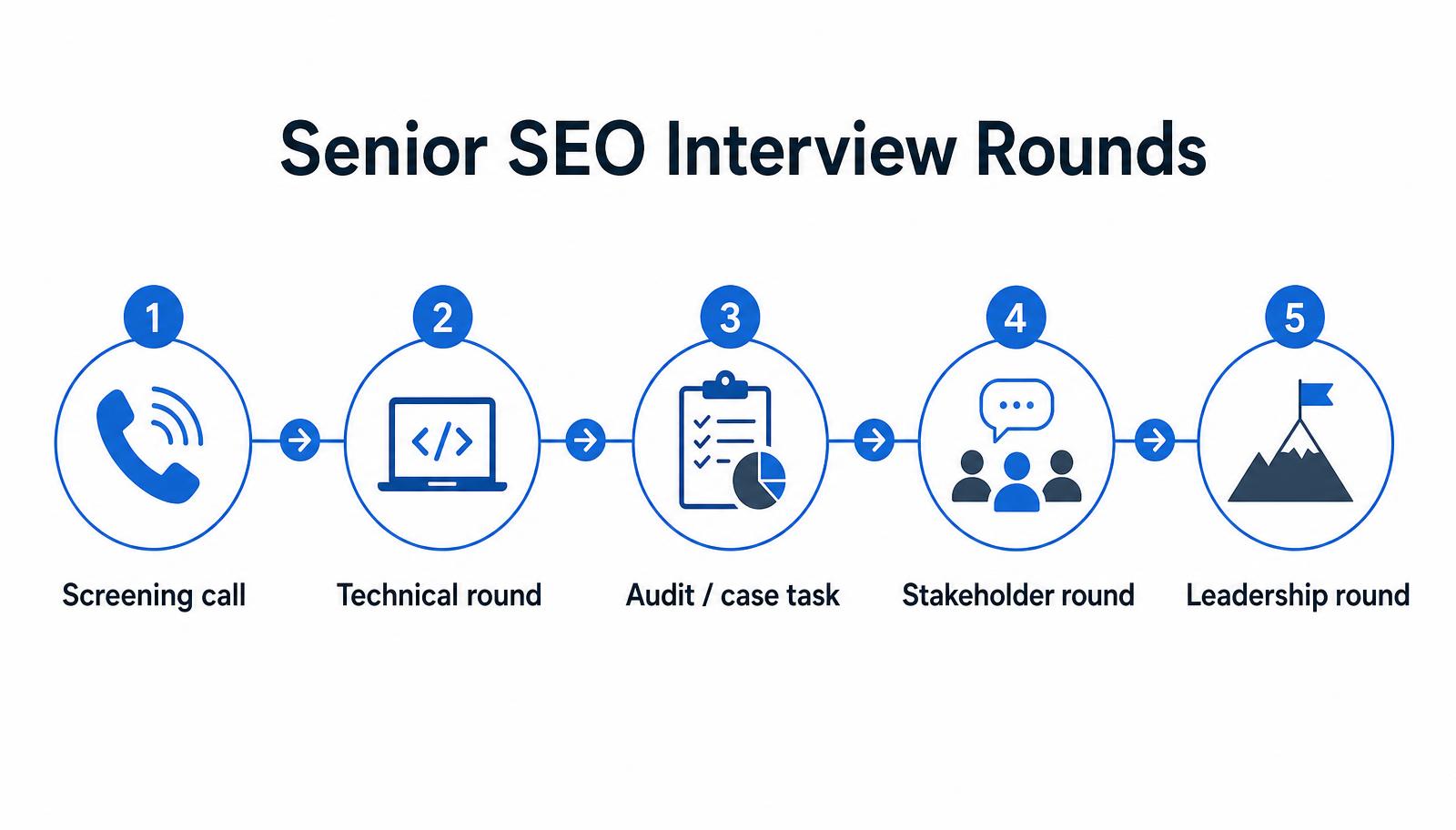
Most processes for a 3–7 year role run four or five rounds, and each one scores something different.
| Round | Who runs it | What they are actually scoring |
|---|---|---|
| Screening | Recruiter or HR | Experience match, salary expectation, notice period, communication |
| Technical round | Senior SEO or Head of SEO | Depth on crawling, indexing, rendering, migrations, diagnostics |
| Audit or case task | Hiring manager | Prioritisation, commercial reasoning, how you think out loud |
| Stakeholder round | Marketing or product leadership | Whether you can influence people who do not report to you |
| Leadership round | Head of Marketing, founder or CMO | Strategy, forecasting, budget reasoning, ownership |
The single most common reason strong practitioners fail is that they answer every round as if it were the technical round. The stakeholder round is not looking for your crawl budget knowledge — it is looking for whether the engineering team will want to work with you.
In every round, ask one clarifying question before answering a scenario. "Is this a 5,000-page site or a 500,000-page site?" instantly signals that you know the answer changes with scale, and it buys you fifteen seconds to structure your response.
The answer framework: Situation, Diagnosis, Action, Result
Use this shape for every scenario question. It is the difference between sounding like someone who reads about SEO and someone who has run it.
- Situation — one sentence of context, including scale. "A 120,000-URL marketplace, organic was 60% of revenue."
- Diagnosis — how you worked out the cause, including what you ruled out and why. This is the step candidates skip and the step interviewers score hardest.
- Action — the specific things you did, in priority order, and who you needed to do them.
- Result — a number and a timeframe. If you genuinely do not have the number, say what you would have measured rather than inventing one.
The diagnosis step is where seniority lives. Anyone can list fixes. Explaining what you eliminated, and on what evidence, is what proves you have actually stood in front of a broken site with a stakeholder asking when it will be fixed.
Test yourself before you read the answers
Before you scroll through 50 model answers, find out where you actually stand. These ten questions are pitched at the level a senior round would use.
No signup, instant score. Answer all 10 and check where you stand.
Technical SEO interview questions
These carry the most weight in the technical round, especially for in-house roles at large sites and for agency roles handling ecommerce or marketplace clients. Each question below is collapsed — try answering it in your head first, then open it to compare.
1How do you know whether crawl budget is actually a problem on a site, and what would you do about it?Show how to answerHide
Most candidates repeat that crawl budget matters. Interviewers want to know if you can tell when it does not, because acting on a non-problem wastes engineering time on a big site.
- State the threshold test: crawl budget rarely constrains sites under roughly 100k URLs unless URLs are being generated dynamically.
- Name your evidence: Search Console crawl stats, server log analysis of bot hits by directory and status code, and the gap between discovered and indexed URLs.
- Describe the fix order — remove the URLs that should not exist, then prevent their crawling, then improve response times and internal linking to what matters.
- Close with how you would prove it worked.
First I check whether it is a real constraint. On a 40,000-URL site it usually is not, and the real problem is quality or internal linking. On a large catalogue site I pull server logs for 30 days and segment bot hits by directory and status code. On one marketplace I found roughly 60% of Googlebot requests going to parameter URLs from sort and filter combinations, and important category pages being crawled once every few weeks. The fix was in order: stop generating the combinatorial URLs in the front end, disallow the remaining parameter patterns, tighten the sitemap to indexable canonical URLs only, and add internal links from high-crawl-frequency hubs to the neglected categories. Within six weeks bot hits on money pages roughly tripled and the average time from publish to indexation dropped from about eleven days to under two.
Recommending crawl-budget work on a small site, or saying 'block it in robots.txt' without noticing that blocked URLs with existing links can still appear in the index and blocked URLs cannot pass or drop signals cleanly.
2Walk me through how you would diagnose a JavaScript rendering issue.Show how to answerHide
Framework-heavy sites are the norm, and this question separates people who have shipped fixes with a dev team from people who have only read about rendering.
- Separate crawl, render and index as three distinct stages and say which stage you are testing.
- Give a concrete tool order rather than a list of tools.
- Explain what you would ask engineering for, in their terms.
I compare the raw HTML response with the rendered DOM. If the content is missing from view-source but present in the URL Inspection live test's rendered HTML, rendering works but is delayed, so the question becomes indexation latency and whether critical content should be server-rendered. If it is missing from the rendered HTML too, I look for blocked resources, client-side routing that requires interaction, a failed API call under Googlebot's conditions, or content behind an event. On one React catalogue, product specifications loaded from an API that failed without a cookie Googlebot never set, so the rendered page had empty spec tables. We moved specs into the server-rendered payload and the affected templates recovered their long-tail rankings within about a month. What I ask engineering for is specific: server-render or pre-render the content that must rank, and keep it in the initial HTML payload rather than behind an interaction.
Saying 'Google renders JavaScript fine now, so it does not matter', or naming five tools without describing what each one would prove.
3A site has 400,000 indexed URLs and only 12,000 real products. How do you fix index bloat?Show how to answerHide
It tests whether you can distinguish between what should exist, what should be crawled, and what should be indexed — three separate decisions people constantly conflate.
- Segment the bloat by URL pattern before proposing anything.
- Apply the right control per segment: remove, noindex, canonical, or disallow — and say why for each.
- Sequence it so signals are not cut off before they are consolidated.
I would export indexed URLs and group them by pattern — parameters, internal search results, thin tag pages, paginated archives, staging or test URLs. Each group gets a different control. URLs with no reason to exist get removed at source and returned as 410 so they drop quickly. Facet and sort parameters that have no search demand get prevented at the link level so they are never crawled, and the existing ones get noindex until they fall out, then disallow. Near-duplicate variants that do have value get canonicalised to the primary. Internal search results get noindexed permanently. The sequencing matters: I never disallow a URL that still needs to be recrawled to see a noindex or a redirect, which is the single most common mistake I see on this job.
Blanket robots.txt disallow as step one, or claiming index bloat directly causes a ranking penalty rather than diluting crawl attention and quality signals.
4How do you handle faceted navigation on a large ecommerce site?Show how to answerHide
Faceted navigation is where technical judgement meets commercial judgement, and it is one of the highest-frequency senior interview topics for retail and marketplace roles.
- Start from search demand, not from technology.
- Define the allowed set explicitly and how it is generated.
- Say how you would stop the combinatorial explosion.
I start with keyword research on facet combinations. If people search 'running shoes size 10' or 'blue cotton kurta', those combinations deserve a real indexable landing page with unique title, intro copy and a stable URL. Everything beyond that — three or more stacked facets, sort orders, view toggles, price sliders — should not be crawlable at all. Practically that means the allowed set is a whitelist generated from a demand list, those pages get clean static-style URLs and internal links, and everything else is rendered without crawlable links, blocked at the parameter level and canonicalised. I also cap it: on one fashion catalogue we allowed around 900 combinations out of a theoretical several hundred thousand, and those pages went on to produce roughly a quarter of non-brand organic revenue.
Answering purely with canonical tags. Canonicals are a hint and do nothing to stop the crawl cost of millions of URLs.
5Who owns Core Web Vitals in your organisation, and how do you get the work prioritised?Show how to answerHide
This is a stakeholder question disguised as a technical one. At 3–7 years you are expected to influence a roadmap you do not control.
- Acknowledge that engineering owns the code and you own the case.
- Translate the metric into money or user behaviour.
- Describe the artefact you take to the prioritisation meeting.
Engineering owns the implementation, I own the business case and the measurement. I never bring a Lighthouse score to a planning meeting. I bring field data from CrUX or our own RUM, segmented by template, and pair it with conversion rate by that segment — for example, that mobile product pages in the poor INP bucket converted noticeably below the ones in the good bucket. Then I bring a shortlist of three specific changes with an engineering estimate attached rather than 'improve performance'. On the last site that got us LCP work into a sprint within two weeks, after six months of it sitting untouched in the backlog as a generic ticket.
Blaming developers, or treating Core Web Vitals as a major ranking lever rather than a tie-breaker and a conversion factor.
6Explain how you would use log file analysis, and what you have actually found with it.Show how to answerHide
Log analysis is claimed on far more CVs than it has been performed on. One concrete finding proves you have done it.
- Say what logs give you that no other tool does.
- Name the segments you build.
- Give one real finding and the action it triggered.
Logs are the only first-party record of what bots actually requested, as opposed to what tools estimate. I segment verified Googlebot hits by directory, template, status code and response time, then compare that against the list of URLs I want crawled. The most valuable thing I have found this way was a legacy directory of expired listings, still linked from a footer element, absorbing a large share of daily bot requests while new listings were taking over a week to be indexed. We removed the links, returned 410s and re-pointed internal linking, and indexation latency for new listings dropped to about a day. I also use logs to confirm that redirects after a migration are actually being followed rather than hitting chains.
Describing log analysis only in theory, or not knowing that Googlebot must be verified by reverse DNS because the user agent is trivially spoofed.
7How do you decide between a 301, a 302, a canonical tag and a noindex?Show how to answerHide
It looks basic, but the follow-up — 'when would you use a 302 deliberately?' — separates people who memorised the definitions from people who have managed real URL changes.
- Frame the choice by intent: is the URL going away, duplicating, or simply not for search?
- Give one deliberate use of the less-common options.
- Mention what each one does not do.
A 301 when the URL is permanently gone and there is a genuine equivalent. A 302 when the change is genuinely temporary and I want the original to keep being indexed — for example a product out of stock for three weeks, or a country page temporarily pointed elsewhere during a promotion. A canonical when both URLs must remain reachable for users but only one should be indexed, such as a product reachable from two categories. Noindex when a page must exist for users but never appear in results, like internal search or account pages. The two things I stress in a team are that canonicals are a hint that gets ignored when the pages differ meaningfully, and that noindex plus disallow together is a bug, because the crawler cannot see the noindex.
Saying 301s pass '100% of link equity' as a rule, or redirecting large numbers of removed pages to the home page instead of a relevant equivalent or a clean 410.
8How do you manage hreflang across 15 country sites?Show how to answerHide
International roles ask this constantly, and it is a governance question as much as a markup question.
- Describe where the annotations live and why.
- Cover reciprocity, x-default and the interaction with canonicals.
- Explain how you keep it correct as pages change.
For a large multi-country setup I keep hreflang in XML sitemaps rather than in the head, because it is generated from one source of truth and does not bloat every page. The rules I enforce are that every annotation is reciprocal, every cluster includes a self-reference, the language-region codes are valid, an x-default exists for the global or selector page, and hreflang always points at canonical, indexable URLs. The failure mode I have seen most is hreflang pointing to a URL that is itself canonicalised elsewhere, which silently invalidates the cluster. Governance is the real answer: I set up an automated weekly crawl that validates reciprocity and flags clusters that break when a market retires a page, because manual checking of 15 markets does not survive contact with a release cycle.
Treating hreflang as a ranking booster or a duplicate-content fix, rather than a serving-and-selection signal.
9Search Console shows a large number of pages as 'Crawled — currently not indexed'. What does that tell you?Show how to answerHide
It is the most misread report in the toolset, and the answer reveals whether you understand quality selection versus technical blocking.
- Say what the status literally means.
- Separate the three usual causes.
- Describe the intervention that actually works.
It means Google fetched the page, evaluated it and chose not to index it, so there is no technical blocker to fix — it is a selection decision. In practice there are three causes. The first is near-duplicate or thin content, where the page adds nothing beyond an existing page, and the fix is consolidation rather than more pages. The second is low discovery value, where the page is barely internally linked and sits deep in the architecture, and the fix is internal linking from real hub pages. The third is site-level quality drag, where thousands of low-value URLs make the engine conservative about the whole domain, and the fix is pruning. I treat a rising count here as a leading indicator that we are publishing faster than we are earning quality.
Recommending mass URL-inspection resubmission or sitemap pinging as the fix, which addresses discovery when the problem is selection.
10How do you approach internal linking at scale, beyond adding a few contextual links?Show how to answerHide
Internal linking is the highest-leverage lever a senior SEO controls without engineering, and interviewers want a systematic answer.
- Define the objective — distributing authority and defining topical relationships.
- Describe the system, not the manual task.
- Say how you measure the effect.
I treat it as a system with three layers. The structural layer is navigation and hub pages, where I make sure every money page is within three clicks of the home page and that hubs exist for each topic cluster. The programmatic layer generates related links from structured relationships — same category, same entity, complementary intent — with rules limiting the number of links per page and preventing orphaning. The editorial layer is manual links from the highest-authority pages to the pages I am actively pushing, which is where I get the fastest movement. To measure it I take a cohort of target URLs, record their average position and impressions before, apply links only to that cohort, and compare against a matched control cohort over the following six to eight weeks.
Talking only about anchor text, or having no way to distinguish the impact of internal linking from everything else happening on the site.
Site migrations, traffic drops and recoveries
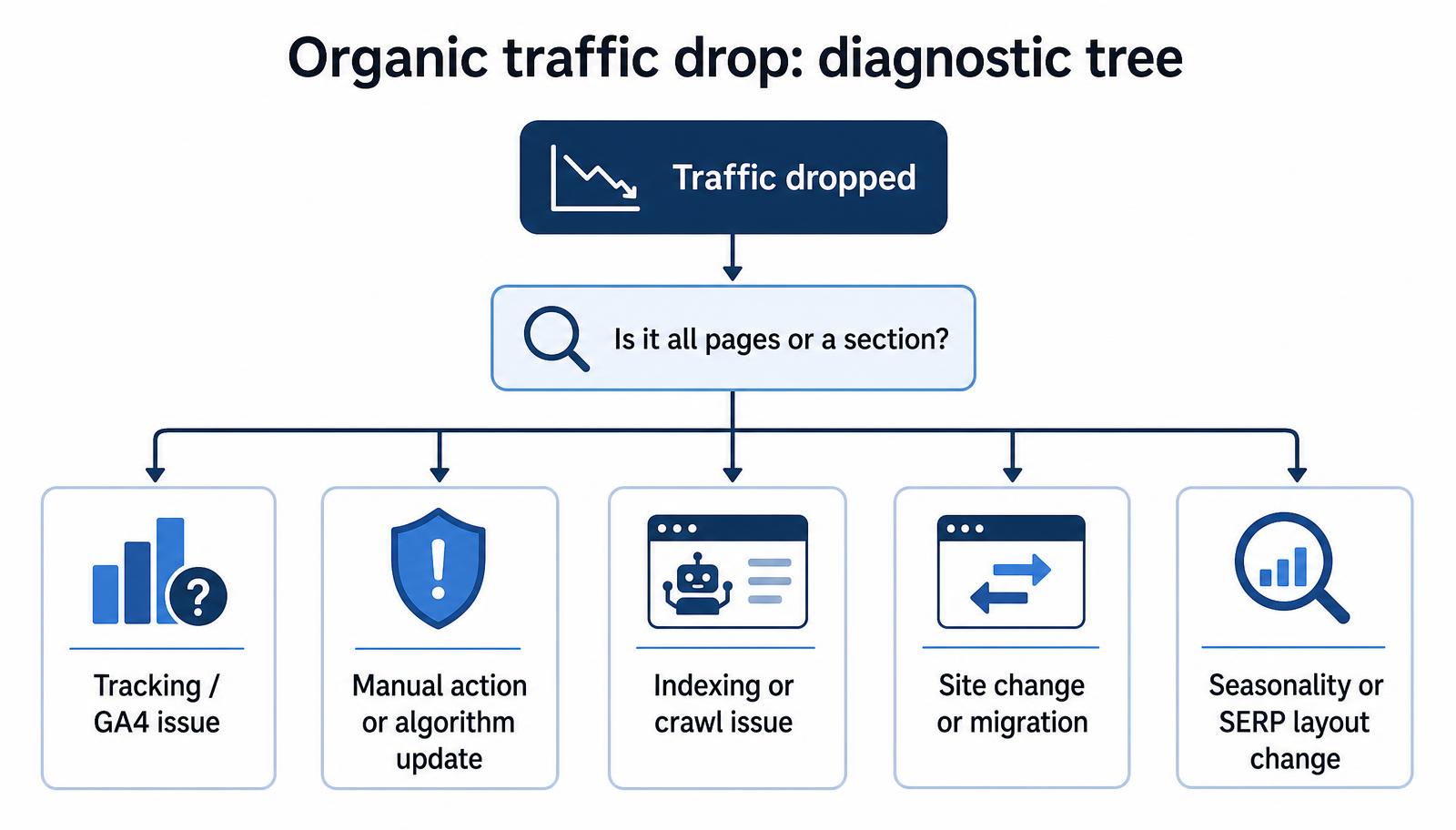
Migration and recovery questions appear in almost every senior interview, because they are the highest-risk projects an SEO owns and the fastest way to see whether someone has real scar tissue.
1Walk me through your site migration plan.Show how to answerHide
Migrations are the highest-risk project an SEO owns. Interviewers use this to test whether you have a repeatable process or have just been present during one.
- Structure it in phases with named deliverables, not as a list of tips.
- Include the pre-launch baseline, because that is what most candidates omit.
- Name your rollback trigger — this is the detail that signals seniority.
Four phases. Pre-launch: a full crawl of the current site, a baseline of rankings, traffic and revenue by template, a list of the top URLs by traffic, revenue, backlinks and conversions, and an inventory of every tracking and verification property. Mapping: a one-to-one redirect map from old to new covering every indexable URL, built from the crawl plus Search Console and log data so nothing that receives clicks or links is missed, with a real equivalent for each rather than a lazy fallback to the home page. Staging QA: crawl staging behind auth, verify redirects, canonicals, titles, structured data, internal links, robots.txt and sitemaps, and confirm the noindex used on staging is definitely removed for launch. Launch and monitor: go live at a low-traffic hour, immediately crawl and spot-check the top 200 URLs, submit new sitemaps, watch server logs for 404s and chains hourly for the first day, then daily comparison of indexation, impressions and revenue for 30 days. My rollback trigger is agreed in writing before launch — for the last one it was a sustained drop beyond a defined threshold in revenue-bearing traffic over 72 hours that was not explained by tracking.
No baseline, redirect chains left in place, or 'we redirected the old sitemap URLs' as the whole mapping strategy.
2Organic traffic dropped 40% two weeks after a migration. What do you do in the first hour?Show how to answerHide
It tests calm, ordered diagnosis under pressure rather than a scattergun of fixes.
- Confirm the drop is real before diagnosing it.
- Move through causes in likelihood order, saying what each check rules out.
- Commit to communicating a timeline, not just a fix.
First I confirm it is real: compare GA4 against Search Console clicks and against server logs, because a broken tag after a migration looks exactly like a ranking collapse. If impressions are down too, it is real. Then I go in order — is the drop sitewide or concentrated in one template or directory, which usually points straight at the cause. I check robots.txt and a sample of pages for a staging noindex that survived launch, which is the single most common cause of exactly this. Then redirect integrity on the top 200 URLs, then canonical correctness, then whether internal linking to key sections was lost in the new navigation, then whether a core update landed in the same window. In the first hour I want the segment identified and the top two hypotheses tested, plus a message to stakeholders that says what I have ruled out and when they will get the next update.
Jumping to 'we need to rebuild content' or 'it is probably an algorithm update' before ruling out self-inflicted causes.
3How do you separate an algorithm update from a self-inflicted drop?Show how to answerHide
It is the diagnostic judgement question, and blaming an update is the classic way to avoid accountability.
- Use timing, shape and scope as three independent tests.
- Mention comparing against competitor visibility.
- Say what evidence would change your conclusion.
Three tests. Timing: does the drop start on a confirmed update date, and is it a step change or a gradual decline? Deployment drops usually align to a release, not to an update window. Shape: an update typically moves a whole class of queries or intent type, while a technical fault usually hits one template, one directory or one device. Scope: if competitors in the same visibility index moved in the opposite direction on the same day, it is an update; if only we moved, it is us. I also always pull the release log for the two weeks before the drop, because in my experience the majority of 'algorithm update' drops turn out to be a deployment. I state the conclusion with the evidence and say what would make me change my mind.
Attributing any drop to an update without checking the release log, or claiming to know the specific factor an update targeted.
4How do you build and validate a redirect map for 50,000 URLs?Show how to answerHide
Scale changes the method, and this reveals whether you have process and tooling or intend to do it by hand.
- Explain how you source the URL list from multiple places.
- Describe matching in tiers, with humans on the valuable tail.
- Cover validation before and after launch.
The URL list is a union of a full crawl, Search Console pages with impressions over 16 months, analytics landing pages, top linked pages from a backlink tool and server logs, deduplicated. Matching happens in tiers: exact slug matches and rule-based pattern rewrites handle the bulk, similarity matching on title and content handles the next layer, and then I manually review the top few hundred by revenue, traffic and links, because those are the ones that cannot be wrong. Anything without a genuine equivalent goes to the closest relevant category, never the home page, and truly obsolete URLs get 410. Validation is a script that requests every old URL and asserts a single 301 to a 200 destination — no chains, no loops, no redirect to a noindexed or canonicalised URL. I run it against staging, then again against production within minutes of launch.
Redirecting everything to the home page for anything unmatched, or ignoring redirect chains because 'they still work'.
5A client wants to move from a subdomain to a subfolder. How do you advise them?Show how to answerHide
It probes whether you can give a commercial recommendation with trade-offs, not a dogmatic rule.
- Give the recommendation and the reasoning.
- Name the risks and the engineering cost honestly.
- Say how you would validate the outcome.
Generally I support the move, because a subfolder consolidates signals into one host and in practice content on the main path tends to benefit from the domain's overall strength. But it is a real migration with real risk, and the reverse-proxy work is an engineering commitment, not a DNS change, so it needs their buy-in before I recommend it. I would size the prize first: how much traffic and revenue the subdomain currently produces and what a realistic uplift would be, against the cost and the risk of a bad execution. If we proceed I run it as a full migration with a baseline and rollback plan, and I measure success as combined traffic across both properties versus the pre-move baseline, not just the new folder's numbers.
Stating 'subfolders always beat subdomains' as a law, with no acknowledgement of the migration risk or engineering cost.
6How long should redirects stay in place after a migration?Show how to answerHide
A small question that tests real-world experience rather than the memorised 'one year'.
- Give the practical minimum.
- Explain what you check before removing any.
- Note the exception for high-value URLs.
At minimum a year, but I do not remove them on a calendar date — I remove them on evidence. Before retiring any redirect I check server logs and Search Console for whether that old URL is still being requested by crawlers or users, and whether it still holds external links. URLs with live inbound links stay redirected indefinitely, because that is free equity and the cost of keeping a rule is close to zero. What I do clean up aggressively is chains, because those accumulate across successive migrations and eventually break.
Removing redirects on a fixed schedule without checking logs or inbound links.
7What is your rollback criteria, and have you ever used it?Show how to answerHide
Very few candidates have one. Having a defined threshold, agreed in advance, is a strong seniority signal.
- Define the metric, the threshold and the window.
- Say who decides.
- Be honest about whether you have invoked it.
I agree it before launch and put it in writing: a defined percentage drop in revenue-bearing organic sessions sustained over a set number of hours, verified against server logs so we know it is not tracking, with the decision made jointly by me and the engineering lead rather than escalated upward in a panic. I have come close once, on a platform replatform where a caching layer served a noindex header to bots for about nine hours. We caught it in the launch-day log monitoring rather than waiting for a traffic drop, fixed the header and did not need to roll back. That is the actual point of the criteria — it forces you to instrument the launch well enough to know within hours instead of within weeks.
No criteria at all, or a criteria based on rankings, which move too slowly to be a launch-day signal.
Content strategy and on-page at scale
1How do you detect and fix keyword cannibalisation?Show how to answerHide
It is one of the most common senior questions, and the weak answer is 'two pages have the same keyword'.
- Define it by engine behaviour, not keyword overlap.
- Give the exact data pull you use.
- Describe the four possible fixes and how you choose.
I define it as the engine being unsure which of our URLs to rank for an intent, so the ranking URL alternates. I find it by exporting the Search Console query-page report and looking for queries where more than one URL has received impressions, then filtering to queries where the ranking URL has changed over time and where average position is stuck outside the top five. Keyword overlap alone is not cannibalisation — a category page and a guide can legitimately target the same term for different intents. When it is real, I choose from four fixes: consolidate the weaker page into the stronger with a 301 if they serve the same intent; differentiate the intent if both deserve to exist, rewriting titles, headings and internal links; canonicalise if the duplication is structural; or fix internal linking, which is often the actual cause because the site links to the wrong URL with the target anchor text. On a B2B site consolidating nine overlapping posts into two guides moved the primary term from around position eleven to the top three within two months.
Deleting pages by default, or treating any keyword overlap as a problem to be eliminated.
2How do you decide what content to prune?Show how to answerHide
Pruning is a judgement call with real downside, and interviewers want to see that you weigh risk, not just delete low-traffic pages.
- Set out the data you assemble per URL.
- Explain the decision tree between improve, consolidate, redirect and remove.
- Mention how you protect against removing something valuable.
For every URL I pull organic sessions, impressions, conversions or assisted conversions, inbound links, internal links, last update date and whether it is indexed. Then it is a decision tree rather than a threshold. Pages with impressions but no clicks get improved, because demand exists and we are losing the click. Pages that overlap another page get consolidated and redirected. Pages with links but no traffic get redirected to the closest relevant page so the equity is kept. Pages with nothing at all — no traffic, no impressions, no links, no strategic purpose — get removed. The safeguard is that I never prune in one big bang: I do it in cohorts, keep the list, and measure the cohort against a control over eight weeks before continuing. I have seen a mass delete take out pages that were quietly assisting conversions.
Deleting everything under a traffic threshold, or expecting a pruning-driven recovery within two weeks.
3What does E-E-A-T mean in practice for a site you have worked on?Show how to answerHide
Almost everyone can recite the acronym. Interviewers want the implementation, especially on YMYL-adjacent sites.
- Reject the idea that it is a score.
- Give concrete on-site artefacts you shipped.
- Connect it to an outcome.
It is not a metric you can optimise directly — it is a description of the evidence a page and a site provide. On a finance site the practical work was: real author profiles with credentials and links to their professional presence, a named reviewer with a qualification and a review date on every money page, sources cited inline to primary documents, a visible editorial policy explaining how content is produced and corrected, business details and registration information available, and first-party data or original calculations on pages that would otherwise repeat what fifty other sites say. The last one matters most. Adding an author box to a page that says nothing original changes nothing.
Claiming E-E-A-T is a ranking factor with a score, or listing schema markup as the solution.
4How would you build topical authority in a competitive niche in twelve months?Show how to answerHide
It tests whether you can produce a strategy with sequencing and prioritisation rather than a content calendar.
- Start from entity and intent mapping, not keyword lists.
- Sequence by winnability, not volume.
- Include the internal architecture and the refresh loop.
I map the topic as entities and the questions a buyer asks across the journey, then group them into clusters with one hub and a set of supporting pages per cluster. Sequencing is by winnability: I start with the clusters where our existing authority already gives us page-two impressions, because those convert into rankings in weeks and buy credibility for the rest of the plan, then move outward to harder clusters. Architecture is decided up front — hub URLs, internal linking rules, and how a new page gets linked from day one rather than being orphaned. Then a refresh loop, where every cluster gets reviewed quarterly against what is actually ranking. Twelve months of that on a mid-size SaaS site took non-brand organic from a small fraction of pipeline to the largest single source, mostly from clusters we did not touch in the first quarter.
Answering with a publishing volume target, or ignoring internal architecture entirely.
5When do you refresh a page versus rewrite it versus leave it alone?Show how to answerHide
Refreshing is fashionable and frequently destroys pages that were working. The question tests restraint.
- Give the diagnostic that decides it.
- Warn about the risk of over-editing.
- Say how you verify the change worked.
The diagnostic is what the SERP is doing versus what the page is doing. If the page is declining while the SERP intent has stayed the same, it usually needs a factual and depth refresh — updated data, more complete coverage, better internal links. If the SERP intent has shifted, for example from informational articles to comparison pages or tools, a refresh is pointless and it needs a rewrite as a different content type. If the page is stable and converting, I leave it alone except for factual accuracy, because I have watched people rewrite a top-three page into position nine chasing a template. Every change gets a date annotation so I can attribute the movement, and I roll out refreshes in batches so I can tell whether the approach is working before applying it to a hundred pages.
Refreshing on a fixed schedule regardless of performance, or changing the URL during a refresh.
6How do you approach programmatic SEO without producing doorway pages?Show how to answerHide
Programmatic is increasingly asked about at senior level, and the line between scale and spam is exactly the judgement being tested.
- State the quality bar per page.
- Describe the demand validation step.
- Say how you would control rollout.
The bar is that each page must contain data or utility that genuinely differs and that a user would want — real inventory, real prices, real comparisons, real availability. If the only thing that changes between pages is the city name in the heading, it is a doorway and it will eventually be treated as one. Before building I validate demand for the pattern by sampling: does 'X in Y' actually get searched across the set, and is there a real result variety in the SERP? Then I roll out in tranches — a few hundred pages first, watch indexation and engagement, and only scale the pattern if those pages get indexed and earn clicks. Pages in the set that stay unindexed after a fair window get removed rather than left to drag on site quality.
Proposing thousands of templated pages on day one, or having no plan for the pages that never get indexed.
7How do you brief and quality-check content when AI tools are in the workflow?Show how to answerHide
Every 2026 team uses AI somewhere. Interviewers want to know where you draw the line and how you keep quality measurable.
- Say where AI helps and where it does not.
- Describe the non-negotiable human inputs.
- Give your QA gate.
AI is good at structure, first drafts, summarising research and generating variations. It is bad at the things that make a page worth ranking — original data, first-hand experience, a real opinion and accurate specifics. So the brief carries the parts a model cannot supply: the target intent and who the reader is, the original data or example we are contributing, the internal links and the entity coverage, and the point of view. QA is a gate, not a vibe check: every factual claim must be traceable to a named source, every statistic must be verified in the primary source rather than a secondary blog, no fabricated quotes or case studies, and a subject expert signs off on anything with commercial or regulatory consequence. I also track a simple quality signal — the proportion of published pages that earn impressions within eight weeks. When that ratio falls, the workflow is producing filler.
Either 'we never use AI' as posturing, or publishing AI drafts with only a plagiarism check.
8A stakeholder wants to target a keyword the SERP clearly does not support. How do you handle it?Show how to answerHide
It is a real weekly situation and tests whether you can say no with evidence rather than authority.
- Show, do not tell.
- Offer the alternative rather than only refusing.
- Agree a way to test cheaply.
I pull the actual SERP and walk through it with them — who ranks, what content type ranks, and what those pages have that we do not. If the first page is entirely marketplaces and our page would be a blog post, the argument makes itself without me being the person saying no. Then I offer the alternative: the adjacent term where the SERP does support our content type, or the different asset we would need to compete for their term. If they still want to try, I agree a bounded test with a defined check-in and a definition of failure, because being right is less useful than keeping the relationship and the roadmap intact.
Refusing on authority alone, or silently agreeing and producing a page you know will fail.
Link building and digital PR
1You have a fixed monthly link budget. How do you spend it?Show how to answerHide
It tests commercial prioritisation and whether you understand that links follow strategy, not the other way round.
- Start from which pages need links and why.
- Split the budget across methods.
- Define how you measure return.
First I decide which pages the links are for. Usually that is a short list of commercial pages that are ranking in positions five to fifteen where competitors have a clear referring-domain gap, plus the hub pages that distribute authority internally. Then I split: roughly half on digital PR or data-led assets that earn links at scale, a quarter on relationship-based placements and partnerships in the niche, and a quarter on reclamation and fixes, which is the cheapest link source almost every site ignores — unlinked brand mentions, broken inbound links pointing at 404s, and links lost during past migrations. I measure by referring domains gained to target URLs and by movement of that cohort against a control, not by total link count.
Buying links at volume with no page-level strategy, or measuring success with a third-party authority score alone.
2How do you evaluate whether a single link is worth pursuing?Show how to answerHide
The lazy answer is a metric threshold. Interviewers want to hear relevance and traffic reasoning.
- Rank your criteria in order.
- Explain why third-party metrics come last.
- Mention the traffic test.
Topical relevance first — would a real reader of that page plausibly be interested in ours? Then placement: an editorial in-content link on a page that gets real traffic beats a sitewide footer link every time. Then whether the site itself receives search traffic, which I check quickly in a visibility tool, because a high authority score with no traffic usually means a network or an expired domain. Then linking-page context: is it a genuine article or a list of outbound links? Third-party authority scores come last, as a sanity filter rather than a decision. The simplest test I apply is whether I would want that link if search engines did not exist.
Using only a DA/DR threshold, or accepting sitewide and footer links as equivalent to editorial ones.
3When would you use the disavow file?Show how to answerHide
It is a trap question. The correct answer is 'rarely', and confidently over-disavowing signals outdated practice.
- State the default position.
- Give the two justified cases.
- Say what you do instead in most cases.
My default is not to use it. Google ignores the vast majority of spam links algorithmically, and disavowing at scale can remove links that were actually helping. I would use it in two situations: an active manual action for unnatural links, where the disavow is part of the reconsideration process, or a documented negative-SEO pattern where a large volume of clearly manipulative links appeared in a short window and correlates with a demonstrable problem. Otherwise I document the profile, monitor it, and put the effort into earning links instead. I have inherited accounts with tens of thousands of disavowed domains added out of caution, which is a liability nobody wants to audit.
Recommending a routine quarterly disavow, or disavowing a whole domain list from a tool's 'toxic' score.
4How do you build links in a boring niche where nobody wants to link to a product page?Show how to answerHide
It tests creativity and realism, and it is common in B2B and industrial roles.
- Accept that the product page is not the linkable asset.
- Name the asset types that work.
- Explain how the equity reaches the money page.
Nobody links to a page selling industrial valves, so I stop trying. The linkable assets are the ones that give journalists, trade publications and practitioners something to cite: original survey or proprietary data from the business, a genuinely useful calculator or specification tool, a standards or compliance explainer maintained better than anyone else's, and the founders' expertise offered as commentary through expert-source platforms and trade press. Those earn the links, and then internal linking moves the authority to the commercial pages. That last step is where most link campaigns quietly waste their budget — they earn links to a blog post that links to nothing important.
Guest posting at volume as the whole strategy, or having no plan to connect linked assets to commercial pages.
5How do you manage an external link-building vendor?Show how to answerHide
At 3–7 years you are likely to be managing budget and vendors, and interviewers want to know you will not get the site penalised.
- Set the approval process.
- Define the metrics and the reporting cadence.
- Name the terms you would not accept.
I insist on approval before placement, not a report afterwards, with the target URL and anchor specified by me. I set the metrics as referring domains to specified target pages, with relevance and traffic criteria written into the contract, and I audit a sample of placements each month for whether they are genuine editorial content or a paid-post farm. Things I do not accept: guaranteed rankings, guaranteed link counts at implausible prices, undisclosed paid placements without appropriate attributes, or link networks where the same set of sites appears across every client. If a vendor cannot tell me who the audience of a placement site is, I do not buy from them.
Paying per link with no approval step, or having no view on whether placements are disclosed paid posts.
6Do links still matter as much as they used to?Show how to answerHide
An opinion question. It tests whether you can hold a nuanced position and support it.
- Give a clear position.
- Support with observed behaviour, not doctrine.
- Say what it means for how you allocate effort.
They still matter, but less as a standalone lever and more as a threshold. In competitive commercial SERPs I still see a clear relationship between referring-domain strength on the specific URL and whether it can break into the top five, so a page with no links usually cannot compete no matter how good it is. But links no longer rescue a page that does not match intent or comes from a site with a weak quality profile, which is why link-first campaigns produce so little now. Practically I allocate the majority of effort to intent match, internal architecture and content quality, and use links deliberately on the small set of pages where a gap analysis says we are otherwise competitive.
Absolutes in either direction — 'links are dead' or 'links are still everything' — with no evidence.
Analytics, forecasting and reporting
1How would you forecast organic revenue for the next financial year?Show how to answerHide
Forecasting is what separates a senior SEO from an executor, and it is increasingly asked because leadership needs a number.
- Describe the model inputs and the maths.
- Be explicit about assumptions and their sensitivity.
- Present ranges, not a single number.
I build it bottom-up per cluster. For each target keyword group: search volume, an assumed achievable position with a timeline, a CTR curve for that position and SERP type, our measured conversion rate for that page type, and average order value or lead value. Multiply through, sum by cluster, and add the baseline from existing pages with a trend applied. Then I make the assumptions visible, because the CTR assumption is where most forecasts break — SERP features and AI Overviews have compressed informational CTR meaningfully, so I use our own Search Console CTR by position rather than a generic table. I always present three scenarios — conservative, expected and stretch — with the specific conditions each requires, such as engineering delivering a template fix by a certain quarter. A forecast that is a single number with no stated conditions is a promise you will be held to.
Using a generic industry CTR table with no reference to the site's own data, or promising a single number.
2GA4 and Search Console disagree. How do you explain that to a stakeholder?Show how to answerHide
It happens weekly, and the ability to explain measurement clearly to non-specialists is a senior requirement.
- Explain that they measure different things.
- Name the specific causes.
- Say which one you use for which decision.
They will never match, because Search Console counts clicks on a result at the search engine, while GA4 counts sessions from a tag firing in the browser. The gap comes from users who bounce before the tag loads, consent choices that block measurement, ad or tracking blockers, redirects that lose the referrer, session timeouts splitting or merging visits, and different date handling and time zones. I explain it once in those terms and then set the convention: Search Console is the source of truth for how search sees us — impressions, clicks, queries and positions — and GA4 is the source of truth for what happens on the site — engagement, conversions and revenue. Trends in both should move together; if they diverge, that divergence is itself the diagnostic signal.
Claiming one tool is 'wrong', or trying to reconcile them to matching numbers.
3How do you attribute SEO to pipeline in a long B2B sales cycle?Show how to answerHide
It tests whether you can survive a CFO conversation where last-click makes SEO look small.
- Acknowledge the limits of last-click.
- Describe the data joins you would build.
- Offer an incrementality approach.
Last-click will always undercount SEO in a six-month cycle, so I stop arguing about it and change the measurement. I capture first-touch channel and landing page on the lead record and pass it into the CRM, so we can report pipeline and closed revenue by first-touch as well as last-touch. I add self-reported attribution on the form, which is crude but catches the dark-social and AI-assistant journeys nothing else sees. Then, for the strongest evidence, I run holdout or phased tests where possible — launching a cluster in one market or one product line before another and comparing pipeline development. I report a range rather than a false precision, and I am explicit that the honest answer is a band, not a decimal.
Reporting only last-click conversions, or claiming precise multi-touch attribution as settled fact.
4What is your reporting stack and what goes in a monthly report?Show how to answerHide
It reveals your audience awareness — junior reports list rankings, senior reports answer business questions.
- Name the stack briefly.
- Describe the structure by audience.
- Say what you deliberately leave out.
Search Console and GA4 feeding a Looker Studio or BI dashboard, with a rank tracker for a curated set and crawl data for technical health. The monthly report has three layers. The top is one page for leadership: organic revenue or pipeline versus target, the trend, and the two things that drove the change. The middle is for marketing peers: performance by cluster and page type, wins, losses and what we are testing. The bottom is the working log for me and engineering: what shipped, what is blocked and what is next. What I deliberately leave out of the leadership page is ranking screenshots and vanity keyword lists, because they invite discussion about positions instead of about revenue and resourcing.
Rankings-first reporting, or one undifferentiated report sent to every audience.
5Which north-star metric would you choose for an SEO team, and why?Show how to answerHide
It tests strategic clarity and whether you can defend a single metric under challenge.
- Pick one and commit.
- Justify why it drives the right behaviour.
- Name the guardrail metrics.
For a commercial site, non-brand organic revenue, or non-brand organic pipeline for B2B. Non-brand matters because branded traffic mostly reflects other channels' work, and including it lets an SEO team take credit for a TV campaign. Revenue rather than sessions because it stops the team optimising for cheap informational traffic that never converts. Then guardrails so the single metric does not get gamed: indexed-page quality ratio, Core Web Vitals field data, and share of revenue concentrated in the top ten URLs, because a number that grows while dependency concentrates is fragile. I would review the guardrails monthly and the north star quarterly.
Choosing total sessions or average rank position, or choosing a metric with no guardrails.
6How do you measure whether an SEO change actually caused the result?Show how to answerHide
Causality discipline is rare and very attractive at senior level.
- Describe cohort testing.
- Mention annotation discipline.
- Be honest about what cannot be isolated.
Wherever the change applies to a set of pages, I split them into a treatment cohort and a matched control cohort with similar traffic and page type, apply the change only to the treatment group, and compare impressions, clicks and position over six to eight weeks. That handles template changes, internal linking and title rewrites well. Sitewide changes cannot be tested that way, so there I rely on tight annotation — every deployment, content release and known update logged on the same timeline — plus a pre-post comparison against a competitor visibility index to control for market movement. And I am upfront when something is unattributable, because claiming causality you cannot evidence is how teams lose credibility after the first bad quarter.
Attributing every improvement to whatever you did most recently, with no control and no annotations.
7Search Console shows impressions up 40% but clicks flat. What is happening and what do you do?Show how to answerHide
A data-interpretation question with several valid causes; interviewers watch whether you enumerate before acting.
- List the plausible causes.
- Say what data distinguishes them.
- Give the action for the most likely one.
Four plausible causes. We started ranking for a broader set of queries at low positions, which adds impressions without clicks. SERP features or AI Overviews expanded on our queries, pushing the organic result down or answering it outright. Our titles and descriptions are no longer matching intent after a rewrite. Or the query mix shifted towards informational terms with naturally lower CTR. I distinguish them by segmenting the report: compare CTR by position band, and compare query sets period over period rather than looking at the aggregate. If CTR at a fixed position has fallen, it is a SERP or snippet problem and I test titles on a cohort. If position has fallen while impressions rose, it is query expansion and the aggregate number is simply misleading, which is worth explaining before someone reports it as a win.
Treating rising impressions as a success by itself, or rewriting every title without segmenting first.
AI search, AEO and GEO questions
This is the section most competing articles do not have, and the section where you can separate yourself fastest in a 2026 interview. Very few candidates have a specific, measured point of view here.
1How have AI Overviews changed your approach to content?Show how to answerHide
The defining 2026 question. Most candidates give a vague answer, so a specific one stands out immediately.
- State the observed effect honestly.
- Describe the strategy shift by intent type.
- Say how you measure it.
The observable effect is that purely informational queries with a simple answer lose clicks, while queries requiring comparison, personal judgement, tools, pricing or recency still send traffic. So the shift is about which intents we invest in. I stop writing definitional posts that an overview answers in a sentence, and shift budget towards pages with something an overview cannot replace — original data, calculators, real inventory or pricing, opinionated comparison and first-hand experience. For the informational pages we keep, I structure them for extraction and citation: a direct answer near the top, clear subheadings matching real questions, structured data, and unambiguous entity and source attribution. I measure it by tracking CTR at fixed positions over time for the query sets where overviews appear, because average CTR sitewide hides the effect.
Claiming AI Overviews have had no effect, or claiming a specific universal percentage drop as fact.
2What is AEO or GEO, and how is it different from SEO?Show how to answerHide
Terminology is fuzzy in the market. Interviewers want to see whether you can cut through hype with a practical definition.
- Define it plainly.
- Say what genuinely differs in the work.
- Say what does not change.
It is optimising to be the source an answer engine extracts and cites, rather than the link a user clicks. What genuinely differs is the unit of optimisation: the extractable passage rather than the page, and being attributable rather than merely ranking. In practice that means self-contained answers that make sense lifted out of context, consistent entity naming so a model can connect us to the topic, structured data and clean semantic HTML, corroboration of our facts across other sources the model trusts, and machine-readable summaries of the site. What does not change is the foundation — the page still has to be crawlable, fast, accurate and genuinely useful, and most of what is sold as GEO is standard content quality work with a new label.
Presenting AEO as a wholly separate discipline with proprietary tactics, or dismissing it entirely.
3How do you measure traffic from ChatGPT, Perplexity and other AI assistants?Show how to answerHide
Very few candidates have set this up. Having done it is a strong differentiator.
- Name the referral sources and their limits.
- Describe segmentation in analytics.
- Mention the qualitative signal.
Some of it arrives as identifiable referrals, so the first step is a GA4 exploration or channel group that isolates known AI assistant referrers, tracked over time as a share of sessions rather than an absolute. But a large share is invisible, because users read the answer and later arrive direct or via a branded search, so I also watch branded search volume and direct traffic for correlated growth. The qualitative signal that matters most is self-reported attribution on forms, which is the only place I have seen users say plainly that an assistant recommended us. And I periodically test the queries we care about in the main assistants to see whether we are cited at all, which is a crude but honest visibility check. I present all of it as directional, because pretending to precise measurement here is not credible.
Claiming full measurement of AI-referred traffic, or having no measurement approach at all.
4Would you add an llms.txt file, and what would you put in it?Show how to answerHide
A current, practical question that shows whether you follow the ecosystem or only the classic playbook.
- Give a proportionate recommendation.
- Describe the content.
- Be honest about adoption.
Yes, because the cost is close to zero and it is a clean, machine-readable summary of what the site is and where the important pages are. I would include what the organisation does, the key pages with a one-line description each, the core products or services, key facts a model would need to describe us accurately, and contact details. I would keep it truthful and current, because the risk is a stale file misrepresenting the business. What I would not do is present it as a ranking tactic — adoption across engines is uneven and it is a supporting signal, not a lever. I would pair it with the things that genuinely help extraction: structured data, consistent entity naming and clear on-page answers.
Overstating its impact, or not knowing what it is at all in a 2026 senior interview.
5How do you keep quality control when a content team is producing at AI-assisted speed?Show how to answerHide
Managing output quality at volume is now a core senior responsibility.
- Name the failure modes you are guarding against.
- Describe the gates.
- Give a measurable quality signal.
The failure modes are fabricated facts, invented sources, generic content that adds nothing, and duplicated angles across pages. The gates are: a brief that specifies the original contribution before writing starts, a fact-check step where every statistic is traced to a primary source, a subject-expert sign-off on anything with commercial or regulatory consequence, and a cannibalisation check against existing pages before publishing. The measurable signal I track is the proportion of newly published pages that earn impressions within eight weeks and clicks within twelve. When that ratio starts falling, we are producing volume without value, and I slow publishing down rather than defend the number.
Relying on AI-detection tools as the quality gate, or having no measurable definition of quality.
6If AI answers keep taking clicks, what is the long-term case for investing in SEO?Show how to answerHide
A strategic, slightly adversarial question. It tests composure and commercial thinking.
- Concede the real change.
- Reframe the objective.
- Give the practical investment implication.
The change is real for informational traffic, and I would not pretend otherwise in a board conversation. But the objective was never clicks, it was being present and trusted at the moment someone decides. Search engines and answer engines both need sources, and both preferentially use content that is well-structured, corroborated and demonstrably authoritative — which is the same work. So the investment case shifts from traffic volume to two things: owning the commercial and comparison intents where users still click because they need to evaluate and buy, and being the cited source on the informational intents so we shape the answer even when there is no click. Practically that means less thin informational publishing, more original data, tools, and product and category pages that actually deserve to rank.
Panic ('SEO is dying') or denial ('nothing has changed'). Both read as a lack of judgement.
Strategy, stakeholders and leadership
For anyone targeting a Lead or Manager title, these questions decide the offer. Technical depth gets you through round two; these get you the role and the salary band.
1How do you build a 12-month SEO roadmap?Show how to answerHide
It tests whether you can plan against constraints — engineering capacity, content budget, commercial priorities — rather than list tasks.
- Start from business goals and constraints.
- Structure by horizon.
- Include how the plan changes.
I start with the commercial target and the constraints, because a roadmap that assumes unlimited engineering time is fiction. Quarter one is foundations and fast wins: fix what is actively costing us — indexation, template issues, cannibalisation — and ship the changes that can be done without engineering, mainly internal linking and on-page. Quarter two is the growth engine: the priority content clusters and the template improvements that needed engineering time secured in quarter one. Quarter three scales what worked and adds links and digital PR to the pages that a gap analysis says are close. Quarter four consolidates, prunes and plans the next year. Every item carries an owner, an estimate and an expected impact range, and the whole plan gets re-forecast quarterly, because a roadmap that has not changed in nine months is not being managed.
A list of tasks with no sequencing rationale, no dependencies and no engineering constraint acknowledged.
2How do you get engineering to prioritise SEO work?Show how to answerHide
This is the single biggest practical blocker for in-house SEOs, and hiring managers know it.
- Describe how you translate the ask.
- Mention relationship and process, not just the ticket.
- Give a concrete example.
Three things have worked consistently. First, I write tickets in their language with the acceptance criteria, the affected templates and the expected effort, not 'fix crawl budget'. Second, I attach a quantified outcome — 'this template accounts for 30% of organic revenue and this change addresses the reason it converts below the rest' — so it competes on the same terms as everything else in the backlog. Third, I get into the planning process rather than sending requests at it: attending refinement, having a standing small allocation for SEO work, and building one relationship with a senior engineer who will tell me honestly what is cheap and what is not. That last one changed more outcomes than any document. On my last team, reframing a technical fix as a conversion problem got a six-month-old ticket delivered in one sprint.
Escalating to management as the first move, or blaming engineering for not caring about SEO.
3A founder insists on a change you believe will hurt organic performance. What do you do?Show how to answerHide
It tests disagreement skills, which is exactly what senior hires are expected to bring.
- Separate the objective from the tactic.
- Bring evidence and a bounded alternative.
- Say what you do if overruled.
I try to understand the objective behind the request first, because usually the goal is reasonable and only the tactic is wrong, and once I know the goal I can propose a route that achieves it without the damage. Then I make the risk concrete — which pages, how much traffic and revenue, over what timeframe — rather than saying it is bad for SEO. If they still want it, I ask for a bounded version: one section rather than the whole site, with a defined review point and an agreed measure of failure, and I make sure we have a rollback path. If I am overruled entirely, I document the risk once, calmly and without drama, commit to the decision, and instrument the measurement so we can see quickly whether I was right. Being unmanageably right is worse for the site than being wrong occasionally.
Either caving instantly or digging in on authority. Both are disqualifying at senior level.
4How do you manage and develop a junior SEO?Show how to answerHide
Lead and manager roles need evidence you can multiply your output through others.
- Describe how you delegate.
- Explain your review approach.
- Give a development structure.
I delegate whole outcomes rather than isolated tasks — 'own the cannibalisation programme for this section' rather than 'export this report' — because ownership is where judgement develops. I review the reasoning, not just the deliverable: I ask what they ruled out and why, which surfaces gaps a corrected spreadsheet never would. Development is structured around a simple skills map covering technical, content, analytics and stakeholder skills, with one deliberate stretch area per quarter and a real project attached to it. And I make them present their own work to stakeholders, because at 3–7 years the ceiling is almost never technical skill, it is the ability to make a case to someone who does not care about SEO.
Describing management as task assignment and quality checking, with no development structure.
5SEO budget is being cut. How do you respond?Show how to answerHide
It tests commercial maturity and whether you can prioritise ruthlessly instead of pleading.
- Do not argue first — quantify.
- Present the trade-off in their terms.
- Show what you would protect.
I do not open with an argument for keeping the budget. I open with what the current spend produces — revenue or pipeline from non-brand organic, and the cost per acquisition compared with paid — because if that comparison is favourable the conversation usually changes on its own. Then I present the cut as a set of trade-offs rather than a single number: at the reduced budget, here is what we stop, what it costs in forecast revenue, and when that shows up, since SEO losses arrive quarters later, which is exactly why it gets cut first. And I make clear what I would protect above everything else: technical health and the existing top revenue pages, because losing those is expensive and slow to reverse, while pausing new content is recoverable.
Arguing that SEO is free traffic, or refusing to prioritise and insisting nothing can be cut.
6Tell me about an SEO project that failed.Show how to answerHide
Interviewers ask this to check self-awareness. A candidate with no failures at 3–7 years is either lying or has not owned anything.
- Choose a real, meaningful failure.
- Own your part specifically.
- State the change you made afterwards.
I ran a large content refresh on a site where around 200 posts were rewritten in one release. Traffic to that cohort dropped roughly a fifth and took months to recover. The failure was mine in two ways: I changed too many variables at once, so I could not tell which change caused what, and I did not run a control cohort, so I could not even prove the loss was the refresh rather than a broader movement. What changed afterwards is now a rule I bring to any team: content changes ship in cohorts with a matched control, and no more than a defined batch size in a single release. The next programme on that site, run that way, produced a measurable gain and I could actually attribute it.
A fake failure ('I cared too much about quality'), or blaming the client, the developers or an update.
7Where do you want to be in three years, and what kind of SEO role suits you?Show how to answerHide
At 3–7 years, retention is a genuine concern. They are checking whether the role matches your trajectory.
- Be specific about the direction.
- Tie it to what this role offers.
- Be honest rather than flattering.
I want to move further into owning outcomes rather than executing channels — a role where I set the organic strategy, forecast it, and work directly with product and engineering on what gets built, with a small team I develop. What appeals here is that the role sits close to the product decisions rather than sitting downstream of them, which is where SEO either works or does not. What I would want to understand is how the roadmap is owned and how much engineering capacity organic realistically gets, because that determines whether the role is strategic in practice or only on paper.
A generic answer with no direction, or a direction obviously unrelated to the role on offer.
The live audit task: how to handle 20 minutes on an unfamiliar site
Most senior processes include a practical task. The format varies — a live screen share, a Search Console export, or a written audit — but the scoring is consistent, and it is not "how many issues did you find".
Minutes 0–2: ask about the business. What makes money, which pages drive it, and what has changed recently. Candidates who start crawling immediately lose points here, because every prioritisation decision afterwards is guesswork without it.
Minutes 2–6: establish the shape of the site. How many URLs, what templates exist, how it is built, what the index looks like in Search Console. Scale determines which problems matter.
Minutes 6–15: diagnose in priority order. Indexation and crawl health of money pages first, then template-level on-page issues, then content and intent match, then links. Say out loud why you are looking at each thing.
Minutes 15–20: prioritise and present. Give three to five recommendations ranked by impact, effort and confidence, and say which one you would ship first and what you would expect it to do. Finish by naming what you would need to check that you could not in twenty minutes.
Interviewers score the order of your reasoning and your ability to say "I do not know yet, here is how I would find out" far more than the completeness of your findings. A candidate who lists 30 issues with no ranking almost always loses to one who names four and explains why those four come first.
How to rate your own answers before the interview
Record yourself answering five questions from this article and score each one against this rubric. Anything below 4 needs rework.
| Score | What it sounds like |
|---|---|
| 1 | A definition. Correct, but anyone could say it. |
| 2 | Best practice advice, in the abstract. No sign you have done it. |
| 3 | A real example, but no diagnosis and no numbers. |
| 4 | Situation, diagnosis and action, with a specific outcome described. |
| 5 | All of the above plus what you ruled out, what it cost, and what you would do differently. |
The jump from 3 to 4 is almost always the diagnosis step. The jump from 4 to 5 is honesty about trade-offs.
Salary ranges for experienced SEO roles in India (2026)
These are indicative market ranges, not guarantees, and they vary widely by city, company type and whether the role is in-house or agency.
| Role | Experience | Typical range (India) |
|---|---|---|
| Senior SEO Executive | 3–4 years | ₹6–10 LPA |
| SEO Specialist / Technical SEO | 4–6 years | ₹9–15 LPA |
| SEO Lead | 5–7 years | ₹12–18 LPA |
| SEO Manager | 6–8 years | ₹15–25 LPA |
| Organic Growth / Content + SEO Lead | 6–8 years | ₹18–30 LPA |
What moves you to the top of a band, in rough order of impact: demonstrable revenue ownership rather than traffic ownership, technical depth that reduces dependence on engineering, forecasting and analytics fluency, and experience at the scale the hiring company operates at. Product companies and global in-house roles pay materially above agency benchmarks for the same years of experience. If you are also comfortable with paid channels, the performance marketing salary bands sit alongside these and open a wider set of roles.
Ten questions to ask your interviewer
Asking nothing, or asking only about growth opportunities, reads as junior. These ten signal that you think about delivery.
- Who owns the organic roadmap, and who can veto it?
- How much engineering capacity does organic realistically get per sprint?
- How is SEO success measured internally, and by whom?
- How do content and SEO work together — same team, or separate?
- What happened with the last person in this role?
- What is the biggest technical constraint on the site right now?
- Is there a forecast for organic this year, and who built it?
- How are content decisions made when SEO and brand disagree?
- What would make the first six months a clear success?
- What is the one thing you are hoping this hire fixes?
Your 14-day preparation plan
Tick these off as you go — your progress is saved in this browser.
Ticks are saved in this browser — come back and pick up where you left off.
The plan behind that checklist runs in the same order as the prep steps outlined for this article: build your evidence bank first, then technical depth, then diagnostics, then numbers, then stakeholder stories, and only then mock interviews. Most people do it backwards and spend two weeks re-reading technical documentation they already know while never once rehearsing the story about how they got a ticket into a sprint.
Where to go next
If you're earlier in your career, our guide to SEO jobs in India covers roles, salaries and how to get hired, and SEO vs AEO vs GEO explains how AI Overviews and assistants are changing search work.
If your target roles combine organic with paid, the performance marketing interview questions and Google Ads interview questions guides cover the paid side at the same depth, and the broader digital marketing interview questions guide covers the full-discipline screening round. For how the two channels fit together in a strategy answer, read SEO vs performance marketing, and for the measurement questions that come up in both, conversion tracking explained.
Live openings for senior SEO and performance marketing roles in India are listed on our jobs board, and if you want to add paid media and analytics to your organic skill set, the AI-powered performance marketing curriculum covers Google Ads, Meta Ads, GA4 and GTM with live client projects.
Glossary
- Crawl budget
- The number of URLs a search engine is willing and able to crawl on your site in a given period, shaped by crawl rate limit and crawl demand. It only becomes a real constraint on large sites, typically hundreds of thousands of URLs or more.
- Log file analysis
- Reading raw server access logs to see exactly which URLs search engine bots requested, how often, and what status codes they received — the only first-party record of real crawler behaviour.
- Keyword cannibalisation
- Two or more pages on the same site competing for the same query intent, so the search engine keeps swapping which one it ranks and neither builds authority.
- Index bloat
- A large number of low-value URLs in the index — parameter variants, thin tag pages, internal search results — diluting crawl attention and site quality signals.
- Hreflang
- Markup that tells search engines which language and regional version of a page to serve, requiring reciprocal annotations across all variants plus an x-default.
- INP (Interaction to Next Paint)
- The Core Web Vitals responsiveness metric, measuring the latency from a user interaction to the next visual update; the 75th-percentile field value is what counts.
- Topical authority
- The depth and internal connectedness of a site's coverage of a subject area, built through comprehensive entity coverage and internal linking rather than a single page.
- AI Overviews
- Google's generative answer block at the top of some results, which can reduce click-through on informational queries while surfacing cited sources.
- AEO / GEO
- Answer Engine Optimisation / Generative Engine Optimisation — structuring content so answer engines can extract, attribute and cite it, through direct answers, clear entities, structured data and machine-readable summaries.
- Disavow
- A Search Console file telling Google to ignore specified inbound links. Rarely needed today and only justified when a manual action or a genuine unnatural-link pattern exists.
- Programmatic SEO
- Generating large numbers of pages from a structured data source against a repeatable query pattern, where the quality bar is unique useful data per page, not a spun template.
Sources & Further Reading
- Google Search Central — Large site owner's guide to managing crawl budget
- Google Search Central — Site moves with URL changes
- Google Search Central — Fix search-related JavaScript problems
- Google Search Central — Creating helpful, reliable, people-first content
- Google Search Central — Intro to structured data markup
- Google Search Console Help — Page indexing report
- web.dev — Core Web Vitals
Frequently Asked Questions
What SEO interview questions are asked for 3–7 years of experience?+
At 3–7 years the questions are scenario-based rather than definitional. Expect traffic-drop diagnosis, site migration planning, crawl budget and index bloat on large sites, keyword cannibalisation detection, content pruning decisions, organic revenue forecasting, attribution in long sales cycles, AI Overviews impact, and stakeholder questions about winning engineering time and defending budget. Interviewers assume you know the terminology and are testing judgement and ownership.
How should I structure answers in a senior SEO interview?+
Use Situation, Diagnosis, Action, Result. State the context in one sentence, explain how you worked out the cause and what you ruled out, describe the specific actions you took, and finish with a measured outcome including a number and a timeframe. The diagnosis step is what most candidates skip, and it is the part that demonstrates seniority.
What is the most common mistake experienced SEO candidates make?+
Answering with best practices instead of with decisions they personally made. Saying 'you should always fix redirect chains' is a textbook answer; saying 'I found 4,000 chained redirects from two previous migrations, prioritised the 300 with inbound links, and indexation latency dropped' is an interview-winning one. The second mistake is claiming credit without numbers.
Do senior SEO interviews include a practical task?+
Most do. The common formats are a 20-minute live audit of an unfamiliar site while thinking out loud, a take-home analysis of a Search Console export, or a case presentation of a project you have run. Interviewers score prioritisation more than volume of findings, so establish the business model and the money pages before listing issues.
What salary can an SEO with 3–7 years of experience expect in India?+
Typical market ranges in 2026 are roughly ₹6–10 LPA for a Senior SEO Executive with 3–4 years, ₹10–16 LPA for an SEO Lead or Manager with 5–7 years, and higher for in-house roles at product companies or for candidates with strong technical SEO and analytics skills. Metro locations, in-house product roles and demonstrable revenue ownership push the range up. These are indicative market ranges, not guarantees.
How do I answer questions about AI Overviews and AEO?+
Give a specific position rather than a hedge. Acknowledge that informational queries with simple answers have lost clicks while comparison, transactional and tool-based intents still convert, explain the on-page changes you would make for extraction and citation, and describe how you would measure AI-referred traffic through referral segmentation, branded search trends and self-reported attribution. Say plainly that the measurement is directional.
Should I prepare a portfolio or case study for an SEO interview?+
Yes. A one-page case study with baseline numbers, the actions you took and the measured result is the single most effective preparation item, because it converts claims into evidence. Anonymise client names if required, keep the metrics honest, and be ready to explain what you would do differently.
What questions should I ask the SEO interviewer?+
Ask who owns the organic roadmap, how much engineering capacity SEO realistically receives per sprint, how SEO success is measured internally, how content and SEO work together, what happened with the previous person in the role, and what would make the first six months a success. These signal that you think about delivery constraints, not just tactics.
Join our live training program and become a performance marketing professional.