Performance Marketing Certification in India (2026): Free & Paid Options Compared
Which performance marketing certification is worth it in India? A detailed comparison of free Google Skillshop and GA4 certificates, paid Meta certification exams and course certificates, what employers actually check, costs, time needed and how to combine a certificate with real proof.
- 01What a performance marketing certification actually proves
- 02Type 1: Google Ads certifications (free)
- 03Type 2: Google Analytics certification (free)
- 04Type 3: Meta certifications (paid)
- 05Type 4: Course certificates
- 06Comparison: which certification should you get?
- 07What recruiters actually check
- 08The best combination for freshers (a 60-day plan)
- 09Is a certification worth it for experienced marketers?
- 10Free vs paid: is it worth paying?
- 11Getting certified with live practice
We'll email you our Performance Marketing Setup Checklist instantly.
No spam. Unsubscribe anytime.
Search "performance marketing certification" and you'll find dozens of options: free Google badges, paid Meta exams, online courses with certificates and expensive diplomas. It's hard to tell which ones employers respect and which are just paper. This guide explains each type, what it costs, how long it takes, what recruiters actually check and how to combine certificates with the proof that gets people hired.
What a performance marketing certification actually proves
Performance marketing means running ads where every rupee is measured against a result: a lead, a sale, an app install. The main platforms in India are Google Ads and Meta Ads (Facebook and Instagram), supported by analytics tools such as Google Analytics 4.
A certification proves one of two things:
- Platform knowledge. You understand how a platform works: campaign types, bidding, targeting, measurement. Google and Meta certificates prove this.
- Completed training. You finished a structured programme. A course certificate proves this, and its value depends entirely on what the course made you do.
Neither proves you can take ₹50,000 of a client's money and turn it into profitable leads. That's why the smartest approach is to treat certificates as a foundation and build real proof on top.
Type 1: Google Ads certifications (free)
Google offers several Google Ads certifications on Google Skillshop, including:
| Certification | What it covers | Who needs it |
|---|---|---|
| Google Ads Search | Keywords, match types, ad copy, bidding, Quality Score | Everyone starting in performance marketing |
| Google Ads Display | Display network, audiences, responsive display ads | Brand and remarketing roles |
| Google Ads Video | YouTube ads, video campaign formats | Video-heavy brands, agencies |
| Shopping Ads | Merchant Center, product feeds, Shopping and Performance Max | E-commerce roles |
| Google Ads Apps | App install and engagement campaigns | App and gaming companies |
| Google Ads Measurement | Conversion tracking, attribution, measurement tools | Analysts and senior roles |
How it works, step by step
- Create a free Skillshop account with your Google account.
- Pick a certification (start with Search).
- Study the learning path: short modules with videos and text.
- Take the online assessment. You need a passing score, and you can retake it if you fail after a waiting period.
- Download your certificate and add it to LinkedIn.
Certificates are typically valid for one year, then you retake the assessment. That's actually useful: it shows employers your knowledge is current.
Worked example
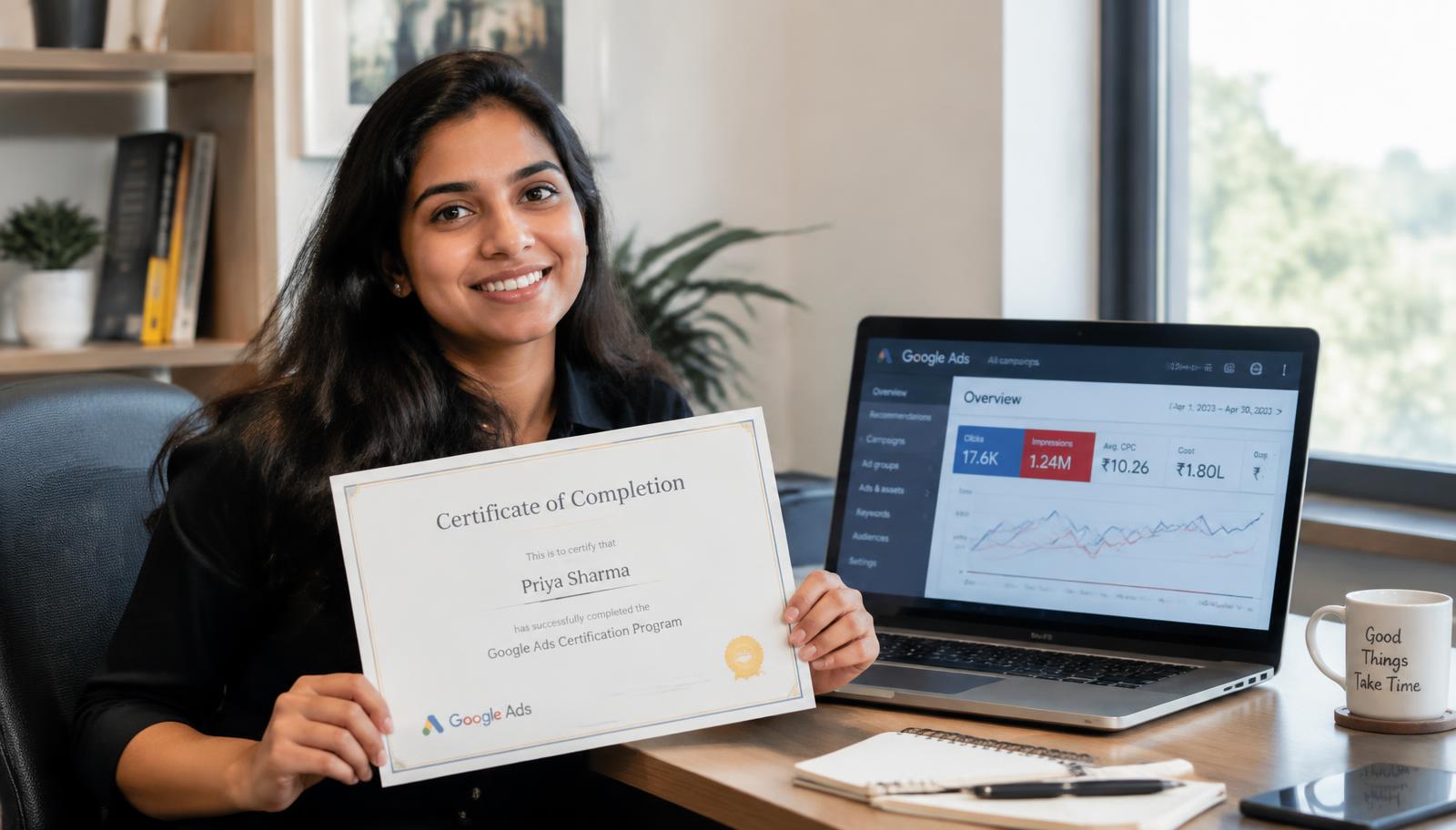
Priya, a BCom graduate in Hyderabad, spends 45 minutes a day for 10 days on the Google Ads Search path, passes, and adds it to LinkedIn. It won't win her a job alone, but it moves her resume past filters that search for "Google Ads certified", and gives her the vocabulary to talk confidently in interviews.
Common mistakes
- Memorising answers from dumps instead of learning. Interviewers ask the same concepts in their own words, and you'll be exposed quickly.
- Collecting all six certificates before running a single campaign. Two certificates plus one real project beats six certificates and nothing else.
Type 2: Google Analytics certification (free)
The Google Analytics certification on Skillshop covers GA4: events, conversions, reports, audiences and how to read data. Performance marketers live inside analytics, so this certificate pairs naturally with Google Ads.
Why it matters: the most common reason campaigns fail is bad tracking, not bad ads. If you can show you understand events, conversions and attribution, you instantly stand out from applicants who only know how to launch campaigns. Our complete conversion tracking guide explains the practical side.
Type 3: Meta certifications (paid)
Meta Blueprint offers free learning courses on Facebook and Instagram advertising. Separately, Meta offers professional certification exams (for example, for media buying and marketing science). These are paid, proctored and harder than Google's assessments.
Should you take one?
- Yes, if you're applying for Meta-heavy roles (D2C brands, e-commerce, lead generation for real estate and education) and you've already run Meta campaigns.
- Not yet, if you're a complete beginner. Learn with the free Blueprint courses and practise with a small budget first, otherwise you'll pay to fail.
Always check the current exam fee and format on Meta's official certification page before registering; they change over time.
Type 4: Course certificates
A course certificate from a training institute or online programme proves you finished that programme. Its value depends on three questions:
- Did you build live campaigns? Recorded-video courses rarely make you spend real money on real ads. Live, practical courses do.
- Did a practitioner teach it? Trainers who manage ad spend today teach what works now, not what worked three years ago.
- Did you leave with a portfolio? Campaign screenshots, an account audit, a tracking setup and a results write-up are what you'll show in interviews.
A course that ticks all three is worth more than any single platform badge, because it produces the proof employers ask for. A course that only hands you a PDF certificate is worth very little.
Comparison: which certification should you get?
| Option | Cost | Time (part-time) | Employer weight | Best for |
|---|---|---|---|---|
| Google Ads Search | Free | 1–2 weeks | High as a filter | Everyone |
| Google Analytics | Free | 1–2 weeks | Medium–high | Everyone |
| Other Google Ads certificates | Free | 1 week each | Medium | Specialised roles |
| Meta certification exam | Paid | 3–6 weeks with practice | High for Meta roles | People with Meta experience |
| Practical live course | Paid | 6–8 weeks | High when projects are real | Beginners wanting structure and proof |
What recruiters actually check
We talk to many hiring managers through our placement support. The pattern is consistent:
- Resume scan (10 seconds). Are "Google Ads", "Meta Ads", "GA4" and a certification visible? This is where certificates help most.
- Screening call. Can you explain CPC, CTR, conversion rate, CPA and ROAS in simple words?
- Practical round. You're given a scenario ("CPA doubled last week, what do you check?") or asked to audit a sample account.
- Portfolio discussion. Walk us through a campaign you ran: objective, audience, budget, tracking, results, what you'd change.
Certificates help you pass step 1. Steps 2–4 are about practical skill. See our performance marketing interview questions to prepare.
The best combination for freshers (a 60-day plan)
Days 1–14: Complete Google Ads Search certification. Read what is performance marketing to understand the big picture.
Days 15–28: Complete Google Analytics certification. Set up GA4 on a free website or a friend's business site.
Days 29–45: Run a small real campaign (₹3,000–5,000) on Google or Meta for a local business or your own project. Track conversions properly.
Days 46–60: Write a one-page case study: goal, setup, spend, results, learnings. Build a simple portfolio. Our portfolio guide shows examples.
At the end you have two recognised certificates and something far more convincing: a campaign you can explain.
Is a certification worth it for experienced marketers?
Yes, for different reasons. If you come from SEO, social media or sales, a Google or Meta certificate signals you're serious about paid media. For people already running ads, the Measurement and Meta exams help with promotions and client trust, especially at agencies where certifications also count towards Google Partner status.
Free vs paid: is it worth paying?
Pay for what you can't get free: structure, feedback and real practice. Platform knowledge is free on Skillshop and Blueprint. What people pay for in a good course is a trainer who reviews their campaigns, live classes where they can ask questions, a real budget to practise with and help turning that work into a portfolio and job applications.
If you're disciplined and can find a business to practise on, the free route works. If you want a faster, guided path, a practical course saves months.
Getting certified with live practice
Our Performance Marketing Course is a live, 6-week programme covering Google Ads, Meta Ads, conversion tracking and analytics, where you build real campaigns and prepare for the Google certifications along the way, with a PMAcademy course certificate on completion. The AI Digital Marketing Course is an 8-week programme that adds SEO, AI tools and more, with placement support; full costs are on the fees page. If you want to see how we teach first, join the free masterclass on Friday, 2 October 2026, 8:00–9:00 PM IST, and browse current openings on our jobs page.
Glossary
- Google Skillshop
- Google's free training platform where you study for and take Google Ads and Google Analytics certification exams.
- Meta Blueprint
- Meta's learning platform for Facebook and Instagram advertising. Its courses are free; its certification exams are paid and proctored.
- CPA
- Cost per acquisition: ad spend divided by the number of conversions (leads, sales or sign-ups).
- ROAS
- Return on ad spend: revenue from ads divided by ad spend. A ROAS of 4 means ₹4 of revenue for every ₹1 spent.
- Conversion tracking
- Setting up tags or pixels so the ad platform knows when a click turns into a lead or sale.
- Proctored exam
- An exam monitored by webcam or at a test centre, so the result is harder to fake and more trusted.
Sources & Further Reading
Frequently Asked Questions
Which certification is best for performance marketing?+
For India, start with Google Ads Search and Google Analytics (both free on Skillshop), then add a Meta certification once you have hands-on Meta Ads experience. Together they cover the two platforms that most performance marketing job descriptions ask for.
Is Google Ads certification free?+
Yes. Google Ads and Google Analytics certifications are free on Google Skillshop. You study the free modules, take an online assessment and receive a certificate that is typically valid for one year, after which you retake it.
Are Meta certifications free?+
Meta Blueprint learning courses are free, but Meta's professional certification exams carry a fee. Check the current price on Meta's certification page before you register, because it changes over time and by region.
Does a certificate get me a job?+
Not on its own. It helps you pass resume filters and shows basic knowledge. Interviews test whether you can build a campaign, set up tracking and explain results, so pair any certificate with real projects.
How long does it take to get certified?+
A Google Ads Search certificate usually takes 1–2 weeks of part-time study for a beginner. Google Analytics takes a similar time. Meta certifications need more preparation, ideally after a few weeks of running real ads.
Is a course certificate better than a Google certificate?+
They do different jobs. Google and Meta certificates prove platform knowledge; a good course certificate shows you completed structured, practical training with projects. Employers value the practical work behind the course more than the paper itself.
Can freshers get performance marketing certification?+
Yes. There are no eligibility requirements for Google Skillshop certifications, and freshers from any degree background take them. They are a sensible first step before applying for executive or internship roles.
Where do I put certificates on my resume?+
Add a short 'Certifications' section with the name, issuer and year, and link to your certificate where possible. Put your projects and results above it, because that is what recruiters read first.
Join our live training program and become a performance marketing professional.