Performance Marketing Strategy: A Step-by-Step Plan with Indian Examples (2026)
Build a performance marketing strategy step by step: set goals from unit economics, choose channels, plan the funnel and budget, set up tracking, write creatives, test and scale. Includes worked Indian examples for a D2C brand, a coaching institute and a local clinic, plus the tools you need.
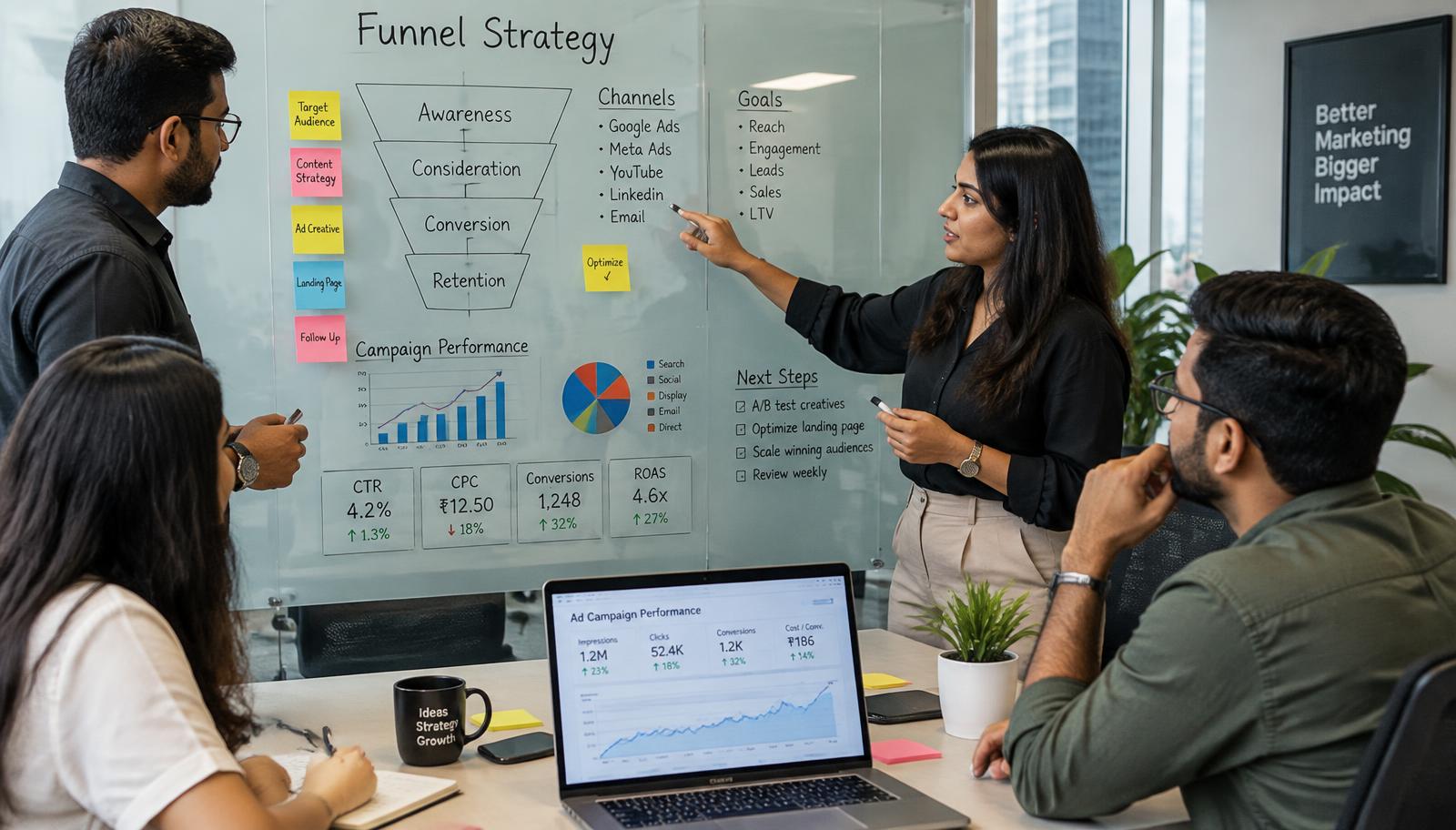
- 01What makes it a "performance" strategy
- 02Step 1: Set your target from unit economics
- 03Step 2: Define the audience and offer
- 04Step 3: Choose channels by intent
- 05Step 4: Map campaigns to the funnel
- 06Step 5: Set up tracking before spending
- 07Step 6: Build creatives and landing pages
- 08Step 7: Test, cut and scale
- 09The weekly review sheet
- 10Worked example 1: D2C skincare brand
- 11Worked example 2: coaching institute in Vijayawada
- 12Worked example 3: dental clinic in Pune
- 13Performance marketing tools
- 14Common strategy mistakes
- 15Learn to build strategies with live campaigns
We'll email you our Performance Marketing Setup Checklist instantly.
No spam. Unsubscribe anytime.
Most businesses in India don't fail at advertising because of bad ads. They fail because they start spending without a strategy: no target cost, no tracking, no testing plan. Money goes out, a few leads come in, and nobody knows whether it's working. This guide walks through building a performance marketing strategy step by step, with three worked Indian examples. If you're new to the field, read what is performance marketing first.
What makes it a "performance" strategy
A performance strategy has one rule: every campaign must be tied to a measurable result, and money moves towards what produces results at an acceptable cost. That makes it different from brand advertising, where the goal is awareness and results are harder to measure. The strategy answers five questions:
- What result do we want, and what can we pay for it?
- Who are we trying to reach, and with what offer?
- Which channels and campaigns will reach them?
- How will we measure results accurately?
- How will we test, cut and scale?
Step 1: Set your target from unit economics
Before choosing any platform, work out the most you can pay for a customer.
For e-commerce (ROAS): Break-even ROAS = 1 ÷ gross margin. If your margin after product, shipping and payment costs is 40%, break-even ROAS is 1 ÷ 0.40 = 2.5. You need ROAS above 2.5 to profit on the first order. Our ROAS formula guide explains this in depth.
For lead generation (CPA): Target CPA = (value of a customer × close rate). If a customer is worth ₹20,000 in profit and 1 in 10 leads becomes a customer, each lead is worth ₹2,000. To keep a healthy margin, you might target a CPA of ₹600–800.
Why this matters: without a target, you can't tell whether a ₹500 lead is excellent or terrible. With one, every decision becomes simple.
Step 2: Define the audience and offer
Write down in plain words:
- Who buys: age, city, income level, job, problem they have.
- What triggers them: the moment they start looking (a wedding, exams, a new baby, a health scare, a business slowdown).
- Your offer: what they get, the price and why it's better than alternatives.
- The first step: what you ask for in the ad (buy now, book a free consultation, download a guide, register for a webinar).
A weak offer can't be saved by clever targeting. "Book a free 15-minute skin consultation" converts far better than "Visit our clinic".
Step 3: Choose channels by intent
| Channel | Intent | Best for | Typical role |
|---|---|---|---|
| Google Search | High (they're searching) | Services, local businesses, B2B, courses | Capture existing demand |
| Performance Max / Shopping | High | E-commerce with a product feed | Sales at scale |
| Meta Ads (Facebook, Instagram) | Low to medium (they're scrolling) | D2C, visual products, lead gen, events | Create demand, remarketing |
| YouTube | Medium | Education, explainer products | Awareness plus conversion |
| LinkedIn Ads | Medium | B2B, high-value services | Reaching decision-makers |
| Marketplace ads (Amazon, Flipkart) | High | Sellers on marketplaces | Sales on the platform |
Start with one or two channels. Spreading ₹30,000 across five platforms gives each too little data to learn anything.
Step 4: Map campaigns to the funnel
- Top (prospecting): reach new people. Meta interest or broad audiences, YouTube, Display.
- Middle (consideration): people who engaged: video viewers, page visitors, Instagram engagers. Show proof, testimonials, comparisons.
- Bottom (conversion): high intent. Google Search on buying keywords, remarketing to site visitors and cart abandoners.
- Retention: existing customers. Email, WhatsApp and remarketing for repeat purchases.
A common starting split for a new business: 60–70% prospecting and search, 20–30% remarketing, 10% testing. Adjust as data comes in. Our sales funnel guide covers funnel design in detail.
Step 5: Set up tracking before spending
This step is where most strategies quietly fail. Set up:
- Google Analytics 4 on your site, with key events (form submits, purchases, calls).
- Google Ads conversion tracking, ideally imported from GA4 or via Google Tag Manager.
- Meta Pixel and Conversions API so Meta can see conversions despite browser restrictions.
- UTM tags on every ad link so you can see source and campaign in analytics.
- A lead quality check: mark which leads became customers, so you optimise for sales, not just form fills.
Read our conversion tracking guide for the setup steps.
Step 6: Build creatives and landing pages
Ad creatives: test different angles, not just different colours. For a coaching institute: angle A "Crack the exam in 6 months", angle B "Learn from a topper", angle C "Free demo class this Sunday". Make 3–5 variations per angle.
Landing pages: one page per offer, matching the ad's promise, with a clear headline, proof (reviews, results, logos), the offer, and a short form or WhatsApp button. Faster pages convert better, especially on mobile data.
AI tools such as ChatGPT help you draft headlines and ad copy variations quickly; you still need to check facts and tone.
Step 7: Test, cut and scale
- Launch small: a few ad sets or ad groups, each with enough budget to get meaningful data.
- Wait for data: don't judge an ad after 200 impressions. For lead campaigns, aim for roughly 20–50 conversions (or spend of 2–3× target CPA) before big decisions.
- Cut losers: pause ads or audiences far above target CPA.
- Scale winners gradually: raise budgets about 20% every few days, rather than doubling overnight, which can reset the platform's learning.
- Refresh creatives: when frequency rises and CTR drops, introduce new ads.
The weekly review sheet
| Campaign | Spend | Conversions | CPA | ROAS | Decision |
|---|---|---|---|---|---|
| Search – brand | ₹4,000 | 20 | ₹200 | – | Keep |
| Search – generic | ₹12,000 | 18 | ₹667 | – | Tighten keywords |
| Meta – prospecting | ₹10,000 | 25 | ₹400 | – | Scale 20% |
| Meta – remarketing | ₹3,000 | 12 | ₹250 | – | Keep |
One decision per row every week keeps the strategy moving. (Figures are illustrative.)
Worked example 1: D2C skincare brand
- Numbers: average order ₹900, gross margin 50%, so break-even ROAS is 2.0. Target ROAS 2.5+.
- Channels: Meta Ads for prospecting with short video creatives; Google Shopping/Performance Max for people searching product terms; Meta remarketing for cart abandoners.
- Tracking: Shopify with Meta Pixel + Conversions API, GA4 purchases, Google Ads conversions.
- Testing: three angles (ingredient story, before/after-style routine video, customer review), each with 3 creatives.
- Scaling: increase the best ad set 20% every 3–4 days while ROAS stays above 2.5; bundle offers to raise order value.
Worked example 2: coaching institute in Vijayawada
- Numbers: course fee ₹30,000; about 1 in 12 leads enrols. A lead is worth about ₹2,500 in revenue; target CPA ₹500–700.
- Channels: Google Search for "coaching near me" and course-specific keywords; Meta lead forms for parents and students in a 25 km radius.
- Offer: free demo class, not "enquire now".
- Tracking: form and call conversions, leads tagged in a sheet by status (called, demo attended, enrolled).
- Optimisation: judge campaigns by cost per demo attended and cost per enrolment, not just cost per lead.
Worked example 3: dental clinic in Pune
- Numbers: a treatment patient is worth ₹8,000+; target cost per booked appointment ₹600.
- Channels: Google Search only at first, targeting "dentist near me", "root canal cost" and similar, within 5–8 km.
- Setup: call extensions, location, a landing page with reviews and a WhatsApp booking button.
- Budget: start around ₹15,000/month, expand keywords once cost per booking is proven.
Performance marketing tools
| Job | Tools |
|---|---|
| Ads | Google Ads, Meta Ads Manager, LinkedIn Campaign Manager |
| Tracking | Google Analytics 4, Google Tag Manager, Meta Events Manager |
| Research | Google Keyword Planner, Meta Ads Library, Semrush |
| Creatives | Canva, CapCut, ChatGPT and other AI tools |
| Landing pages | Website builders, WordPress, AI site builders such as Lovable |
| Reporting | Google Sheets, Looker Studio |
See our guide to using the Meta Ads Library for competitor research, and best AI tools for digital marketing.
Common strategy mistakes
- Spending before tracking works.
- Judging results on clicks and CTR instead of CPA and ROAS.
- Too many campaigns with too little budget each.
- Changing everything every day, so platforms never learn.
- Sending all traffic to the home page instead of a focused landing page.
- Optimising for cheap leads that never become customers.
Learn to build strategies with live campaigns
Our Performance Marketing Course is a live 6-week programme where you plan and run real Google Ads and Meta Ads campaigns with tracking, budgets and weekly optimisation. The AI Digital Marketing Course is an 8-week programme adding SEO, AI tools and automation, with placement support; see the fees page. Start with the free masterclass on Friday, 2 October 2026, 8:00–9:00 PM IST, and when you're ready, look at open roles on our jobs page.
Glossary
- Target CPA
- The most you can afford to pay for one conversion and still make money.
- Break-even ROAS
- The ROAS at which ad spend equals gross profit. Below it, ads lose money; above it, they make money. Calculated as 1 ÷ gross margin.
- Funnel
- The stages a customer moves through: awareness, consideration, conversion and retention.
- Prospecting
- Campaigns aimed at people who don't know you yet.
- Remarketing
- Showing ads to people who already visited your site or engaged with you.
- Creative fatigue
- When the same audience has seen an ad too often and results decline.
Sources & Further Reading
Frequently Asked Questions
What is a performance marketing strategy?+
It's a plan for paid advertising where every campaign is tied to a measurable goal such as leads, sales or installs, with a target cost per result, the channels to use, the tracking setup and the rules for testing and scaling.
What are the main performance marketing channels?+
In India the main channels are Google Ads (Search, Performance Max, YouTube, Display), Meta Ads (Facebook and Instagram), affiliate marketing and, for some businesses, LinkedIn Ads, marketplace ads on Amazon or Flipkart, and newer placements such as ChatGPT Ads.
How do I set a performance marketing budget?+
Work backwards from your target CPA. If you want 100 leads a month at ₹300 each, you need about ₹30,000, plus 20–30% for testing. Start smaller while you learn your real costs, then increase.
What metrics matter most?+
The business metrics: cost per acquisition (CPA), return on ad spend (ROAS) and conversion rate. CTR and CPC are useful diagnostics but not goals in themselves.
How long before a strategy shows results?+
Search campaigns can produce leads within days. Meta campaigns usually need one to two weeks for the platform to learn. Plan on 4–8 weeks of testing before judging the strategy as a whole.
Google Ads or Meta Ads: which first?+
If people already search for what you sell, start with Google Search. If your product is new, visual or impulse-driven, start with Meta. Many businesses end up using both.
What tools do I need?+
At minimum: Google Ads, Meta Ads Manager, Google Analytics 4, Google Tag Manager, a spreadsheet for weekly reports and a landing page builder. AI tools such as ChatGPT help with ad copy and research.
Can a small business use performance marketing?+
Yes. It's often the best fit because you can start with a small budget and only continue what pays back. A local clinic can start with ₹10,000–15,000 a month on Google Search for high-intent keywords.
Join our live training program and become a performance marketing professional.