What is a Sales Funnel? Stages, Examples & How to Build (2026)
A sales funnel is the step-by-step path a stranger takes to become a paying customer. Learn the 5 sales funnel stages, real examples for ecommerce, courses and B2B, and how to build your first funnel in 2026.
We'll email you our Performance Marketing Setup Checklist instantly.
No spam. Unsubscribe anytime.
You've probably heard marketers say "you need a funnel" about a hundred times. Here's what they actually mean — and how to build one that works, using the same framework we teach on our 6-week live performance marketing course.
What is a sales funnel?
A sales funnel is the step-by-step journey a potential customer takes from first hearing about your business to buying from you.
It's called a funnel because of the shape of the numbers: 10,000 people might see your ad, 500 click it, 100 give you their email, and 10 buy. Wide at the top, narrow at the bottom.
The concept matters because it changes the question you ask. Instead of "why isn't my marketing working?", you ask "which stage of my funnel is leaking?" — and that's a question you can actually answer with data.
Sales funnel vs marketing funnel vs sales pipeline
These three terms get used interchangeably, and honestly, the differences are subtle:
- Marketing funnel — usually emphasises the top: awareness, reach, engagement. Owned by marketing.
- Sales funnel — emphasises the journey all the way to the purchase. In digital businesses, it covers both marketing and sales stages.
- Sales pipeline — the seller's view: a list of active deals and which step each one is at. Used by sales teams in CRMs like HubSpot or Zoho.
For most small businesses, course creators and D2C brands in India, one funnel covers everything — so don't get hung up on terminology.
Sales funnel stages explained
The classic model has five stages. Some frameworks use three (TOFU, MOFU, BOFU) — it's the same idea, just grouped differently.
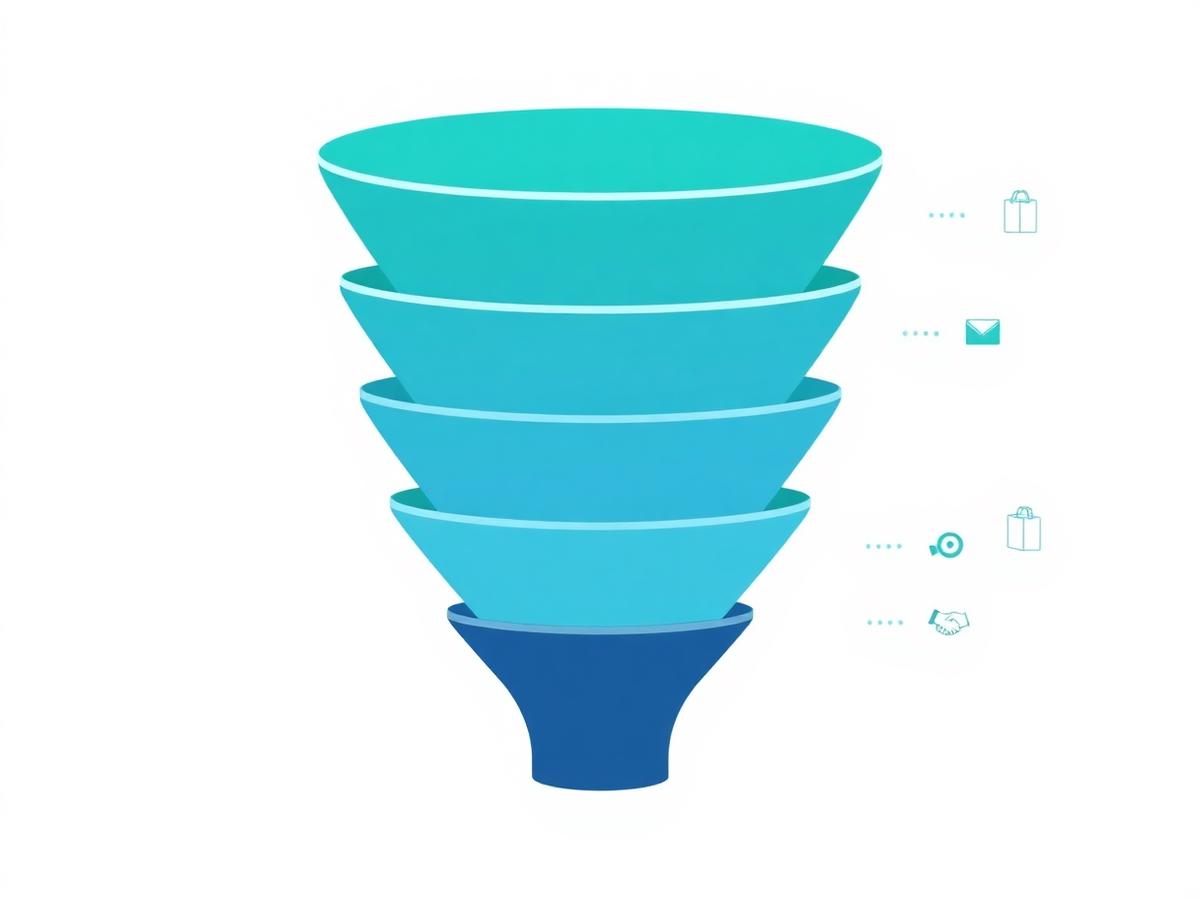
Stage 1: Awareness (TOFU)
The stranger discovers you exist. They have a problem; you might have an answer. They owe you nothing and trust you less.
- Channels: Meta and YouTube ads, SEO blog content, Instagram Reels, Google Display.
- Content: educational posts, short videos, ads that name the problem — not the product.
- Metrics: reach, impressions, video views, CTR. Not sales.
Stage 2: Interest
They've engaged — read a blog post, watched a video, followed your page. Now they're deciding whether you're worth more of their time.
- Channels: blog content, YouTube, email newsletter signups, remarketing ads.
- Content: in-depth guides, comparison posts, lead magnets (checklists, templates, free webinars).
- Metrics: time on page, lead magnet opt-ins, email subscribers, CPL.
Stage 3: Consideration (MOFU)
They know they need a solution and they're comparing options — you vs competitors vs doing nothing. "Doing nothing" is usually your biggest rival.
- Channels: email sequences, WhatsApp follow-ups, case studies, remarketing.
- Content: case studies, testimonials, demo videos, webinars, FAQ pages.
- Metrics: email open/click rates, returning visitors, cost per qualified lead.
Stage 4: Decision
They're ready to buy something. The question is whether it's you. Price, trust and risk dominate their thinking.
- Channels: retargeting ads with offers, sales calls, WhatsApp conversations.
- Content: offer pages, pricing clarity, guarantees, urgency (batch start dates, limited seats), objection-handling FAQs.
- Metrics: add-to-carts, checkout initiations, booked calls, cost per acquisition (CPA).
Stage 5: Action (BOFU)
Money changes hands. But the funnel isn't done — smart marketers add a sixth stage:
- Retention & Advocacy: onboarding, support, upsells, referral programmes. A repeat customer costs a fraction of a new one, which is why LTV — not first-purchase ROAS — decides whether your funnel is truly profitable. (More on that math in our ROAS formula guide.)
The single most common funnel mistake in India is running only Stage 1 and Stage 5 — cold ads straight to a "buy now" page — with nothing in between. If your CPL looks fine but sales are dead, your missing middle is the reason.
Sales funnel examples
Theory is cheap. Here's how the funnel looks in three real business models:
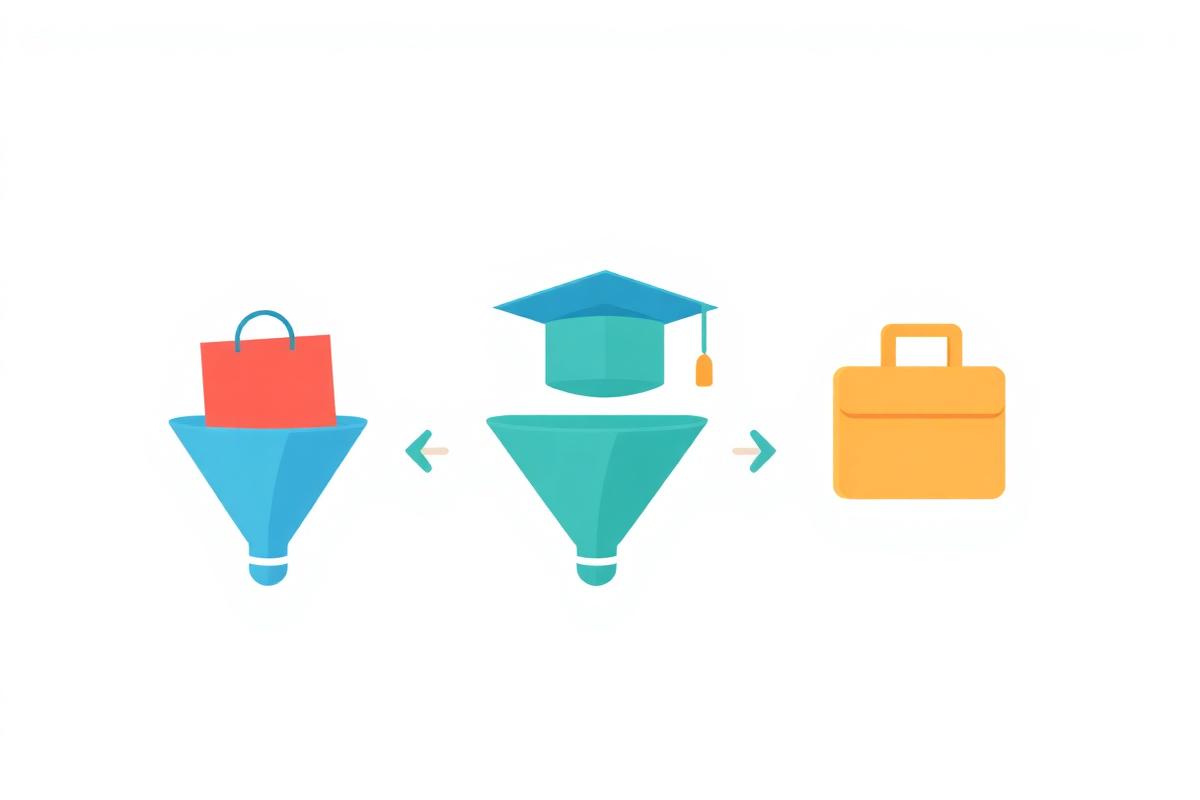
Example 1: D2C ecommerce (skincare brand)
| Stage | What happens |
|---|---|
| Awareness | Instagram Reels + Meta ads: "Why your moisturiser stops working after 30" |
| Interest | Blog/quiz: "Find your skin type in 60 seconds" → email capture |
| Consideration | 4-email sequence: ingredients, before/after photos, reviews |
| Decision | Retargeting ad: first-order discount + free shipping |
| Action | Purchase; post-purchase WhatsApp flow for the second order |
Example 2: Online course / coaching
| Stage | What happens |
|---|---|
| Awareness | YouTube videos and Meta ads on the career outcome ("performance marketing salary in India") |
| Interest | Free live masterclass registration |
| Consideration | Masterclass itself + student success stories + curriculum breakdown |
| Decision | Batch start date, limited seats, fee and payment options |
| Action | Enrollment; alumni community for referrals |
This is the exact funnel we run at PMAcademy — and the one students learn to build in the course curriculum.
Example 3: B2B lead generation (agency / SaaS)
| Stage | What happens |
|---|---|
| Awareness | LinkedIn content + Google Search ads on problem keywords |
| Interest | Downloadable audit template or industry report |
| Consideration | Case-study emails + webinar invite |
| Decision | Discovery call, proposal, pilot offer |
| Action | Contract signed; onboarding and quarterly reviews drive retention |
Notice the pattern: every funnel trades value for commitment, in small steps. Nobody jumps from stranger to customer in one leap.
How to create a sales funnel step by step
Here's the build order we recommend for a first funnel. Resist the urge to add complexity — a simple funnel with clean data beats a fancy one you can't measure.
Step 1: Define one audience and one offer
"Small business owners who want leads" is too broad. "Salon owners in Hyderabad who want more weekend bookings" is a funnel. The narrower the audience, the sharper every other step becomes.
Step 2: Pick one traffic source
Choose the one matching your audience's intent:
- Google Search ads — people already searching for the solution (high intent, higher CPC).
- Meta ads — people who don't know you yet (interruption-based, cheaper reach).
- SEO content — slow to build, but compounds and costs nothing per click. (Here's how SEO and paid ads work together.)
Master one before adding a second.
Step 3: Build one focused landing page
One page, one promise, one call to action. Remove the navigation menu — every exit link is a leak. The page should answer three questions in five seconds: What is it? Who is it for? What do I do next?
Step 4: Add a lead magnet
Only 1–3% of cold visitors buy immediately. A checklist, template, free session or audit converts another 20–40% into leads you can follow up with. This single step is what separates businesses with a funnel from businesses with an ad.
Step 5: Set up the follow-up sequence
Write 5 emails or WhatsApp messages over 7–14 days:
- Deliver the lead magnet + set expectations
- Teach something genuinely useful
- Tell a customer story / case study
- Handle the top objection
- Make the offer with a clear deadline
Step 6: Install tracking before spending a rupee
Set up GA4 events, Google Tag Manager, and Meta's Conversions API so every stage change is recorded. Without this, you're optimising blind — the algorithm included.
Step 7: Find the biggest leak, fix only that
Every week, look at the conversion rate between each pair of stages. The worst one gets your attention; the rest wait. Funnels improve one stage at a time.
If you'd rather have this built for you than build it yourself, a performance marketing agency typically charges ₹25,000–₹75,000 for funnel setup — our guide explains how to evaluate one.
Sales funnel templates you can copy
Three starter templates, from simplest to fullest:
Template A — The Minimum Viable Funnel (for testing an idea) Ad → Landing page with lead magnet → 5-email sequence → Offer page
Template B — The Webinar Funnel (for courses and high-ticket services) Ad → Webinar registration → Reminder sequence → Live webinar → Offer with deadline → Replay + last-call emails
Template C — The Ecommerce Funnel Ad → Product page → Cart abandonment remarketing → Discount email sequence → Purchase → Post-purchase upsell flow
Want these as ready-made spreadsheets? Our full-funnel strategy template, budget split calculator and CPL tracking sheet in the shop are built for exactly this workflow.
Measuring your funnel
Each stage has one primary metric. Mixing them up is how funnels get misdiagnosed:
| Stage | Primary metric | Healthy sign |
|---|---|---|
| Awareness | CTR / video view rate | People stop scrolling |
| Interest | Opt-in rate / CPL | Visitors trade contact info for value |
| Consideration | Email engagement / return visits | Leads keep paying attention |
| Decision | Checkout start rate / CPA | Offers get seriously evaluated |
| Action | Purchase CVR / ROAS | The math works |
Two derived numbers tell you if the whole system is viable:
- Blended CPA — total marketing spend ÷ total customers. Must sit comfortably below your customer LTV.
- Stage conversion rates — if leads→customers is strong but clicks→leads is weak, your landing page is the problem, not your ads. The metrics tell you where to work.
Common sales funnel mistakes
- No tracking. You can't fix a leak you can't see. Set up GA4 and pixel/CAPI events first.
- Skipping the middle. Cold ad → "buy now" page works for almost no one. The follow-up sequence is where most revenue hides.
- Wrong metric per stage. Judging awareness ads on sales kills campaigns that were actually working.
- Too many offers. One funnel, one audience, one offer. Confusion doesn't convert.
- Giving up at the ad. When an ad "fails," the ad is often fine — the landing page or the offer behind it is the real problem.
Sales funnel tools
You need far fewer tools than the industry wants you to believe:
- Landing pages: your own website, or builders like Unbounce/Instapage — our SaaS landing page guide breaks down the block-by-block structure that converts
- Analytics: GA4 + Google Tag Manager — free
- Ad tracking: Meta Pixel + Conversions API, Google Ads conversion tracking
- Follow-up: any email platform's free tier, or WhatsApp Business for India-first audiences
- Ads: Google Ads and/or Meta Ads Manager — one is enough to start
The tool stack matters far less than the tracking discipline. A ₹0 tool stack with clean data beats a ₹20,000/month stack with broken events every single time.
The bottom line
A sales funnel isn't a piece of software or a growth hack — it's just an honest map of how strangers become customers, with a metric at every step. Build the simple version, measure every stage, and fix one leak at a time.
If you want to learn to build and optimise funnels hands-on — with live campaigns, real budgets and mentorship — that's exactly what we do in our 6-week AI-powered performance marketing course, starting with a free masterclass.
Glossary
- Sales Funnel
- The step-by-step path a prospect takes from first discovering a business to becoming a paying customer, typically divided into Awareness, Interest, Consideration, Decision and Action stages.
- TOFU / MOFU / BOFU
- Top, Middle and Bottom of Funnel — shorthand for the awareness, consideration and purchase stages of the customer journey.
- Lead Magnet
- A free resource (checklist, template, webinar, trial) exchanged for contact details, used to move visitors from the awareness stage into your follow-up system.
- CPL (Cost Per Lead)
- Total marketing spend divided by the number of leads generated. The key efficiency metric for middle-of-funnel campaigns.
- CPA (Cost Per Acquisition)
- Total spend divided by the number of paying customers acquired. The bottom-line metric every funnel is judged on.
- CVR (Conversion Rate)
- The percentage of people at one stage who move to the next — e.g. landing page visitors who become leads, or leads who become customers.
- Remarketing
- Showing ads to people who already interacted with your business (visited the site, abandoned a cart, watched a video), used heavily in the middle and bottom of the funnel.
- Attribution
- The method of deciding which touchpoints in the funnel get credit for a sale — first-click, last-click, or data-driven models.
Sources & Further Reading
Frequently Asked Questions
What is a sales funnel in simple words?+
A sales funnel is the journey a customer takes from first discovering you to buying from you. It's shaped like a funnel because lots of people enter at the top (they see an ad or a post) and only a small percentage come out at the bottom as paying customers.
What are the 5 stages of a sales funnel?+
The five classic stages are Awareness (they discover you), Interest (they engage with your content), Consideration (they compare you against alternatives), Decision (they evaluate the offer and price) and Action (they buy). Many modern funnels add a sixth stage, Retention, because repeat customers are the cheapest revenue you'll ever earn.
What is the difference between a sales funnel and a marketing funnel?+
In practice the terms overlap heavily. The marketing funnel usually describes the top stages (awareness and interest, run by marketing), while the sales funnel emphasises the bottom stages (decision and purchase, often owned by a sales team). In most small businesses and digital campaigns, one funnel covers both.
What is the difference between a sales funnel and a sales pipeline?+
A funnel describes the customer's journey and is measured in conversion rates between stages. A pipeline describes the seller's process — the deals a sales team is working on and which step each deal is at. Funnels are a marketing concept; pipelines are a sales-management concept.
Do I need a sales funnel for a small business?+
Yes — but it doesn't need to be complicated. A single ad leading to a single landing page with a WhatsApp follow-up is a sales funnel. The framework just makes you deliberate about what happens at each step instead of hoping visitors figure it out themselves.
How much does it cost to build a sales funnel in India?+
A basic funnel costs almost nothing in tools: a landing page, GA4 (free), an email platform's free tier and your ad budget. Realistically, plan ₹10,000–₹30,000/month of ad spend to gather enough data to optimise. Done-for-you agency builds typically start around ₹25,000–₹75,000 as a one-time setup.
What is a good conversion rate for a sales funnel?+
It depends on the stage and industry, but rough benchmarks: 20–40% of landing page visitors opting in for a strong lead magnet, 1–3% of cold traffic buying directly, and 5–15% of nurtured email leads eventually purchasing. What matters more than benchmarks is improving your own stage-by-stage rates month over month.
Which tools do I need to build a sales funnel?+
At minimum: a landing page builder, an email or WhatsApp follow-up tool, GA4 for analytics, and one ad platform (Google or Meta). Everything else — funnel builders, heatmaps, CRMs — is an optimisation you add once the basic funnel is profitable.
Why is my sales funnel not converting?+
The three most common causes: you're measuring the wrong metric per stage (judging awareness ads on sales), the middle of the funnel is missing (no follow-up for people not ready to buy today), or tracking is broken so you can't see where people actually drop off. Fix tracking first — you can't repair a leak you can't see.
Join our live training program and become a performance marketing professional.
Instant-download resources from the PMAcademy shop that pair with this guide.
- TemplatesFull-Funnel Strategy Template (Instant Download)Plan awareness to retention on one page₹299
- Trackers & SheetsAd Budget Split Calculator (Instant Download)Decide where every rupee should go₹149
- Trackers & SheetsCPL & ROAS Tracking Sheet (Instant Download)See which campaign is actually making you money₹199