Features of E-Commerce: 12 Key Features Explained + How AI Is Changing Online Shopping (2026)
The 12 key features of e-commerce explained from basics to advanced — types of e-commerce, must-have website features, how AI is transforming online shopping, and the future scope of e-commerce in India with AI.
- 01What is e-commerce? (the basics)
- 02Types of e-commerce
- 03The 12 key features of e-commerce
- 04Must-have features for an e-commerce website (store-owner level)
- 05E-commerce in India: where the market stands
- 06How AI is changing e-commerce (advanced level)
- 07The future scope of e-commerce with AI
- 08E-commerce store audit checklist
- 09Frequently asked questions
We'll email you our Performance Marketing Setup Checklist instantly.
No spam. Unsubscribe anytime.
E-commerce is one of those topics that looks simple from the outside — "selling things online" — but the difference between a store that grows and one that dies comes down to understanding its features properly and using them deliberately.
This guide goes from absolute basics (what e-commerce is, its types, its 12 defining features) to advanced (how AI is reshaping every one of those features and where the scope of e-commerce in India is heading). Whether you are a student preparing for exams, a founder building a store, or a marketer running ads for one, this is written for you.
What is e-commerce? (the basics)
E-commerce (electronic commerce) is the buying and selling of products or services over the internet, with payment and delivery coordinated online. That's the textbook e-commerce definition. In practice, it covers everything from ordering a phone on Flipkart, to a saree weaver selling on Meesho, to a Hyderabad bakery taking birthday cake orders through its own website.
A few real e-commerce examples you already use:
- Marketplaces: Amazon, Flipkart, Myntra — many sellers, one platform
- Grocery / quick commerce: Blinkit, Zepto, Swiggy Instamart
- D2C brand stores: boAt, Mamaearth, Licious — the brand's own website
- Service e-commerce: course platforms, salon booking apps, Ola/Uber rides
E-commerce vs e-business: e-commerce is only the transaction layer. E-business is the wider umbrella — it includes online customer support, supplier systems and internal digital operations. Every e-commerce store is an e-business; not every e-business sells online.
Types of e-commerce
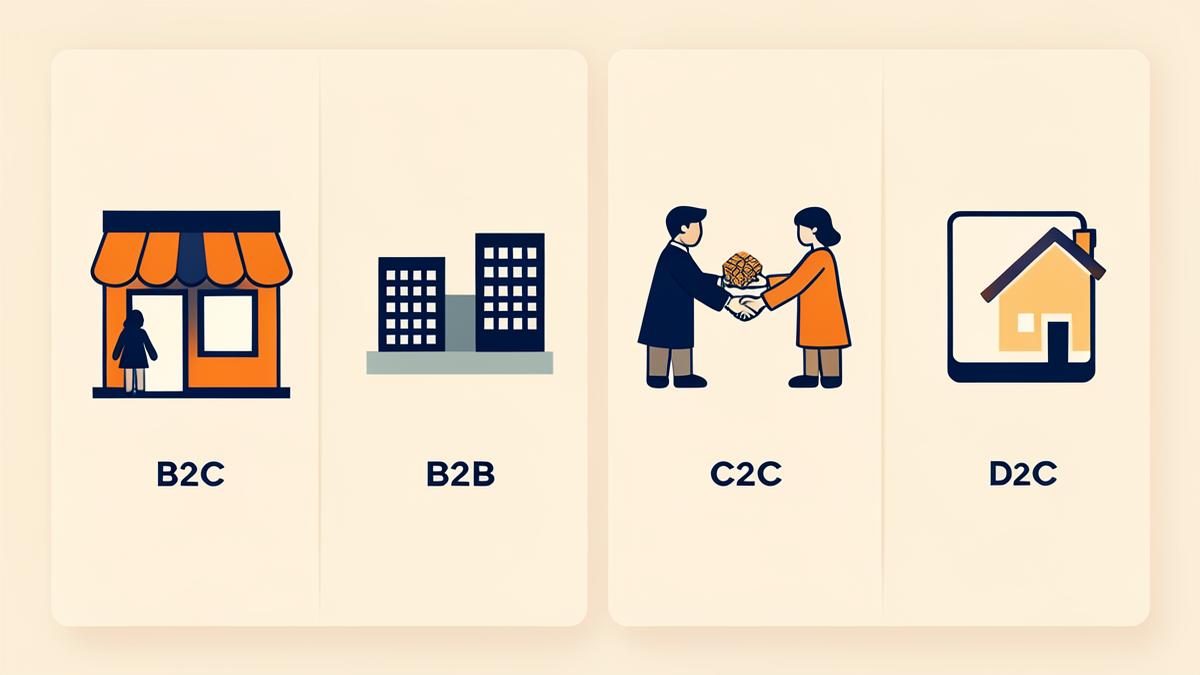
| Type | Who sells to whom | Indian examples | Typical order size |
|---|---|---|---|
| B2C (Business to Consumer) | Company → individual | Flipkart, Nykaa, Amazon | ₹300 – ₹5,000 |
| B2B (Business to Business) | Company → company | IndiaMART, Udaan | ₹50,000+ |
| C2C (Consumer to Consumer) | Individual → individual | OLX, Facebook Marketplace | ₹500 – ₹50,000 |
| D2C (Direct to Consumer) | Brand → individual, on own site | boAt, Mamaearth, Wakefit | ₹500 – ₹15,000 |
| Quick commerce | Local dark store → individual, in minutes | Blinkit, Zepto, Instamart | ₹150 – ₹800 |
The fastest-growing models in India right now are D2C (brands want to own their customer data instead of renting it from marketplaces) and quick commerce (which has trained customers to expect everything fast).
The 12 key features of e-commerce
These are the defining characteristics — the answer to "what are the features of e-commerce?" whether the question comes from an exam paper or a store audit.
1. 24/7 availability
A physical shop closes; an online store sells while you sleep. A large share of Indian e-commerce orders are placed after 8 PM — hours when no offline retail could serve them.
2. Global and national reach
A seller in Tirupur can sell to a customer in Srinagar or Singapore without opening a single branch. Geography stops being the limit on who can buy from you.
3. Lower operating cost
No showroom rent, fewer staff, no display inventory. This is why D2C brands can launch with a few lakh rupees instead of crores — the storefront is a website, not a building.
4. Search and filters
Instead of walking aisles, customers search "red running shoes under 2000" and filter by size, price and rating. Good search is one of the highest-converting features on any store.
5. Secure online payments
UPI, cards, net banking, wallets, EMI and Cash on Delivery — processed through PCI-compliant payment gateways like Razorpay or Cashfree. India's UPI rails are a genuine e-commerce advantage: instant, free and trusted.
6. Customer reviews and ratings
Online buyers can't touch the product, so they trust other buyers instead. Reviews are the digital replacement for the shopkeeper's word — stores with 100+ reviews convert dramatically better than stores with none.
7. Personalisation and recommendations
"Customers who bought this also bought…" — the store rearranges itself for every visitor based on browsing and purchase history. No physical store can do this at all.
8. Order tracking and transparency
From "order placed" to "out for delivery", customers see exactly where their purchase is. This visibility is itself a feature — it removes the anxiety of paying a stranger on the internet.
9. Easy returns and refunds
7–30 day return windows and doorstep pickup de-risk the purchase. Liberal returns feel costly but they raise conversion enough to pay for themselves — this is why every major marketplace leads with them.
10. Mobile commerce
The majority of Indian e-commerce happens on phones, not desktops. App-first and mobile-first design isn't a nice-to-have feature; in India it is the store.
11. Digital marketing integration
Every product page can be an ad landing page. Stores plug directly into Google Shopping, Meta catalogues, WhatsApp broadcasts and email — with tracking that tells you exactly which rupee of ad spend produced which order. (This is the feature performance marketers live inside — see what is performance marketing.)
12. Data and analytics on everything
Every click, scroll, cart and purchase is measurable. Offline retail guesses; e-commerce knows. Metrics like conversion rate, AOV, cart abandonment and ROAS turn selling into an optimisable system.
Exam note: If a question asks "which is not a feature of e-commerce?", look for options that require physical presence — "fixed business hours", "limited local reach", "physical storefront required" or "cash-only payment". Those describe traditional retail, not e-commerce.
Must-have features for an e-commerce website (store-owner level)
Knowing the features of e-commerce as a concept is one thing. If you're building or marketing a store, here is what the feature list looks like in practice, ordered by revenue impact:
- Speed on mobile — every extra second of load time measurably cuts conversion. Compress images, lazy-load, and test on real 4G, not office Wi-Fi.
- Product pages that answer every doubt — multiple photos, video, size charts, delivery date, return policy, reviews. The page must replace the shopkeeper.
- Frictionless checkout — guest checkout, UPI, COD, minimal form fields. Every extra step loses a slice of buyers.
- Trust signals — real reviews (including imperfect ones), clear return policy, reachable support, secure payment badges.
- Recovery systems — abandoned-cart reminders on WhatsApp and email recover 5–15% of otherwise-lost carts.
- Tracking — GA4, Meta Pixel, Conversions API. Without it you cannot run profitable ads, full stop. Our conversion tracking guide walks through the full setup.
Want these features on your own store? Our step-by-step guide to building an e-commerce website using AI without coding covers every one of them, from cart to Razorpay payments.
The checklist at the end of this article turns this into a saveable audit you can run on any store.
E-commerce in India: where the market stands
India is one of the fastest-growing e-commerce markets in the world. Industry reports (IBEF, Statista) consistently project double-digit annual growth through 2030, and three structural forces keep pushing it:
- UPI made digital payment instant and free — billions of transactions a month, trusted from metros to villages.
- Tier-2 and tier-3 cities now drive the majority of new online shoppers, thanks to cheap data and vernacular interfaces.
- Quick commerce and ONDC are expanding what "buying online" even means — 10-minute groceries on one end, and an open network that lets small sellers list across platforms on the other.
The short version: the market is nowhere near saturation. The shoppers arriving in the next five years will outnumber the ones who arrived in the last five.
How AI is changing e-commerce (advanced level)
Every one of the 12 features above is being upgraded by AI. This is not a 2030 prediction — all of these are live in Indian e-commerce today:
| AI application | What it does | Who uses it |
|---|---|---|
| Recommendation engines | Personalise homepages, "also bought" carousels, emails | Amazon, Flipkart, Myntra |
| AI chatbots | Answer order-status, return and product questions 24/7 | Most large stores; Shopify apps for small ones |
| Dynamic pricing | Adjust prices to demand, stock and competition | Airlines, marketplaces, hotel platforms |
| Visual search | Upload a photo → find matching products | Google Lens, Myntra, Pinterest |
| Demand forecasting | Predict what stock will sell, where, when | Quick commerce and grocery especially |
| Fraud detection | Flag fake orders, payment fraud, fake reviews | Payment gateways, marketplaces |
| AI content & creative | Product descriptions, catalogue photos, ad images and video | D2C brands of every size |
The last row matters most for small sellers. Catalogue photography, ad creatives and product copy used to require agencies. Now a two-person brand can generate them in an afternoon — our guides on ChatGPT photo editing prompts and Gemini couple photo prompts show how far the tools have come, and ChatGPT ads covers what advertising inside AI assistants will look like.
The future scope of e-commerce with AI
Put the growth curves together — more Indian shoppers, UPI, quick commerce, and collapsing content costs — and the scope of e-commerce over the next 5 years comes down to five shifts:
- Agentic shopping. Customers will increasingly tell an AI assistant "find me running shoes under ₹3,000, size 9, delivered by Friday" — and the AI will search, compare and buy. Stores will need to be machine-readable, not just pretty.
- Hyper-personalisation. Homepages, emails and even prices tuned per individual, in real time. The "average customer" stops existing.
- AI-generated catalogues. Product photos, videos and descriptions generated per audience segment — one product, fifty tailored presentations.
- Voice and vernacular commerce. The next 200 million shoppers will shop in Telugu, Hindi and Tamil, often by voice. Stores that stay English-only will miss them.
- Small brands competing with giants. When AI handles creative, support and media buying, brand and product quality — not team size — become the constraint. This is the largest opportunity for Indian D2C founders and the marketers who serve them.
Career note: every one of these shifts needs people who understand both e-commerce and performance marketing — ads, tracking, funnels and analytics. That combination is exactly what hiring managers ask about in performance marketing interviews, and it's why e-commerce marketing remains one of the strongest career paths in digital marketing in India.
No signup, instant score. Answer all 5 and check where you stand.
E-commerce store audit checklist
Save this and run it against any store — yours or a client's. Each item maps to a feature covered above.
Ticks are saved in this browser — come back and pick up where you left off.
Frequently asked questions
Everything from "what are the main features of e-commerce?" to exam-style MCQs is answered in the FAQ section below — including the classic "which is not a feature of e-commerce" question that trips people up in tests.
Want to build your own store? Our AI E-Commerce Website Course takes you from a blank page to a live store with Razorpay payments in 60 minutes — no coding. Learning e-commerce marketing hands-on instead? Our AI-Powered Performance Marketing course trains you on real store campaigns — Google Shopping, Meta catalogues, tracking and AI tools — on live budgets. See the curriculum or sign up for the free masterclass.
Glossary
- E-Commerce
- Buying and selling goods or services over the internet, including payments, delivery and customer support handled online.
- B2C (Business to Consumer)
- A business selling directly to individual customers — for example Flipkart or Nykaa selling to you.
- B2B (Business to Business)
- A business selling to other businesses — for example IndiaMART or Udaan connecting manufacturers with retailers.
- C2C (Consumer to Consumer)
- Individuals selling to other individuals through a platform — for example OLX or Facebook Marketplace.
- D2C (Direct to Consumer)
- A brand selling through its own website instead of marketplaces — for example boAt or Mamaearth selling on their own stores.
- Quick Commerce
- Ultra-fast delivery (usually 10–30 minutes) of groceries and essentials from nearby dark stores — Blinkit, Zepto and Instamart.
- Conversion Rate
- The percentage of visitors who buy. If 100 people visit and 2 order, the conversion rate is 2%.
- AOV (Average Order Value)
- Total revenue divided by number of orders — how much a typical customer spends per order.
- Payment Gateway
- The service that processes online payments (cards, UPI, wallets, net banking) — Razorpay, Cashfree and PayU are common in India.
- SKU (Stock Keeping Unit)
- A unique code for each product variant a store sells, used to track inventory.
- Dark Store
- A small local warehouse that only fulfils online orders — the backbone of quick commerce.
- Cart Abandonment
- When a shopper adds items to the cart but leaves without paying. Most stores lose 60–80% of carts this way.
Sources & Further Reading
Frequently Asked Questions
What are the features of e-commerce?+
The main features of e-commerce are: 24/7 availability, global reach without physical stores, lower operating cost, product search and filters, secure online payments (UPI, cards, COD), customer reviews and ratings, personalised recommendations, order and delivery tracking, easy returns and refunds, mobile shopping apps, integration with digital marketing channels, and data analytics for every visitor action.
Which is not a feature of e-commerce?+
Anything that requires physical, in-person presence is not a feature of e-commerce — for example face-to-face negotiation at a shop, touching and trying a product before buying, or cash-only payment at a counter. In MCQ exams, options like 'physical storefront required', 'limited geographical reach' or 'fixed shopping hours' are the correct 'NOT a feature' answers, because e-commerce is defined by the opposite: online, global and 24/7.
What is e-commerce in simple words?+
E-commerce means buying or selling anything over the internet. When you order shoes on Amazon, groceries on Blinkit or a course online, that is e-commerce. The seller lists products on a website or app, you pay digitally (or choose cash on delivery), and the product is delivered to you.
What are the main types of e-commerce?+
The five main types are B2C (business to consumer, like Flipkart), B2B (business to business, like IndiaMART), C2C (consumer to consumer, like OLX), D2C (direct to consumer, like boAt selling on its own website) and quick commerce (10–30 minute delivery, like Blinkit and Zepto).
How is AI used in e-commerce?+
AI is used in e-commerce for product recommendations ('customers also bought'), chatbots that answer customer questions 24/7, dynamic pricing that adjusts to demand, visual search (upload a photo, find the product), demand forecasting for inventory, fraud detection in payments, and generating product descriptions, images and ad creatives at scale.
What is the future scope of e-commerce in India?+
The scope is large and still growing: India's e-commerce market is projected to keep growing at double-digit rates through 2030, driven by tier-2 and tier-3 city shoppers, UPI payments, cheap data, quick commerce and ONDC. AI will accelerate this — small sellers can now create catalogues, ads and customer support with AI tools that earlier needed full teams.
What are the advantages of e-commerce over traditional retail?+
Lower setup and running cost (no shop rent), 24/7 selling, access to customers across India and abroad, easy scaling, measurable marketing (you know exactly which ad caused which sale) and personalisation. The trade-offs are delivery time, returns logistics and the inability for customers to touch the product.
What features should a good e-commerce website have?+
Fast mobile-first pages, clear product photos and videos, honest pricing with no surprise charges, guest checkout, UPI and COD payment options, visible delivery date and return policy, real customer reviews, search with filters, WhatsApp or chat support, and order tracking. The store-owner checklist in this article covers all of these.
Is e-commerce a good career in India?+
Yes. E-commerce companies and D2C brands hire for performance marketing, catalog management, marketplace operations, SEO, retention marketing and analytics. Roles like performance marketer for e-commerce brands are among the most in-demand digital marketing jobs in India right now.
What is the difference between e-commerce and e-business?+
E-commerce is only the buying and selling part — the online transactions. E-business is wider: it includes e-commerce plus online customer service, supplier management, internal systems and digital operations. Every e-commerce business is an e-business, but not every e-business sells online.
Join our live training program and become a performance marketing professional.
Instant-download resources from the PMAcademy shop that pair with this guide.
- AI Prompts10,000+ AI Prompts Library for Marketers (Instant Download)Ready-to-use prompts for ads, content, SEO and research₹499
- AI Prompts100 AI Website Building Prompts (Instant Download)Build landing pages and sites without writing code₹249
- ChecklistsWebsite Launch Checklist (Instant Download)Ship a site that loads fast, ranks and converts₹99